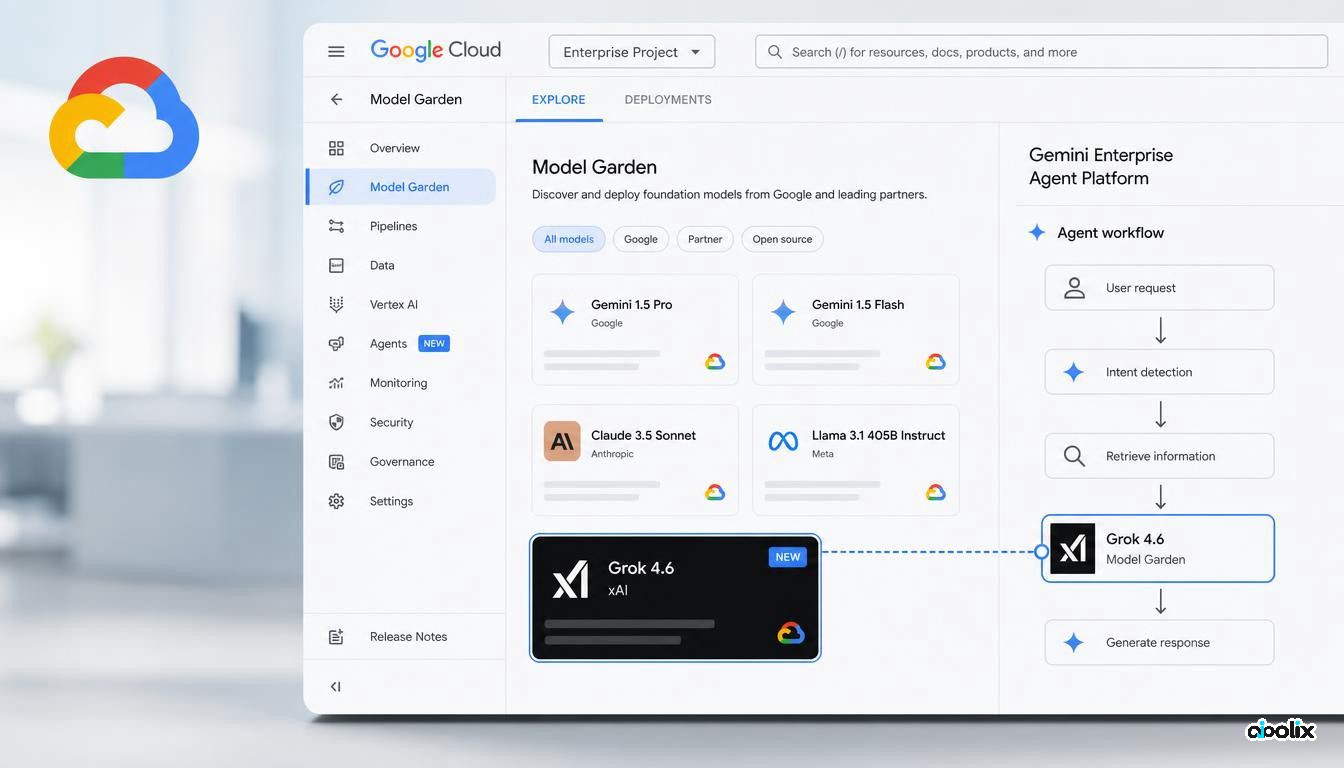
SpaceXAI’s Grok 4.6 is now available in Preview through Google’s Gemini Enterprise Agent Platform, giving Google Cloud customers a new managed route to the model inside Model Garden. Google recorded the release on August 21, while SpaceXAI announced the same availability. The change matters less as a new model launch, because Grok 4.6 itself debuted on August 12, and more as an enterprise distribution event that puts the model inside Google’s existing governance, quota and agent-development environment.
Google’s Grok 4.6 model card lists the model ID as `grok-4.6` with text and image inputs and text output. It supports function calling, structured output and reasoning, all currently marked as Preview capabilities. The platform exposes the model through a global endpoint and documents a context length of 524,288 tokens. Those details make the release relevant to teams building long-running agents, code assistants and multimodal workflows that already rely on Google Cloud infrastructure.
The most important operational caveat is the launch stage. Grok 4.6 is a Preview offering on Google’s platform, so Google’s Pre-GA terms apply and support or behavior can change before general availability. The model card also shows that standard pay-as-you-go and Provisioned Throughput are not currently supported. Instead, the listed usage mode is fixed quota, with documented global limits of 13 queries per minute, 188,000 input tokens per minute and 16,000 output tokens per minute. For production architects, that is a material constraint rather than a footnote.
SpaceXAI says Grok 4.6 was trained for long-running agents, coding, knowledge work and more ambitious visual or interactive projects. In its original model announcement, the company describes a longer supplemental training run than Grok 4.5, followed by supervised fine-tuning and reinforcement learning across general coding, domain-specific engineering and knowledge-work environments. SpaceXAI also reports better self-testing and verification on longer trajectories. These are vendor claims, not independent guarantees, but they explain why the model is being positioned as an agentic option rather than simply another chat model.
The model’s reasoning controls are another practical differentiator. SpaceXAI and Google document configurable reasoning, while Google’s platform exposes reasoning as a supported Preview capability. That gives application teams a way to trade latency and token usage against deeper deliberation on harder tasks. The useful engineering question is not whether the highest reasoning setting is always best, but where additional test-time compute improves task success enough to justify the cost and latency.
Pricing on the Google platform is straightforward at launch. SpaceXAI lists $2 per million input tokens, $0.50 per million cached input tokens and $6 per million output tokens for Grok 4.6 on Google Enterprise Agent Platform. Those numbers match the base pricing SpaceXAI advertises for its own API, although platform-specific terms and quotas differ. Teams comparing providers should therefore evaluate total deployment cost, including retries, longer reasoning traces, observability, networking and the operational value of staying inside an existing cloud control plane.
The timing also shows how quickly frontier models are becoming multi-cloud products. Grok 4.6 reached Amazon Bedrock on August 19, two days before its Google Preview. AWS describes the same 500K-class context window and configurable reasoning, but its Bedrock integration emphasizes cross-Region inference, monitoring, logging and enterprise security. The Google release now gives organizations another managed path without forcing them to adopt SpaceXAI’s first-party API directly. For procurement teams, this can reduce integration friction and preserve existing identity, billing and platform-governance patterns.
That does not make the two cloud offerings interchangeable. Google currently labels Grok 4.6 as Preview and documents fixed-quota limits, while AWS presents broader regional availability through Bedrock. Endpoint behavior, supported APIs, quota mechanisms and enterprise controls differ. An organization that treats the same model as operationally identical across providers risks missing those differences. Model selection is increasingly only one layer of a larger architecture decision about serving platform, governance, observability and failure handling.
For agent builders, the platform context may be especially important. Google’s Enterprise Agent Platform includes evaluation tooling, request-response logging, model-governance features and integrations with agent infrastructure. Grok 4.6 entering that catalog means teams can compare it against Gemini, Claude and other partner models without redesigning the entire application stack. A multi-model agent system can route tasks according to capability, cost or policy while keeping common evaluation and operational controls around the models.
There are also governance implications. Preview status should trigger tighter change management, explicit regression testing and careful dependency pinning. Teams should record which model ID, platform endpoint and configuration produced a given result, because model behavior can change independently from application code. For regulated or high-impact workloads, organizations should also verify data handling, region selection, retention and contractual terms rather than assuming that using a model through a major cloud automatically satisfies internal policy.
Benchmark claims need similar caution. SpaceXAI reports that Grok 4.6 matches or exceeds competing frontier models on several agentic coding and knowledge-work evaluations. The company publishes detailed scores, including results on CursorBench, DeepSWE, FrontierCode and other benchmarks, but competitor values come from published cards or public leaderboards and the overall comparison is not a neutral third-party evaluation. Teams should run workload-specific tests using their own prompts, tools, data and latency budgets before changing production routing.
The immediate significance of the August 21 release is therefore practical rather than theatrical. Grok 4.6 did not suddenly become a different model, but it became easier for Google Cloud organizations to evaluate and integrate it inside an enterprise agent stack. The next milestones to watch are general availability, expanded quota or pay-as-you-go support, clearer regional and data-residency options, and evidence from production workloads that the model’s long-horizon strengths survive real tool failures, noisy data and operational constraints. For AI architects, the larger trend is clear: frontier-model competition is increasingly a contest not just of raw capability, but of where models can be governed, observed and deployed.