HarnessDev asks a more operational question than most agent benchmarks: can a language model design the software harness around another agent, then improve that harness over time? The authors built a benchmark around runnable agent infrastructure rather than final answers, and their results expose a practical problem for teams building self-improving systems. A harness can look better on visible tasks while becoming worse on hidden tasks or under a different executor model.
That distinction matters because the harness is where many production controls actually live. It decides how an agent decomposes work, calls tools, stores state, retries failures, verifies outputs and stops. If agents start modifying that layer themselves, model evaluation alone is no longer enough. The harness becomes a versioned software artifact that needs its own release discipline.
The benchmark moves evaluation from answers to infrastructure
The HarnessDev preprint, submitted on September 1, evaluates two settings. In Creation, six creator models generate agent harnesses across four domains and five downstream benchmarks, covering 2,207 unique downstream instances. The weak seed intentionally lacks an agent loop, decomposition logic, tool policy, context management, persistent state, a verifier, retries and stopping rules, so non-zero performance depends on what the creator model actually adds.
The generated harnesses are executable, but their quality varies by domain. The authors report that self-created harnesses still trail mature human-engineered references on coding and search/research tasks, while selected writing and machine-learning experimentation tasks can match or exceed the chosen references.
This is useful because it separates two questions that are often collapsed in agent evaluation. Can a model solve a task when given a strong scaffold? And can a model design the scaffold itself? HarnessDev measures the second question directly.
Self-built harnesses work, but transfer is the weak point
The Evolution setting is more revealing for production use. The project tracks 73 official harness versions across nine optimization trajectories. According to the project page, feedback-set and held-out performance agree on only 34 of 64 comparable version transitions, or 53.1%. Only two of the nine versions declared final are also optimal on the held-out set.
The same harness can also change rank when the executor model changes. In one reported comparison, replacing the executor with a fixed Gemini model turns three of four optimization lineages negative. The paper therefore treats the executor as part of the system rather than an interchangeable implementation detail.
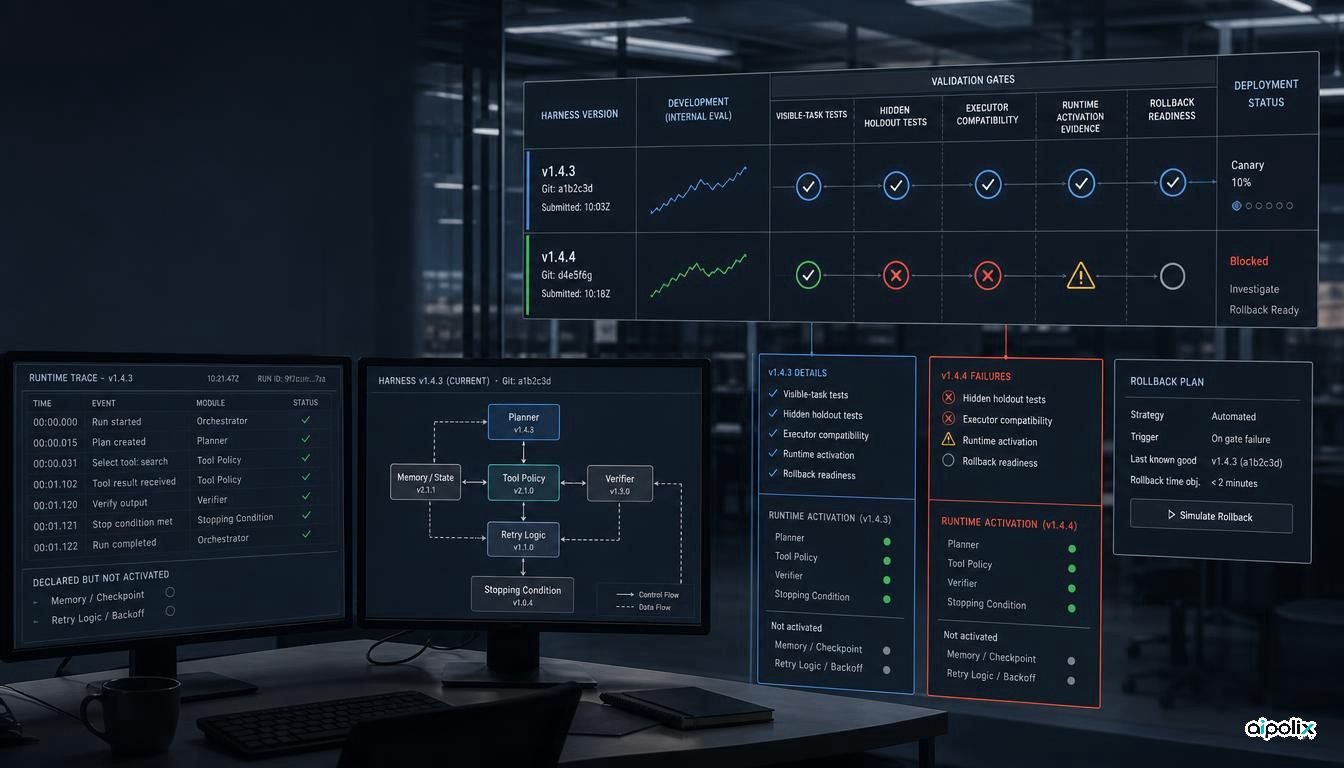
The practical implication is straightforward: a harness update should not be promoted because it improves the tasks used to generate the update. Teams need hidden-task validation, and they need to test the same harness with the executor models that will actually run in production.
Harness changes should be promoted like software releases
The strongest lesson from HarnessDev is not that agents can now autonomously write better agents. The results are too mixed for that claim. The stronger conclusion is that self-modifying agent infrastructure creates a software-release problem.
A production workflow should assign every harness version an immutable identity, keep the evaluation set that motivated the change separate from the promotion set, record the executor model used for both, and preserve rollback to the previous harness. A change should move forward only if it clears predefined regression limits across task quality, cost, latency and safety-relevant behavior.
That is stricter than a leaderboard mindset. An improvement on one benchmark can be a regression in the deployment envelope. HarnessDev makes that visible because it evaluates version transitions rather than only final scores.
A mechanism that exists in code may still be absent at runtime
The project also audits whether generated harness components are actually used. Across 108 component instances, 18 are never observed during execution, and all of those unused components are state or memory mechanisms. Eleven artifacts define a State class, but only one exposes state saving, only one implements periodic checkpointing, and the project reports zero checkpoint events across 26,679 task trajectories.
This is an important governance signal. Static code inspection can show that a control exists without proving that it ever fires. The same problem applies to retries, verifiers, memory, authorization checks and safety hooks in real agent systems.
For operational assurance, teams should therefore distinguish declared capability from runtime activation. A harness should not receive credit for a control merely because the class, configuration or policy is present. Evidence should show that the mechanism is reachable, invoked under the intended conditions and produces the expected state transition.
What teams should take from the result
HarnessDev is still a preprint. Its benchmarks, creator models and reference systems are selective, and the post-freeze held-out Evolution analysis is concentrated on software engineering. The results should not be read as a general proof that autonomous harness evolution is unsafe or ineffective.
But the benchmark does establish a useful testing pattern. If an agent can change its own orchestration layer, the controlled deployment unit is no longer just the model. It is the model plus harness, executor, tool policy, state system and promotion process.
That shifts the engineering question from “did the agent improve?” to “did this specific system version improve under independent validation, with the controls actually active at runtime?” For teams moving toward self-improving agents, that is a more defensible release gate.