
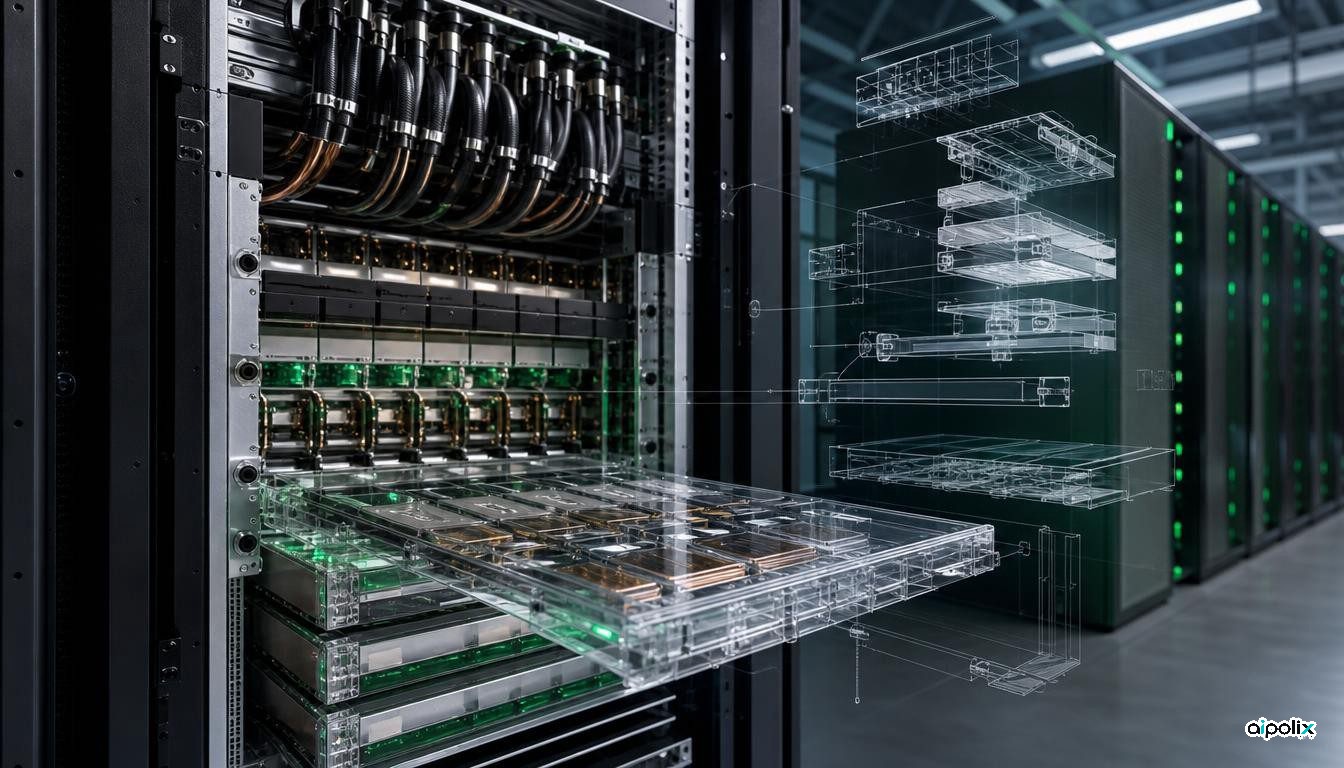
NVIDIA's blog from the Open Compute Project Global Summit says the company contributed key Vera Rubin rack and compute tray designs to OCP through the open MGX architecture. The goal is a shared foundation for next-generation AI factory infrastructure as deployments scale from megawatts toward gigawatts.
MGX 1.2 extends the open rack architecture with blind-mate liquid cooling, interoperable rack-scale interconnects, a liquid-cooled 5,000A busbar, native 19-inch equipment support, and designs aimed at racks up to about 250 kW. NVIDIA also describes a Vera CPU rack on the same MGX principles for agentic workloads such as tool calling, orchestration, and sandboxed execution alongside Vera Rubin NVL72 training and inference systems.
On the software side, NVIDIA expanded DSX OS with open-source components for switch configuration, cluster readiness testing, rack management, and bare-metal provisioning via a Cluster API provider. The company points developers to the DSX AI Factory GitHub for those pieces, drawn from experience running DGX Cloud.
NVIDIA and hyperscalers also published open facility standards, including an Open Data Center Specification and a Grid Resilience Specification co-authored with Google, Meta, and Microsoft covering how large AI loads should ride through utility disturbances. Partner notes include Visionbay's 800 VDC K-1 AI factory concept for the Vera Rubin era, Meta adopting Spectrum-6 Ethernet switches for large fabrics, a Cisco collaboration on denser USFP optics, and Google Falcon Transport support on future ConnectX-10 SuperNICs and BlueField DPUs.
Because NVIDIA Blog is configured direct=1, the announcement authenticity rests on the first-party post. Adoption claims about partner products should still be read as vendor and partner statements until independently measured in production.
For operators planning Vera Rubin-class sites, the practical change is clearer open targets for racks, cooling, power, networking, and factory software rather than only proprietary NVIDIA references.
The packaging matters for ecosystems beyond NVIDIA's own clouds: ODMs, colocation providers, and multi-tenant platforms can align mechanical, electrical, and operational interfaces earlier in the Vera Rubin ramp. That does not remove the need to validate thermals, power quality, and network loss under real cluster loads.
Cisco and NVIDIA's denser USFP optic plans, plus Falcon Transport support on upcoming ConnectX-10 and BlueField devices, point to the same theme as the rack contribution: shared physical and transport layers so AI fabrics can scale without every operator inventing a private stack. Meta's Spectrum-6 and multiplane networking notes similarly stress open switching software on Facebook Open Switching System alongside NVIDIA silicon.
None of these announcements replace capacity planning. Operators still need verified power delivery, coolant loops, and congestion control under mixture-of-experts training and high-concurrency inference. What changed on 12 Oct 2026 is the public reference surface for Vera Rubin-era factories.