
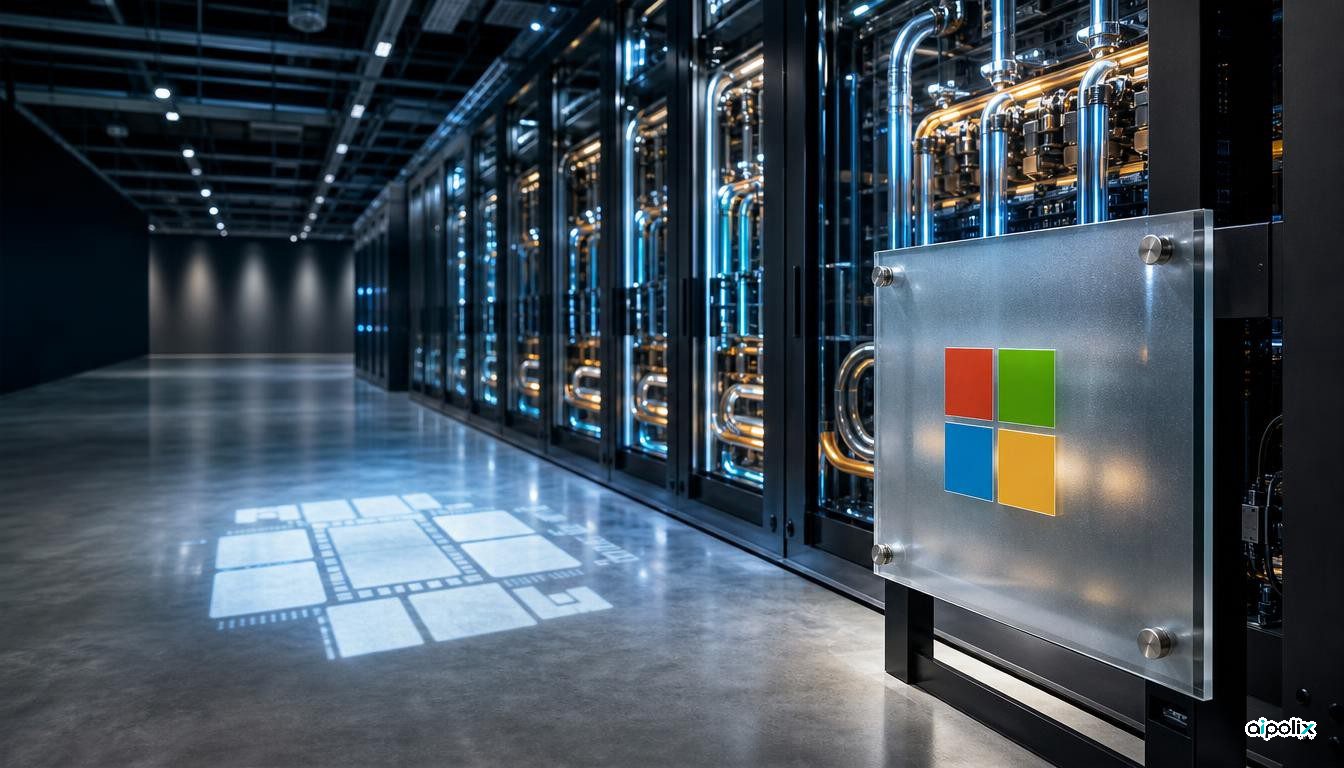
Microsoft said on 12 October 2026 that it will scale its Azure Maia custom AI systems to multi-gigawatt deployments starting in 2027, making Maia the primary inference platform for Microsoft products and services. In the same announcement, Scott Guthrie, executive vice president of Cloud and AI, introduced Azure Maia 300, the third generation of the company's in-house inference stack, while stating that Maia 200 is already serving production workloads.
According to the Official Microsoft Blog, Maia 200 is running production AI for Microsoft Copilot today, with GitHub Copilot and Microsoft Foundry expected to follow by year end. The company says Maia 200 runs OpenAI models, Microsoft's own MAI models and leading open-source families, and delivers up to 1.7 times more tokens per watt than leading GPU infrastructure for built-in AI features in Teams, Copilot and Cowork experiences.
Maia 300 is framed as an inference-first system for long-context reasoning, latency-sensitive conversation and multi-step agentic workloads. Microsoft expects it to deliver 40 percent more tokens per megawatt than leading GPU-based systems, and up to seven times the rack-scale token throughput of Maia 200 in a full 96-accelerator configuration. Production deployments are planned for 2027.
A companion Azure Blog deep dive by Rani Borkar and Saurabh Dighe adds hardware detail: a multi-chiplet design with compute on TSMC's N2P process; eight HBM4 stacks providing 288 GB and 18 TB/s per accelerator; 96 accelerators in a 167-kilowatt rack with 27.6 TB of HBM and 1.7 PB/s aggregate bandwidth; and a scale-up fabric that can grow to a superpod of 12,288 accelerators. Relative to Maia 200, Microsoft claims about 2.5 times memory bandwidth, 33 percent more capacity, roughly twice the HBM bandwidth per watt, more than 2.5 times performance per watt, and up to 7 times rack-scale token throughput.
The Verge reported the announcement the same day, quoting Guthrie on reducing reliance on Nvidia and AMD GPUs for Microsoft's own inference, and citing Microsoft AI CEO Mustafa Suleyman on co-designing models with owned silicon. Reuters separately reported Microsoft's plan for large Maia deployments aimed at cost savings. Efficiency, power and throughput figures are Microsoft's own projections and measurements, not third-party benchmarks.
For cloud customers and the broader chip market, the story is less a single SKU launch than a public commitment that Microsoft intends Maia, not merchant GPUs, to be the default inference engine inside its own products at multi-gigawatt scale in 2027.
Microsoft also points customers to a Maia 300 microsite for photos, video and further architectural material, and says it will share more of its AI infrastructure strategy at Microsoft Ignite 2026 in San Francisco next month. Those channels do not add independent benchmarks, but they underline that the company is treating Maia as a multi-year silicon-to-systems program rather than a one-off chip launch.