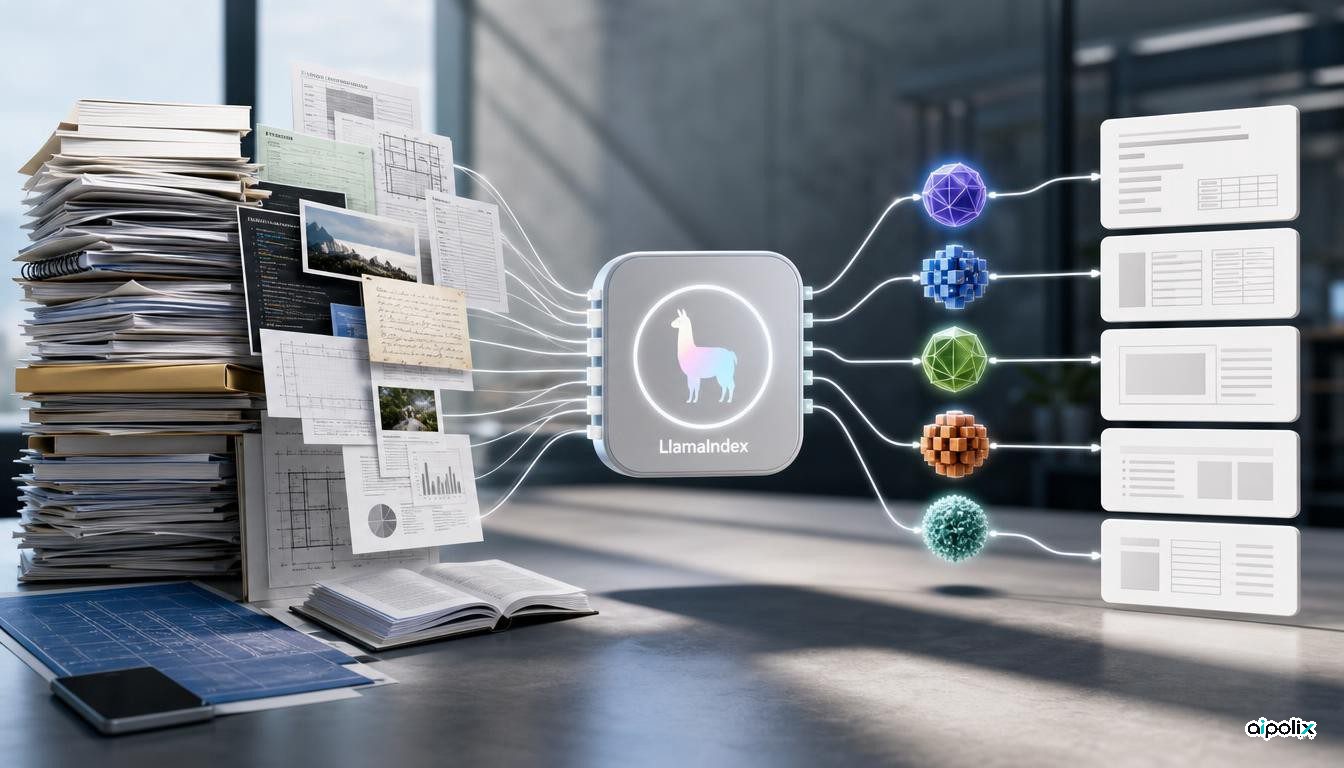
LlamaIndex has introduced OpenDocRouter, a document-to-Markdown service that places multiple proprietary and open document-understanding models behind a single API. The product is designed for teams that do not want to hard-code one OCR or parsing model into their ingestion pipeline. Instead, developers can submit a document through one interface and choose among supported model recipes while keeping the surrounding application contract consistent.
At launch, OpenDocRouter accepts PDFs, PNG and JPEG files as well as URLs. LlamaIndex says synchronous requests support documents up to 50 pages, while the broader input limit reaches 500 pages or 50 MB. The service returns Markdown and can optionally provide layout grounding through a shared set of layout classes, giving downstream systems a more consistent way to reason about elements such as text regions, tables or other page structures even when different underlying models are used.
A central part of the design is the use of versioned recipes. Rather than exposing only a model name, OpenDocRouter packages model choice and processing behavior into a versioned configuration that can be selected explicitly. LlamaIndex lists a mixture of frontier commercial models and open OCR systems in the initial catalogue, including models from OpenAI, Google and Anthropic alongside open document parsers. That breadth is intended to let teams compare quality, latency and cost without rebuilding their integration for each provider.
The practical value is strongest in document pipelines where no single parser performs best on every input type. Invoices, research papers, scanned forms and visually complex reports can fail in different ways, and model quality can shift quickly as providers release updates. A common API can make experimentation easier and reduce integration churn. It also creates a cleaner path for routing policies, where an application could select a cheaper parser for straightforward pages and a stronger model for more difficult documents.
LlamaIndex publishes token-based pricing and ParseBench measurements for the supported recipes, but performance comparisons should be treated with the usual benchmark caution. Results on a curated benchmark do not guarantee equivalent behavior on a company's own document distribution, and model-provider changes can affect real-world outcomes. Teams considering the service will still need to evaluate representative files, especially where extraction errors have financial, legal or operational consequences.
OpenDocRouter is available now according to LlamaIndex. The launch is significant less because it invents a new parsing model than because it standardizes access to many of them. If the abstraction remains stable as models change, it could shift document ingestion from a provider-specific integration problem toward a routing and evaluation problem. The main test will be whether the common schema preserves enough model-specific capability while actually reducing the operational complexity that multi-model document processing usually introduces.