
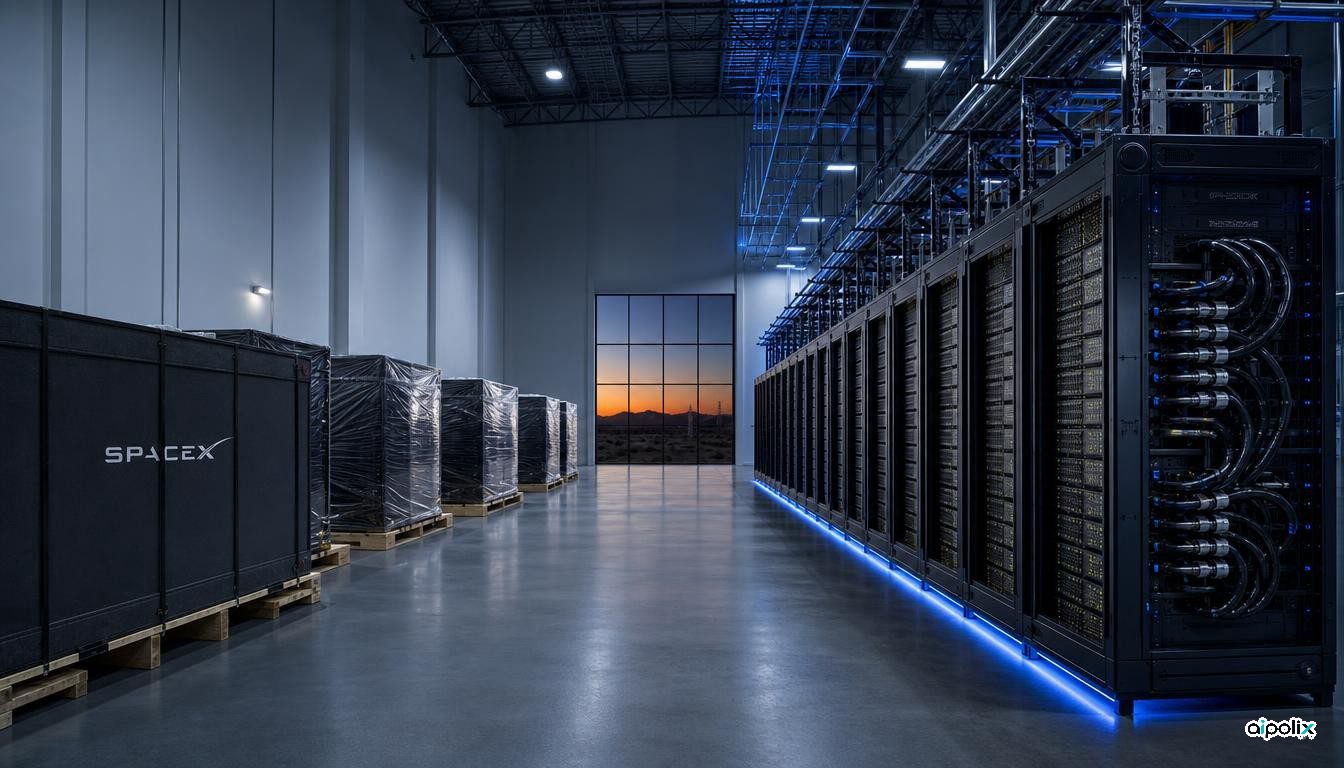
SpaceX has agreed the terms of what it calls the largest committed GPU financing to date: a master finance lease worth about $40 billion in principal payments, under which an entity managed by Apollo Global Management will purchase graphics processing unit pods and related equipment and lease them to the company. SpaceX disclosed the arrangement in a Form 8-K and an investor-relations release on October 26, 2026, a day after chief executive Elon Musk said on X that the financing was done.
According to the filing, SpaceX signed a binding commitment letter on October 24. The hardware will be delivered in tranches, each with its own lease schedule running roughly five to five and a quarter years from the start date. Rent is due quarterly in advance and is built from one-twentieth of the financed cost of each tranche plus interest at a fixed annual rate on the outstanding balance, with that rate to be set at pricing. The equipment will sit in data centers chosen by SpaceX.
According to the release, the lease is meant to supply NVIDIA's upcoming Vera Rubin chips to expand the company's ground-based compute. Apollo and Goldman Sachs lead the group of financing parties, with Goldman acting as sole structuring agent, and funds managed by BlackRock and Goldman Sachs Asset Management, along with accounts advised by KKR, made anchor commitments. SpaceX's chief financial officer said in the release that the company sees payback periods of under a year on its AI infrastructure, a company claim that the documents do not break down.
There is a gap between Musk's wording and the paperwork. Musk told followers the company had "closed" $40 billion of debt, mostly callable, for GPUs due in the first two quarters of 2027. The 8-K describes a commitment that still has to meet specified closing conditions, with signing of the master lease expected before year-end and lease schedules starting only when the chips are delivered. Reuters reported that CFO Bret Johnsen still expects fourth-quarter capital spending of $35 billion to $40 billion, and Musk said the new money would make little difference to spending in the current quarter.
The scale reflects how much of SpaceX is now an AI business. Its Super Intelligence segment, which houses Grok and its data center operations, reported third-quarter revenue of $7.56 billion, up from $813 million a year earlier. Part of that demand comes from outside customers: Anthropic's IPO filing, made public the same day, discloses compute agreements with SpaceXAI worth up to $120.5 billion through 2029. Musk also used the occasion to predict that more than 200 so-called neoclouds would face failures and consolidation as debt markets tighten for companies without other revenue.
Structuring the deal as a lease through a separate lessor lets SpaceX add a large block of hardware without buying it outright, though the obligation remains a long-term fixed payment stream tied to GPUs whose economic life is uncertain. The interest rate, the exact number of chips and the final closing terms have not been disclosed.