
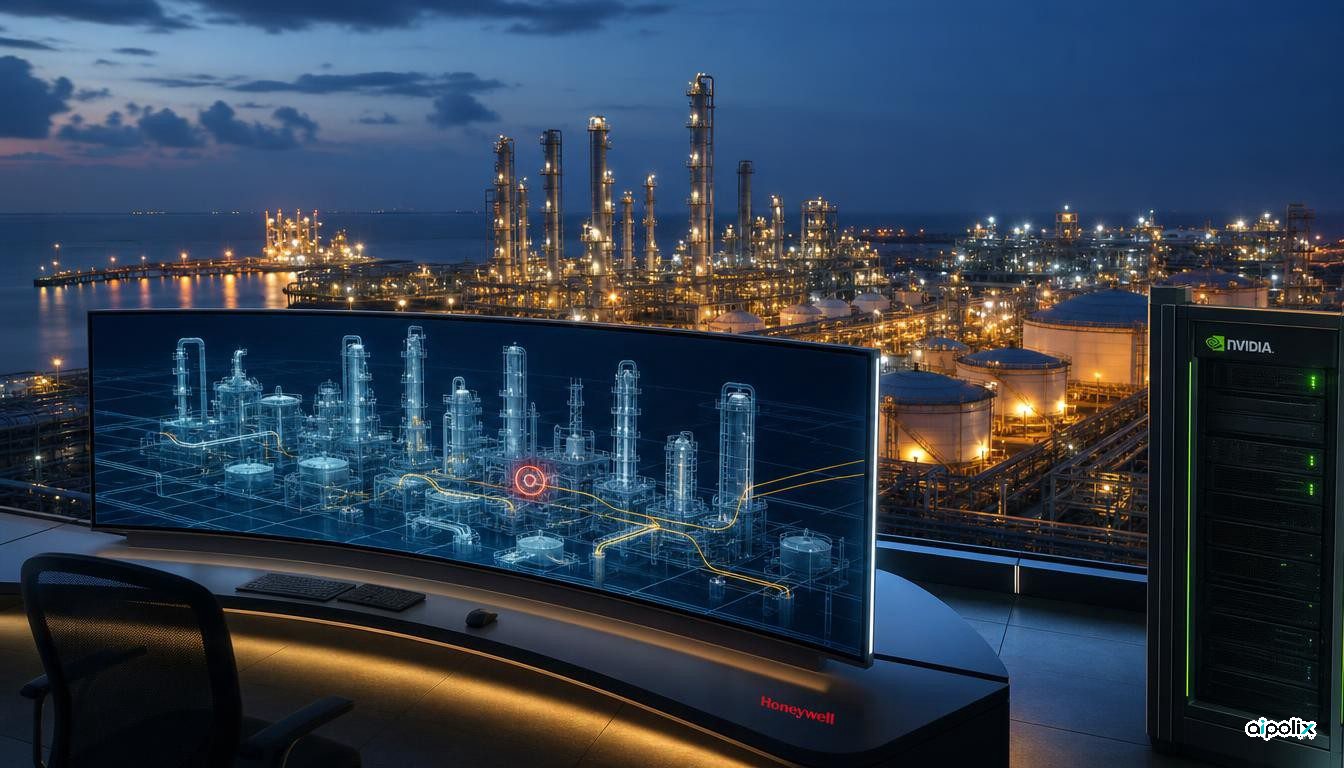
Honeywell Technologies on Monday, October 26, launched Forge Plant Cognition, an AI platform aimed at refining, petrochemical and liquefied natural gas operators, and named Dangote's petroleum refinery in Lekki, Nigeria, as the first plant to use it. Dangote's facility is one of the largest single-train refineries in the world. Honeywell built the system with NVIDIA's AI models and accelerated computing and with Dell Technologies' AI infrastructure, and Reuters reported the launch shortly after the announcement.
The software sits on top of Forge Cognition, the agentic AI and simulation platform for buildings and industrial sites that Honeywell introduced on October 14. The new version is tuned for process plants. It blends live operating data with engineering knowledge, the refining know-how of Honeywell's UOP unit and physics-based calculations, and Honeywell pitches it as a tool that does more than flag problems: it is meant to recommend and help carry out corrective actions. The company describes three jobs for it: finding bottlenecks that limit throughput, yield and product value; spotting equipment and process issues early to reduce unplanned downtime; and packaging specialist process knowledge into AI-assisted workflows for operators and engineers.
The technology stack is spelled out in unusual detail. The platform runs on the Dell AI Factory with NVIDIA, supported by Dell Services. NVIDIA's Nemotron open models drive agents that read and interpret plant data, Omniverse libraries create a digital twin of the refinery for simulation-based training and planning, and Cosmos open models combined with the Metropolis VSS Blueprint power vision agents that raise real-time alerts about anomalies. The PhysicsNeMo framework is used to build and fine-tune physics AI models for optimisation work tied to the digital twin.
Honeywell attaches a number to the deployment, but frames it carefully. Based on preliminary data, it estimates the platform could produce an operating gain above 29 cents per barrel at Lekki, which would add up to more than $60 million a year in gross benefit at full-capacity throughput. Footnotes in the release say the figure excludes implementation costs, is specific to this site, is not guaranteed and depends on crude slate, utilisation, data quality, margins and other factors.
For Dangote, the project is also about people. David Bird, chief executive of Dangote Petroleum Refinery and Petrochemicals, said the company picked the platform for its mix of industrial expertise and AI capability and tied the investment to developing Nigerian talent. Honeywell says the tools should help Dangote move toward a workforce that is 70% Nigerian by giving engineers faster access to expert guidance.
The launch extends a relationship that already runs deep. Honeywell says it has worked with Dangote for nearly a decade and is helping the refinery lift capacity from 650,000 barrels a day to 1.4 million, a goal Reuters reported is set for 2028. Reuters also noted that Honeywell has been selected to help Dangote build a new mega-refinery in Lamu County, Kenya, which gives the AI platform a potential second large site within the same customer.
The evidence so far is a vendor announcement and wire coverage of it. No operating results from Lekki have been published, the $60 million estimate is Honeywell's own and comes before implementation costs, and neither company has said when the system will be fully running or what it costs. The deployment will be worth watching as a test of whether agent-based AI and digital twins can deliver measurable gains in heavy process industries, where the earlier Forge Cognition pilots focused mostly on buildings and campuses.