
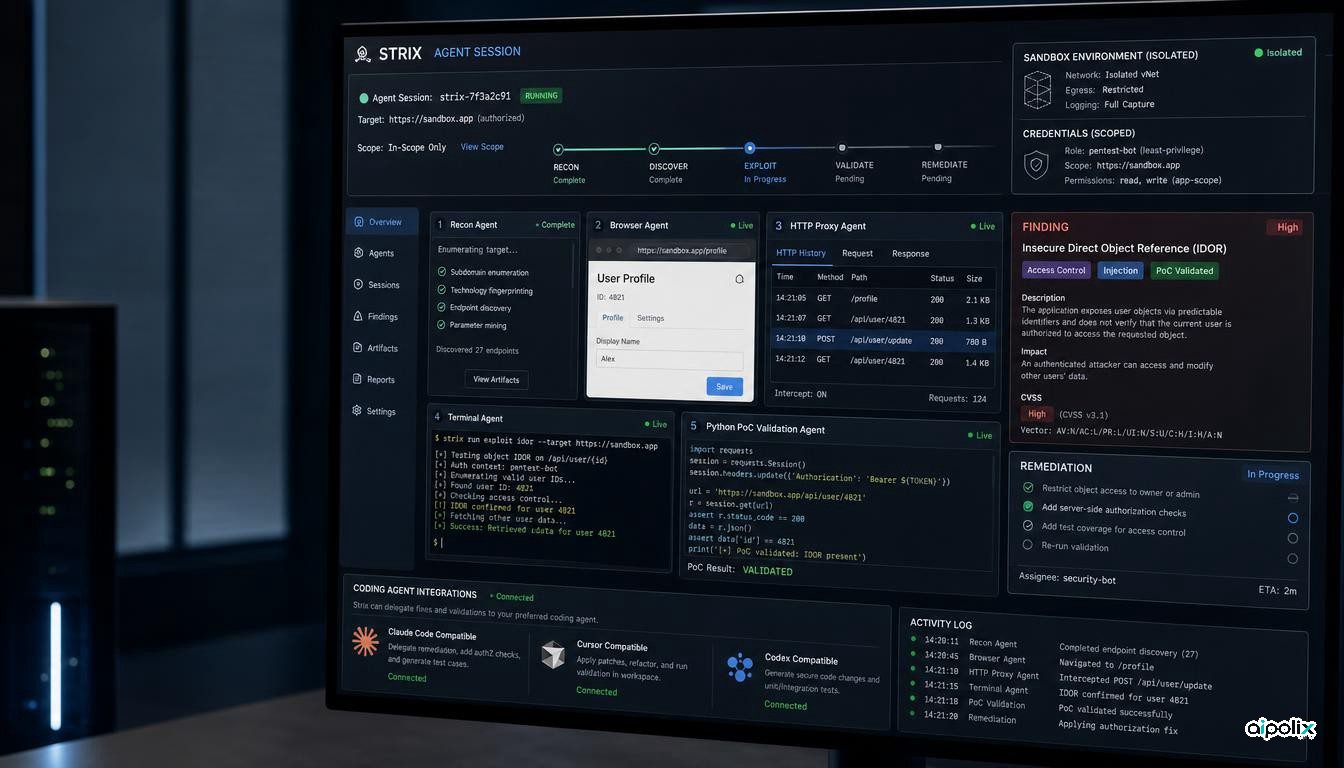
Strix is an open-source AI penetration-testing system that gives autonomous agents a browser, HTTP interception proxy, terminal, Python runtime and reconnaissance tooling so they can move beyond identifying suspicious patterns and actually validate vulnerabilities with working proofs of concept. The project is now at version 1.5.3, is licensed under Apache 2.0 and describes itself as alpha software in its package metadata. At the time of review, its GitHub repository showed roughly 59.8K stars and 6.5K forks.
The important shift is not that another security scanner uses an LLM. Strix is designed around an active execution loop. Its agents can explore an application, manipulate requests, run commands, develop a proof of concept and then turn the result into a finding. That makes the system more interesting than a conventional static scanner, but it also changes the operational boundary: a tool that can validate an exploit must be governed like a privileged execution system, not like a passive code-quality check.
From scanner to proof-driven security agent
The Strix repository describes a multi-agent architecture in which specialized agents coordinate reconnaissance, exploitation and validation. The toolkit includes browser automation for web flows, an interception proxy, shell execution, a Python sandbox and static plus dynamic code analysis.
That combination matters because many application-security tools stop at detection. A rule can flag a potentially dangerous code path, but the engineering team still has to decide whether the path is reachable, whether the vulnerability is exploitable and whether the reported severity reflects the real application context. Strix tries to close part of that gap by making exploit validation part of the agent loop.
For developers, the practical benefit is fewer findings that exist only as pattern matches. The trade-off is that validation is itself an action. A security agent with a terminal, browser, network access and application credentials can create side effects if it is pointed at the wrong environment or given overly broad permissions. The project explicitly says testing should be limited to systems the user owns or is authorized to test.
Pentesting is becoming part of the coding-agent toolchain
Strix is also moving closer to the normal software-development loop. Its current repository documentation includes an agent-skill installation path for Claude Code, Cursor, Codex and other SKILL.md-compatible coding agents. Those skills cover running pentests, fixing findings, CI security scanning and target-specific workflows such as API or web-application testing.
That is a more consequential design choice than a new user interface. It means a coding agent can potentially call a specialized security agent as part of the same workflow that writes or changes code. The security check can move from a separate late-stage activity toward a callable capability inside development automation.
The architectural implication is that the boundary between "coding agent" and "security tool" becomes less important than the permissions of the combined workflow. A developer agent that can modify code, launch a Strix scan and consume the resulting findings is effectively operating across build, test and offensive-security surfaces. Production teams therefore need explicit separation between what may run automatically, what may execute only in an isolated test target and what still needs human approval.
The 96% XBEN result is strong, but narrower than the headline
Strix publishes a 96% success rate on XBEN, solving 100 of 104 challenges in black-box mode. The project's benchmark page says the result was produced by Strix v0.4.0, with an average solve time of about 19 minutes and a total reported cost of roughly $337 for the 100 solved challenges.
The result is useful evidence that the system can autonomously discover and exploit a broad set of web vulnerabilities in a controlled environment. But it should not be read as "Strix finds 96% of real production vulnerabilities."
The independent XBOW validation-benchmark repository explains that XBEN is a curated suite of 104 self-contained web-security challenges built to test offensive tools. Each task behaves like a capture-the-flag exercise with a known hidden objective. That is valuable for repeatable evaluation, but production applications add conditions that a CTF-style benchmark does not fully represent: authentication complexity, business-specific authorization logic, rate limits, noisy telemetry, distributed services, third-party dependencies and the cost of false or disruptive actions.
There is another limitation that is easy to miss. The headline score belongs to v0.4.0, while the current package metadata reports v1.5.3. A high score on an older version is not evidence that every later architectural change preserves the same benchmark behavior, and it does not establish real-world coverage. The right interpretation is narrower: Strix has demonstrated strong autonomous exploitation capability on a known public benchmark, and teams should run their own evaluation before trusting it as a production control.
The real production question is the control boundary
For a normal code scanner, a false positive mainly costs review time. For an autonomous pentesting agent, an incorrect action can be materially different. A scan may interact with authentication, mutate application state, trigger defensive controls or consume credentials and network access.
That changes what good deployment looks like. The safest default is to treat Strix as active security automation: run it against authorized targets, isolate test environments where possible, scope credentials and network access, retain execution evidence and keep destructive or high-impact actions behind explicit policy.
CI/CD integration makes those controls more important, not less. The project's release history shows continued work on runtime, browser sessions, agent coordination and CI-related behavior, while the package metadata still classifies the project as alpha. That combination is normal for a fast-moving open-source tool, but it is a reason to separate experimentation from control-plane trust.
Why Strix is worth watching
The most important idea in Strix is not "AI can hack." Security teams have automated reconnaissance and exploitation for years. The interesting change is that an LLM-driven agent can choose among tools, pursue evidence, validate an exploit and return a reproducible proof within one coordinated loop.
That could make security testing more continuous and more accessible to development teams. It could also create a new class of privileged automation that needs stronger sandboxing, identity, auditability and approval boundaries than ordinary developer tooling.
Strix is therefore best understood as a signal of where agentic software engineering is going. Coding, testing, remediation and offensive validation are starting to become composable agent capabilities. The question for production teams is no longer only whether the agent can find a vulnerability. It is whether the organization can let it try, observe exactly what it did and constrain the blast radius when it is wrong.