U.S. school systems are moving from an early instinct to block generative AI toward teaching students how to use it critically. An Associated Press report published on August 21 describes AI literacy becoming a central back-to-school theme, while districts such as Charleston County in South Carolina are building policies, training and classroom resources around responsible use.
Charleston County School District offers a useful example. The district says it spent the 2025–26 school year developing policy, consulting families, students and teachers, and planning implementation. In January 2026 its board adopted AI guidance, and for the 2026–27 school year it is moving into educator training and broader classroom use. A new Generative AI Resource Hub includes material on AI literacy, human oversight, bias, academic integrity and family guidance.
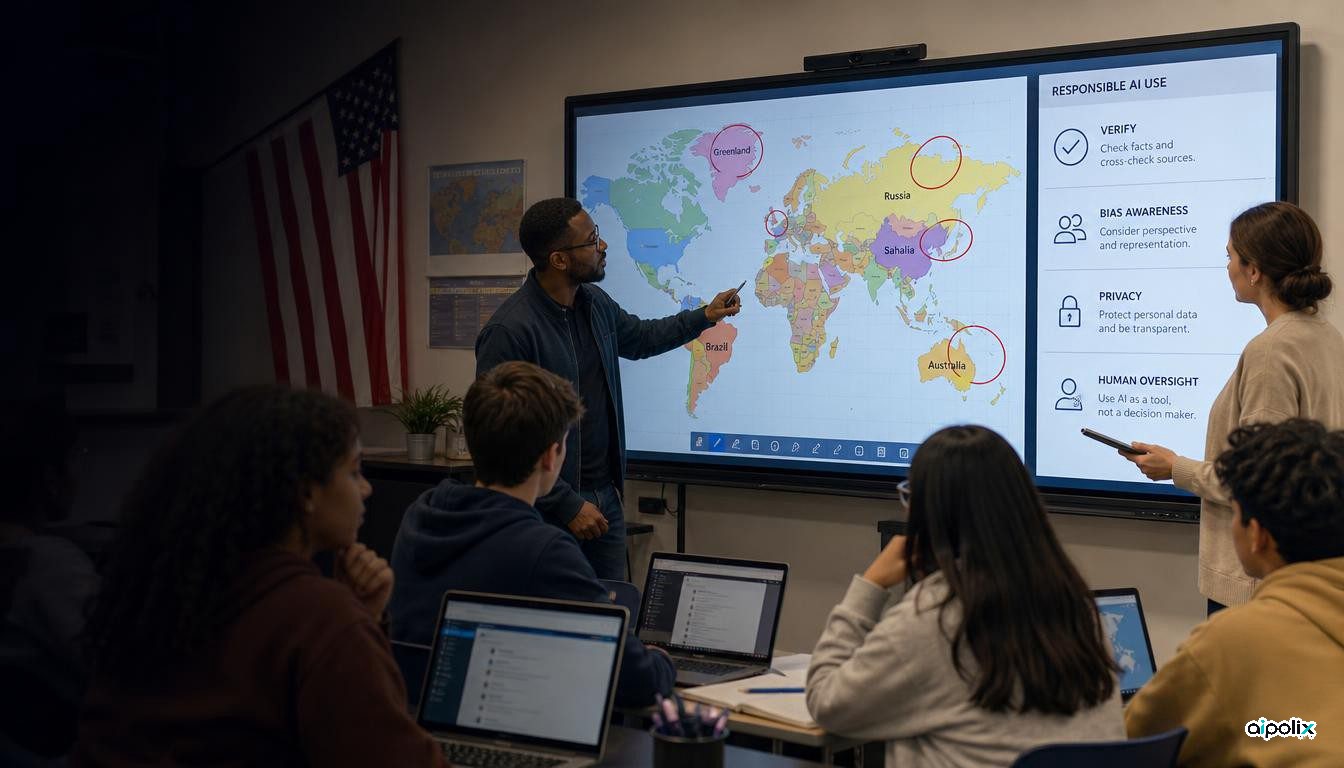
The goal is not simply to make students better at prompting chatbots. Educators are increasingly defining AI literacy as the ability to recognize when a system is unreliable, verify claims, understand bias and privacy risks, and know when not to use AI at all. In the Charleston training described by AP, teachers were shown a generated world map filled with spelling and geographic errors as a practical lesson in why students should not over-trust fluent AI output.
That approach reflects a wider policy shift. AP reports that 37 U.S. states have issued guidance related to AI in education. Utah is one of the more developed examples. The Utah State Board of Education’s AI framework explicitly argues that unrestricted use creates risks, while an outright ban can prevent students from developing future workforce skills. The state now maintains guidance for students and educators and a dedicated AI education function.
The difficult part is that “AI literacy” remains an unsettled term. Schools have to balance preparation for an AI-shaped workplace against academic integrity, data protection and the danger that students may outsource core thinking skills. Commercial AI companies also provide education programs, but school systems still have to decide which tools are acceptable, what data can be shared and where human judgment must remain mandatory.
Charleston’s policy makes several boundaries explicit. Teachers retain discretion over whether AI is used in class. Any adopted tool must meet student privacy and security requirements, and the district says student information will not be used to train commercial AI models without appropriate authorization. AI also cannot be the sole basis for high-stakes decisions such as discipline, special-education placement or academic advancement.
The shift matters because banning AI was easier when access could be treated as exceptional. That is becoming less realistic as AI features are embedded in search engines, productivity software, phones and learning platforms. Schools increasingly face the same governance problem as workplaces: they need to teach users how to work with AI while preserving accountability for decisions and outputs.
If this model spreads, the educational goal may become less about whether students are allowed to use AI and more about whether they can interrogate it. That means understanding hallucinations, checking sources, recognizing biased outputs, protecting personal data and knowing when the right answer is to work without the model. In that sense, AI literacy is starting to look less like software training and more like a new layer of digital and information literacy.