
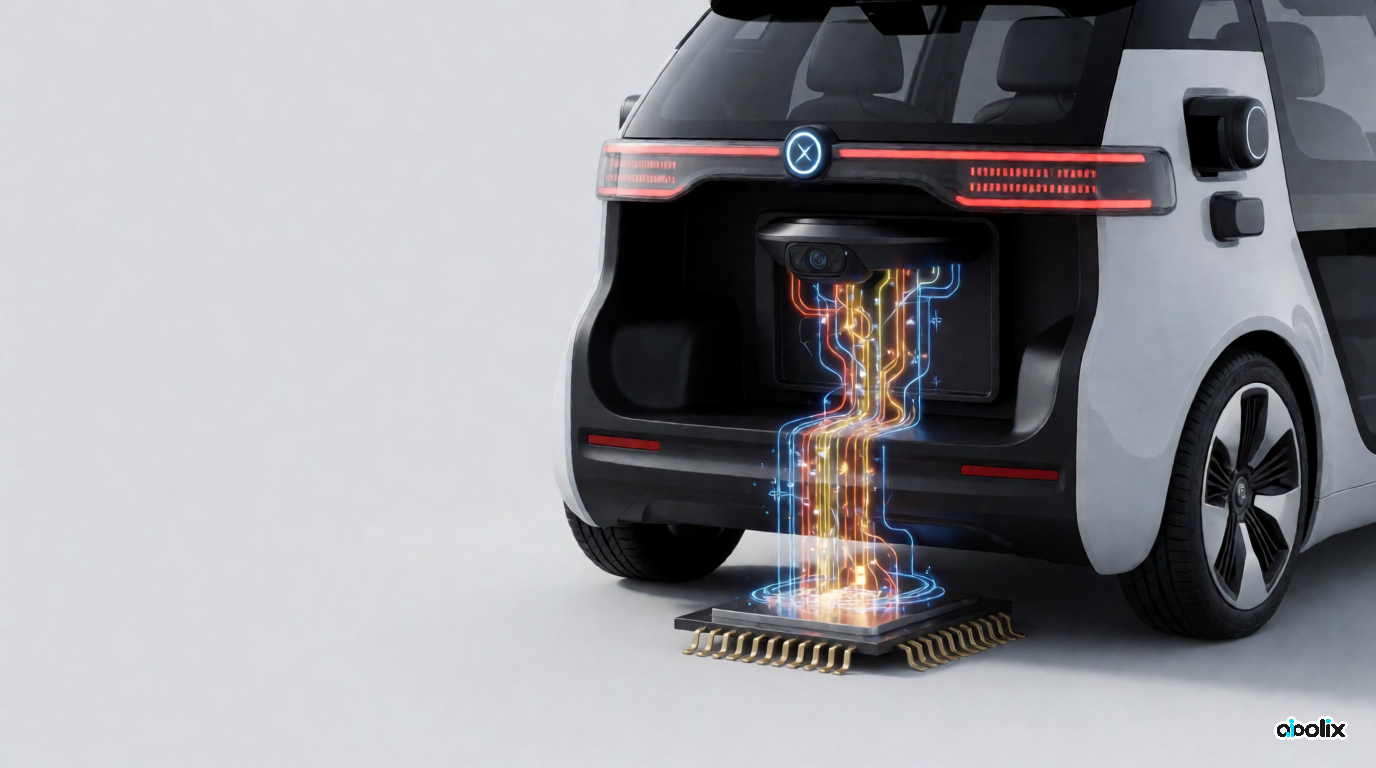
Waymo has disclosed the custom silicon and heterogeneous compute architecture behind its latest robotaxi platform, revealing a purpose-built 5-nanometer ASIC that performs more than 1,000 trillion machine-learning operations per second for front-end perception and sensor processing. The disclosure, published on August 20, matters because it shows one of the world’s largest commercial autonomous-driving deployments moving deeper into vertically integrated AI infrastructure instead of relying entirely on general-purpose accelerators.
The chip is not a replacement for every processor inside a Waymo vehicle. Waymo describes it as a specialized accelerator positioned near the front of the perception pipeline, where it processes raw lidar, radar and camera streams before data reaches the broader inference system. Its role includes extracting features, fusing sensor information and running neural-network workloads under strict latency constraints. Waymo says the latest system can process high-fidelity input from 13 high-resolution cameras simultaneously and in real time.
This is a different engineering problem from data-center AI. A robotaxi must run its critical driving stack locally, continuously and under hard limits on latency, power, heat, space and reliability. Waymo says the vehicle’s compute system makes decisions within milliseconds and is designed around responsiveness, ruggedization and redundancy. The company also says it has increased available compute by about 20 times over eight years while continuing to fit the system inside a vehicle and manage battery efficiency, cooling and acoustic constraints.
The custom ASIC reflects that workload specialization. Waymo says the design includes accelerators for operations such as temporal denoising, which can improve perception in low-light conditions, and supports a range of model types from sparse convolutions to dense transformers. Because autonomous-driving workloads often run at low batch sizes, throughput figures alone do not determine performance. The company emphasizes full-stack optimization, including memory movement, sensor fidelity, quantization and achieved latency, rather than peak theoretical compute in isolation.
The broader architecture remains heterogeneous. Waymo explicitly names AMD, Micron, Nvidia, Samsung, SanDisk, Socionext and TSMC among the suppliers supporting its current compute platform. That detail is important because the custom chip does not mean Waymo has abandoned merchant CPUs, GPUs or other accelerators. Instead, it suggests a hybrid strategy in which the company owns increasingly specialized parts of the inference path while continuing to buy components where external suppliers offer better economics, performance or development speed.
Independent reporting broadly matches Waymo’s account. The Verge described the system as the computing brain in the vehicle and reported the same 5nm process, 1,000-TOPS-class front-end capability and continued reliance on suppliers including Nvidia and AMD. SiliconANGLE also reported that Waymo’s sixth-generation autonomous-driving module uses custom ASICs alongside a wider computing stack. Those reports do not independently benchmark Waymo’s performance claims, so the 1,000 TOPS figure and efficiency advantages should still be treated as company-reported technical specifications rather than third-party validated measurements.
For AI infrastructure teams, the architectural lesson is more important than the headline number. As AI moves from cloud services into robots, vehicles, industrial systems and other real-time environments, the balance between general-purpose accelerators and domain-specific silicon changes. A data-center GPU can be extremely flexible, but edge autonomy rewards predictable latency, tightly coupled sensor processing, power efficiency and hardware-software co-design. Waymo is effectively treating the vehicle as a distributed edge AI system whose compute, sensors and models are designed together.
That approach also changes software architecture. Custom accelerators increase the importance of compiler support, quantization strategies, model partitioning, observability and fallback behavior. Teams cannot optimize only model accuracy. They must decide which operations belong on specialized silicon, which remain on CPUs or GPUs, how data moves between processors, how failures are detected and isolated, and how software can be updated without weakening safety guarantees. In safety-critical systems, redundancy and deterministic behavior can matter as much as raw model throughput.
The disclosure also has implications for the AI chip market. Nvidia remains a named Waymo supplier, so this is not a simple story of a customer replacing Nvidia. It is better understood as evidence that large AI operators may internalize the most differentiating parts of their workloads while continuing to use commercial components elsewhere. The same pattern is already visible in hyperscale cloud infrastructure, where companies mix custom accelerators with merchant silicon. Autonomous vehicles extend that trend into physical AI, where the economics and constraints are different but the incentive to co-design hardware and models can be even stronger.
There are important limits to what is known. Waymo has not published die size, transistor count, manufacturing volumes, unit cost, power consumption, memory bandwidth, detailed redundancy topology or independently reproducible benchmarks. It also has not disclosed enough information to compare the ASIC directly with competing autonomous-driving chips on an apples-to-apples basis. The company’s claim of more than 1,000 TOPS therefore should not be treated as a standalone measure of driving capability or safety.
Still, the timing is significant. Waymo is expanding commercial service across more U.S. cities while increasing the scale and diversity of its fleet. A bespoke compute platform only makes economic sense if the operator expects sufficient deployment volume, long product lifetimes or strategic value from controlling critical parts of the stack. The disclosure suggests Waymo believes its autonomous-driving workload has matured enough to justify that investment.
The next things to watch are the details Waymo chooses to reveal at technical events such as Hot Chips, whether later vehicle generations move additional inference workloads onto custom silicon, and how the architecture affects cost, power consumption and serviceability at fleet scale. For practitioners building physical AI systems, the larger message is already clear: once AI leaves the data center and must act in the real world under hard timing and safety constraints, specialized compute and end-to-end co-design become first-class architectural decisions.