Anthropic has opened a research preview of the Model Hardware Standard, or MHS, a shared interface intended to let AI agents discover, monitor and control programmable physical equipment. The preview matters because it moves agent interoperability beyond software tools and into laboratories, robotics and manufacturing, where a bad action can have physical consequences and where proprietary device interfaces have historically made automation slow and expensive.
The company says the early specification is being tested with scientific labs and manufacturers before a planned open-source release. Anthropic's announcement describes deployments spanning liquid handlers, robotic arms, microscopes and quantum-computing laser systems. Reuters independently reported the research preview and its focus on allowing agents to operate physical devices while Anthropic and partners develop safety evaluations.
A common driver layer for agents and machines
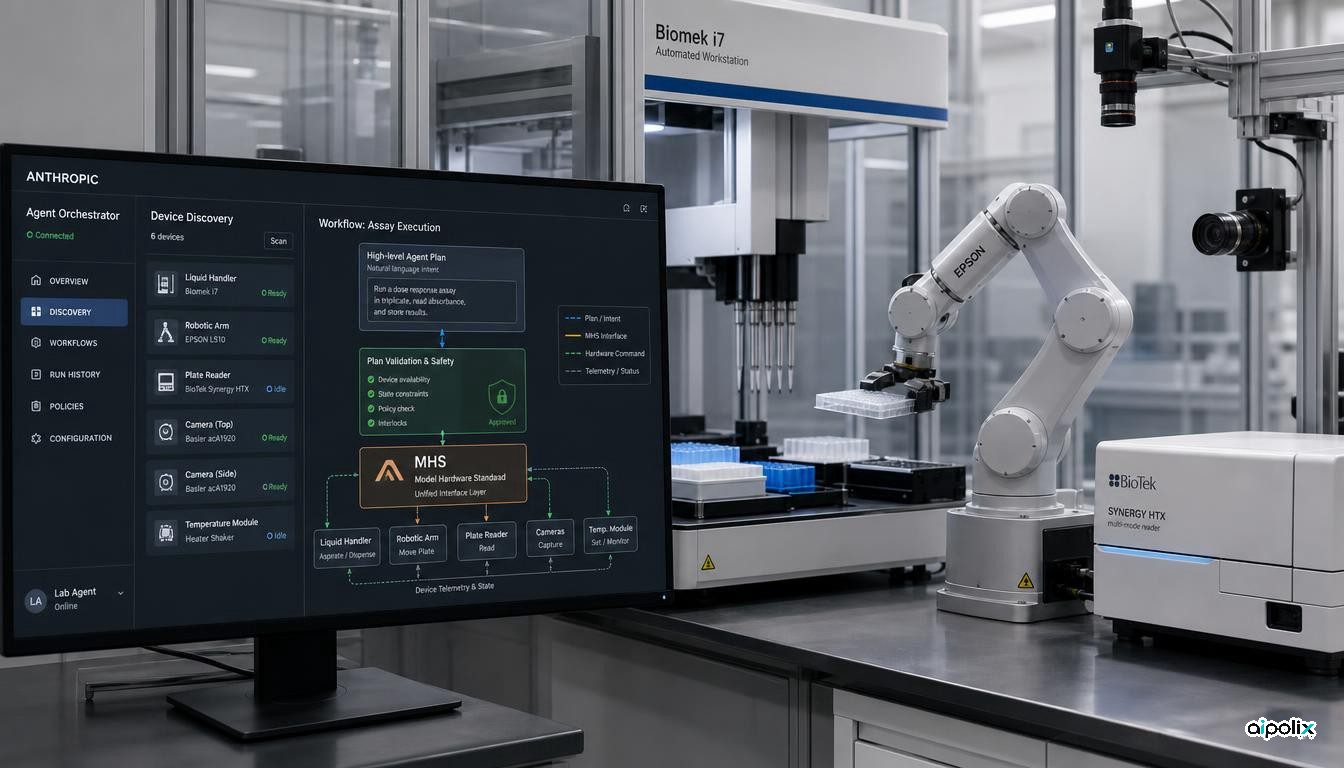
MHS introduces a standardized driver between an agent and a device. Instead of every automation project building a bespoke integration, the driver exposes basic operations such as reading state and writing settings, makes devices discoverable on a network, and describes capabilities and safety limits in a machine-readable reference. Anthropic says the same interface can be reached through mechanisms including Model Context Protocol, command-line tools and code APIs.
That architecture is important for agent systems because it separates high-level reasoning from device-specific control. An agent can inspect available equipment, sequence operations across several machines, monitor results and change parameters. For long-running or time-sensitive operations, it can also turn a sequence of driver commands into deterministic code rather than reasoning online at every step.
The idea resembles what software agents gained from standardized tool protocols, but with a much higher consequence boundary. A malformed database query can corrupt data; a malformed hardware action can collide a robot arm, damage a sample or create unsafe operating conditions. The standard therefore has to carry not only callable operations but also constraints, provenance and an enforceable safety model.
Early pilots show both leverage and limits
Anthropic's announcement includes several partner demonstrations. At Genentech, researchers used MHS to coordinate a liquid handler, robotic arm and plate reader for a protein assay. The system could recover from some instrument errors, but it also exposed a core weakness: the model initially treated a physical problem, bubbles in a viscous liquid, as if parameter retries alone could solve it. Human experts had to explain the underlying physical constraint before the agent adopted a safer procedure.
Carnegie Mellon researchers reported that they built drivers and an orchestration layer for four instruments across three incompatible computers in about eight hours, compared with several weeks for a conventional vendor setup. They also reported roughly three-times-faster serial-dilution experimentation. Those figures come from the participating researchers in Anthropic's announcement, not from an independent benchmark, so they should be treated as early pilot results rather than established industry-wide performance.
Other pilots cover qPCR monitoring, robotics, quantum laser stabilization and laboratory platforms. Anthropic says companies including Tecan and Universal Robots are working on support, while Hugging Face is adding MHS support to LeRobot and Raspberry Pi is enabling integrations for some products. These are useful release signals, but the specification is still a research preview and is not yet an open standard with broad independent implementation.
Safety becomes part of the interface contract
The most consequential part of MHS may be the attempt to put physical constraints into the interface itself. Device descriptions can include characteristics and safety limits that an agent needs before issuing actions. In the pilots, some systems also used interlocks or human confirmation for risky operations.
That does not eliminate the model-risk problem. Anthropic explicitly says current models still have weak spatial and physical reasoning, may require substantial expert context, and can fail to diagnose real-world mechanical, chemical or biological problems. Hardware without a programmable interface is also outside the current design. The company says the preview period will be used to build additional safety evaluations and a physical-safety roadmap before open sourcing the standard.
For architects, this is a reminder that agent authorization cannot stop at a generic tool-call permission. Physical agents need device-level limits, state validation, emergency-stop behavior, identity and auditability, and clear rules for when deterministic control should replace model reasoning. MHS provides a possible interoperability layer, but production assurance will depend on controls implemented around and beneath that layer.
Why MHS is worth watching
MHS is not yet proof that autonomous laboratories or factories are ready for unattended operation. The evidence is a collection of early partner pilots, mostly described by Anthropic and collaborators, and the standard itself is still restricted to a research preview. The stronger claim is narrower: Anthropic has defined and deployed a common agent-to-hardware abstraction across multiple real devices and organizations, and it is explicitly treating safety constraints as part of that interface.
If the specification is open-sourced as planned and gains implementation beyond Anthropic's launch partners, it could become an important bridge between agent frameworks, robotics and laboratory automation. The key tests will be whether independent implementers can reproduce the integration gains, whether safety controls remain enforceable across models and harnesses, and whether the standard can evolve without turning a convenient interoperability layer into an overly broad execution authority.