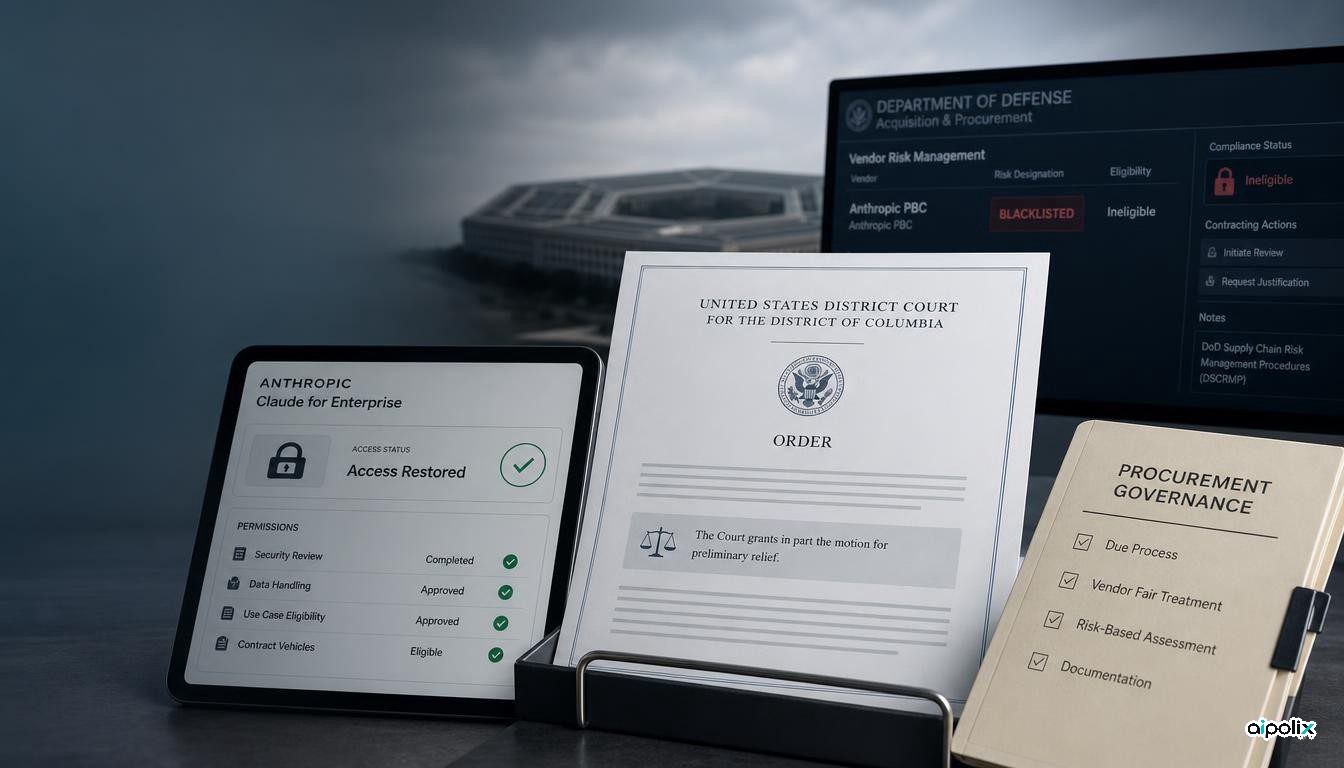
A U.S. federal judge has ruled that the Pentagon's broad measures against Anthropic were unlawful, overturning the national-security supply-chain-risk designation and blocking related sanctions. The decision matters beyond one AI company because it defines limits on how the government can use procurement and national-security powers when a model provider publicly disputes acceptable uses of its technology.
The litigation grew out of Anthropic's refusal to remove two restrictions for military use of Claude: mass surveillance of Americans and fully autonomous lethal weapons. A March preliminary-injunction order had already found that Anthropic was likely to succeed on claims that the government's response was retaliatory and procedurally defective. The new ruling, reported by Reuters and the Associated Press, converts that earlier warning into a final decision on major parts of the case.
The court separated vendor choice from punitive blacklisting
One of the most important distinctions in the litigation is that the government remains free to choose a different AI vendor. The March order explicitly recognized that the Pentagon can decide Claude is not suitable for its operational requirements and can stop using it. The legal problem arose when the government went further and used a supply-chain-risk designation and broader sanctions that affected Anthropic's ability to work across the federal market and with military suppliers.
Reuters reports that Judge Rita Lin found the designation unlawful and concluded that national-security authority could not be used as retaliation for protected criticism. AP similarly reports that the judge found the measures illegal and baseless and that the ruling blocks enforcement of the broader campaign against Anthropic.
For AI procurement teams, that distinction is consequential. Governments can still impose technical requirements, safety conditions and mission-specific constraints, and they can reject a vendor that will not accept them. What the ruling challenges is using a security designation as a punitive mechanism when the evidentiary and procedural basis for that designation is not satisfied.
The dispute exposes a new governance boundary for frontier models
The underlying contract conflict concerned who controls the final usage boundary for powerful general-purpose models in classified or high-risk settings. Anthropic argued that Claude was not ready for mass surveillance of Americans or fully autonomous lethal weapons and wanted those uses excluded. The Pentagon argued that lawful operational decisions should remain with the government rather than a private AI provider.
That disagreement is not resolved by the court as a technical question. The March order said the policy choice over which AI product the military should use was not for the court to decide. Instead, the litigation focused on what the government could legally do to a supplier after the disagreement became public.
This is a governance issue that other model providers and enterprise buyers will watch closely. Frontier-model contracts increasingly include usage policies, deployment controls and restrictions that do not map neatly onto traditional software procurement. In high-security environments, customers may want maximum operational discretion while model developers may insist on non-negotiable safety boundaries. The Anthropic case shows that those clauses can become questions of public law when the buyer is the state.
The ruling does not make Anthropic mandatory for government use
The practical effect should not be overstated. The ruling does not require the Pentagon to buy Claude or to accept Anthropic's preferred usage restrictions. Reuters notes that the government remains able to choose other vendors, and a separate legal dispute involving another Pentagon mechanism remains unresolved.
The government is also expected to appeal. That means the final shape of the legal precedent could change. Organizations should therefore treat the current decision as a strong district-court ruling, not as the last possible word from the appellate system.
The ruling also does not independently validate Anthropic's technical claim that current models are too unreliable for particular military uses. That remains Anthropic's safety position. The court's role was to assess retaliation, due process and statutory authority, not to certify model reliability.
What this changes for AI governance and procurement
For public-sector AI programs, the case raises the bar for documenting why a vendor is treated as a security risk rather than simply as an unsuitable supplier. Security designations can have consequences far beyond a single contract, so evidence, procedure and proportionality become part of AI governance.
For model companies, the ruling preserves more room to state safety red lines without automatically accepting that doing so justifies exclusion across unrelated government relationships. It does not remove commercial risk, but it narrows the legitimacy of using extraordinary security tools as leverage in a contracting disagreement.
Private-sector buyers should pay attention too. The case illustrates why deployment responsibility must be explicit. A model provider can control API policies and contractual terms, while a customer can control mission decisions and local infrastructure. When those responsibilities conflict, the contract needs a defined offboarding path rather than assumptions that one side can unilaterally redefine the safety boundary.
The broader significance is that AI governance is moving into ordinary institutions of law, procurement and administrative procedure. Questions about model safety are no longer confined to system cards or voluntary policies. They now affect who can sell to government, which restrictions can survive a contract negotiation, and how national-security powers may be used when a vendor publicly disagrees with the state.