
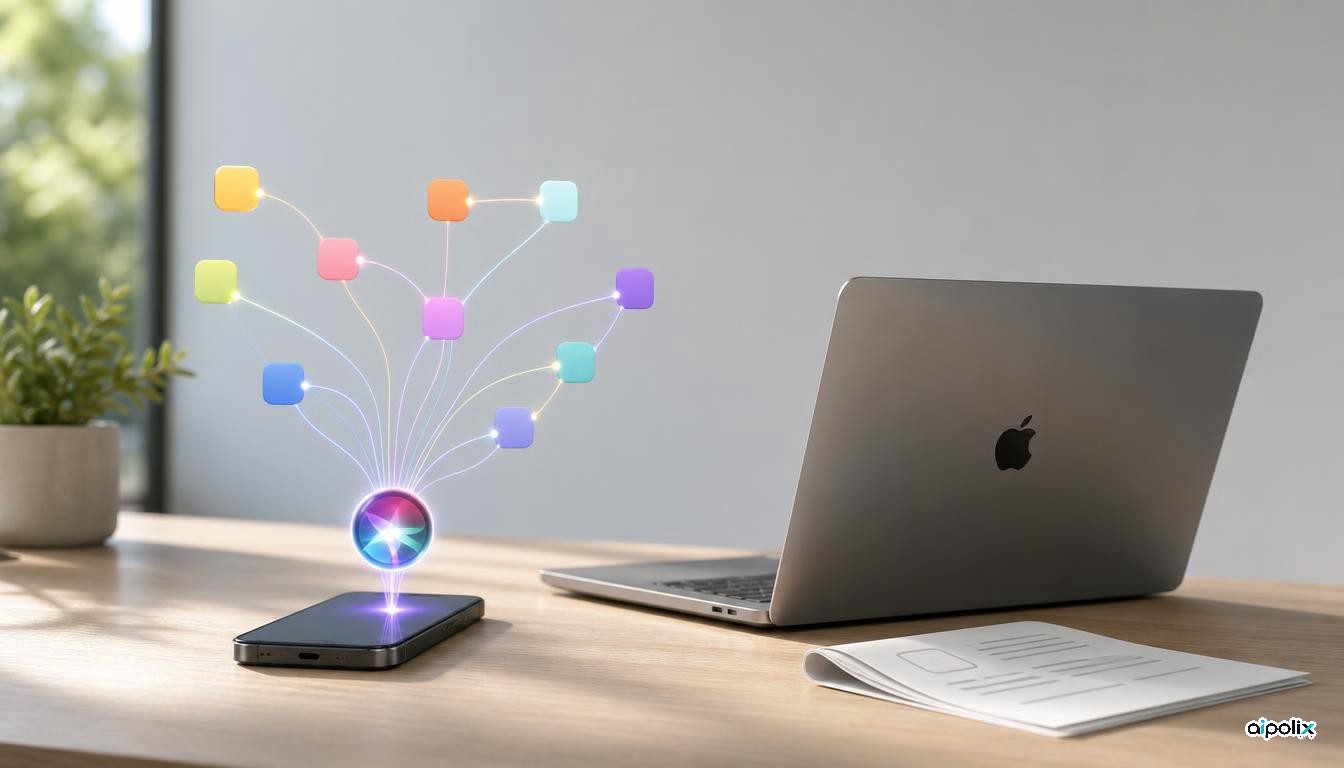
Apple has opened its rebuilt assistant to the whole developer community. On November 3, 2026 the company released a Siri AI Developer Preview inside the 27.3 betas of iOS, iPadOS, macOS and visionOS, allowing any app to plug its own actions and content into Siri AI through the App Intents framework. Until now, Siri AI could act mostly on data and functions that fit system-defined app schema domains, a narrower set that 9to5Mac describes as the main limit of the first release.
The practical change is that custom actions become something the model can choose and run. Apple's documentation calls them tool intents: an app marks an intent as a tool, and Siri AI can call it when a request needs it, drawing on personal context, onscreen awareness and ordinary natural language. Apple's examples include checking a delivery, booking a reservation and placing an order. People will not always have to name the app. If it is in the foreground, has an active Live Activity, or was mentioned earlier in a Siri conversation, Siri can infer it, and Apple's ride-share example moves a pickup address mid-trip. Siri can also pull content from one app and hand it to another, and show results in card snippets built from the developer's own views.
For requests that need several steps, Apple is introducing app skills. Each skill is a folder containing a SKILL.md Markdown file, placed in a single Skills.skillsbundle per app target, that tells Siri how a group of tool intents fits together, which one to prefer and what to avoid. Apple is explicit that skills are guidance rather than scripts: they cannot enforce deterministic behavior, and Siri does not simply execute the listed intents in order. Siri AI can also now surface any entity in the Spotlight semantic index, not only those matching an existing schema.
Apple is shipping testing tools alongside the APIs. A Siri Integration Advisor in Xcode suggests improvements to App Intents code, and a new SiriEvaluations framework lets developers script requests, measure how Siri handles them and catch regressions as intents change. No new entitlement or separate program is required. The same capabilities are rolling out across Apple's own apps, among them Calendar, Files, Mail, Maps, Messages, Notes, Photos, Safari and Shortcuts.
The preview is fenced off from real users for now. Integrations work only in development builds and for internal TestFlight testers, not for external testers or App Store versions. Apple says the features will first ship to customers in a few months, that App Store submissions open in the spring, and that terms and usage policies for Siri AI experiences will follow. Siri AI itself runs in English, French, Japanese, Korean, Portuguese and Spanish, is not available in the EU on iOS, iPadOS and watchOS, is not offered to users under 13, and is subject to daily usage limits that Apple says will be expandable for a fee later.
The Verge and 9to5Mac both covered the announcement on the day, highlighting that users can skip naming apps in many situations and that app skills bring Siri closer to what other model-driven assistants already do. Apple is running online labs for developers on November 4 and 5.
For developers, this is the moment Siri becomes a real distribution channel for app functionality rather than a fixed menu of intents. It also hands Apple a familiar agent design, tools plus natural-language skills, across a very large installed base. How reliably Siri picks the right tool, how app makers will be credited or charged, and how the EU gap is resolved remain open until the terms arrive and the features leave beta.