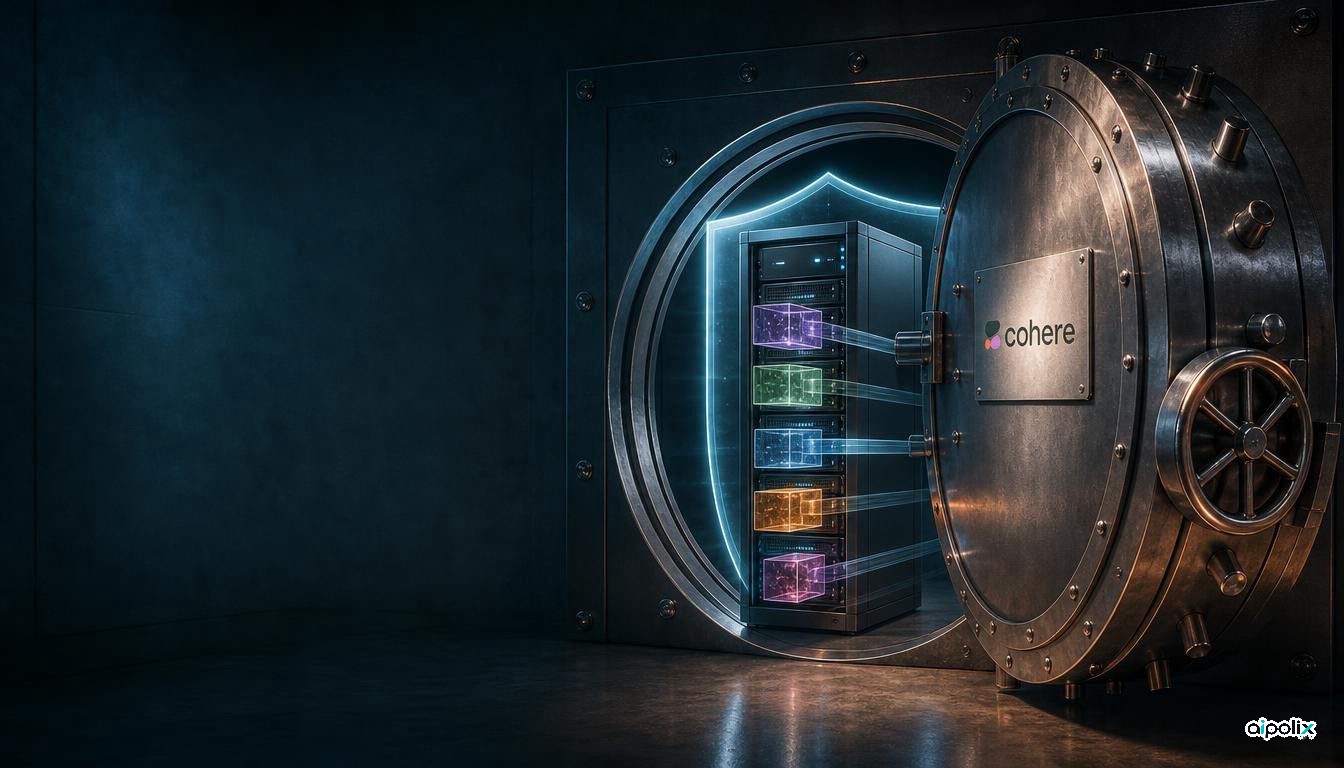
Cohere is turning its private inference service into a home for other companies' models. On November 3, 2026 the Canadian AI company said Model Vault, its managed platform that gives each customer an isolated deployment, now serves leading third-party open models alongside Cohere's own. The list includes DeepSeek V4.1 Flash, GLM 5.3 Flash from Z.ai, Xiaomi's MiMo V2.6 Pro, Google's Gemma 4, NVIDIA Nemotron, OpenAI's GPT-OSS, Microsoft's Phi and Tencent's Hy3, and Cohere's documentation also mentions Qwen.
The pitch is aimed at banks, hospitals and government departments that cannot send sensitive data to a shared API but also lack the staff or capacity to host open models themselves. In Model Vault, workloads run on single-tenant infrastructure in a region the customer chooses, Cohere operates the serving stack, and prompts and outputs are not retained by default. Customers set minimum and maximum replicas, can turn on autoscaling, and, according to the documentation, avoid shared rate limits.
Not every model is available at the highest protection level. Model Vault Encrypted keeps data encrypted while it is processed, using confidential computing in hardware-backed trusted execution environments with remote attestation, and Cohere says neither it nor the cloud provider can see prompts or responses. In that tier the supported models are Cohere's Embed, Rerank, Parse, Transcribe and Translate plus Gemma, GPT-OSS and Phi. Cohere's Command models and the DeepSeek, GLM, MiMo, Nemotron and Hy3 families run only in the standard vault for now.
Availability differs by tier. Model Vault serves customers in the United States, the European Union and Canada, while the Encrypted version is live only in the US, with EU and Canadian serving described as coming soon. Pricing is per GPU per hour, with reserved capacity and monthly or annual commitments sold through Cohere's team. The company lists new regions and larger models in the Encrypted tier as next steps.
The move builds on October's public beta of confidential inference in Model Vault, when Cohere let customers verify the hardware before sending sensitive prompts. Opening the platform to rival model families is a notable shift for a company whose sovereignty argument had centered on its own models. Cohere frames it as letting customers pick the best model per task without giving up control over where data lives or who can see it, and quotes RWS's Language Weaver unit as a customer using Model Vault for its own LW Pro model.
For enterprise buyers, the practical effect is one managed, isolated stack for both Cohere and popular open-weight models, which may simplify compliance reviews compared with operating several inference providers. Security and retention guarantees are Cohere's own statements; the announcement includes no independent audit results, no performance comparisons for third-party models on its infrastructure and no published GPU prices in the post itself, which points readers to Cohere's pricing page.