
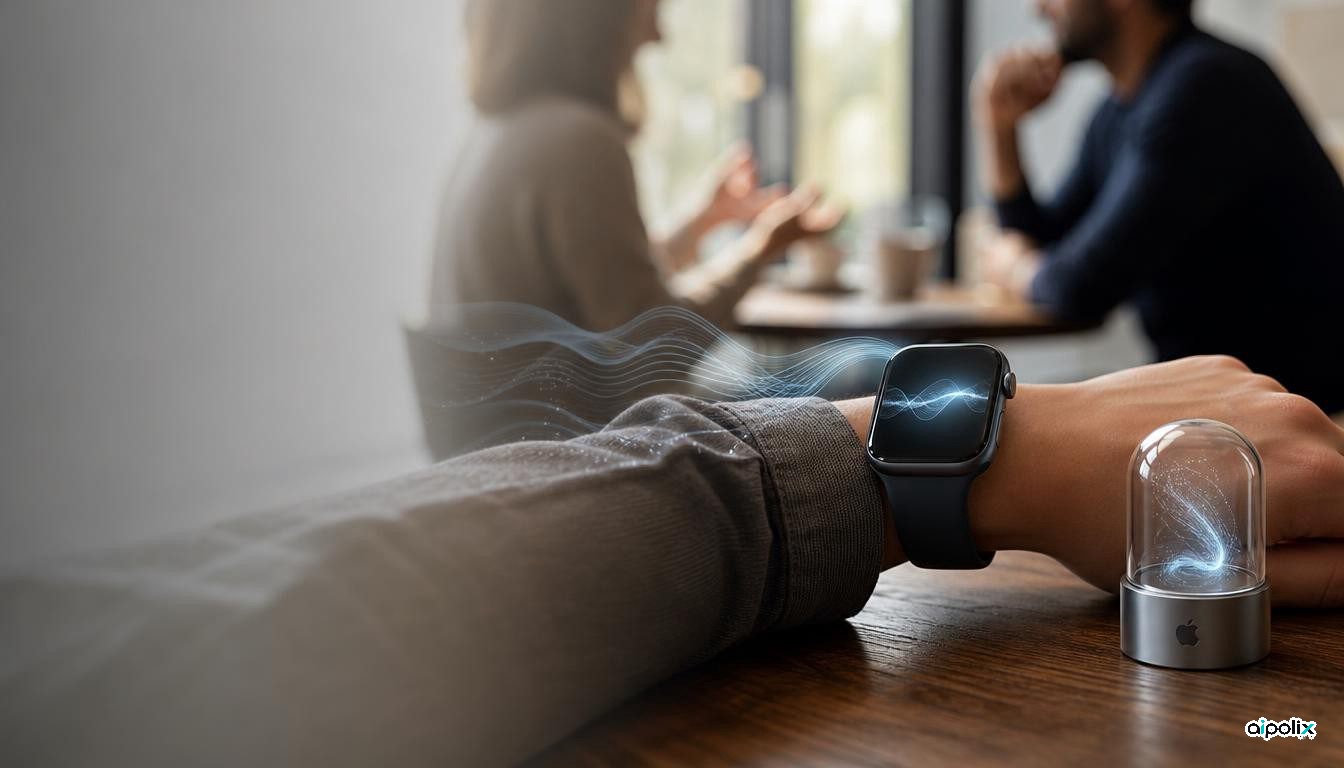
Apple has started testing the most sensitive part of its new Apple Watch software. On November 3, 2026 the company released the 27.3 developer betas of watchOS and iOS, and with them the Audio Intelligence features it first showed in September for Apple Watch Series 12 and Apple Watch Ultra 4. Two of those features listen to the people around the wearer, which makes this beta the first chance for outsiders to see how Apple's privacy promises hold up in practice.
Audio Intelligence bundles four opt-in tools. Sound Recognition alerts the wearer to sirens, alarms or doorbells, even without an iPhone nearby, and is pitched mainly at deaf and hard-of-hearing users. Music Recognition uses Shazam to put the name of a song playing in the background into the Smart Stack. Live Rewind and Siri Recap are the new conversational features, and they are the ones drawing attention.
Live Rewind works only on demand. A double-press of the Digital Crown shows the last 15 seconds of speech as a text snippet, which the wearer can dismiss, save to the Siri app or question through an Ask Siri option. According to TechCrunch, the gesture also plays a chime and shows an animation so people nearby can tell something was captured. Apple's support page says an unsaved snippet disappears roughly 30 seconds after the display dims. Siri Recap goes further: when switched on, manually or on a time or location schedule, it takes ambient notes during the day and produces a short Apple Intelligence summary with key points, which can be kept or left to delete itself within seven days.
Apple frames the design around what is never kept. Its documentation says the features make no audio recordings, that sound flows into a protected buffer in the Secure Exclave of the watch's S11 chip, and that for Siri Recap the encrypted audio is passed to the iPhone's Secure Exclave, transcribed there and condensed before Private Cloud Compute writes the summary. Recaps do not identify speakers, are not transcripts, and are designed to leave out items such as financial data, government identifiers and language promoting self-harm. Saved recaps and snippets sync end to end encrypted through iCloud when two-factor authentication and a passcode are set.
The rollout comes with tight limits. Live Rewind and Siri Recap launch in English only, will not initially be offered in the EU, are not available in China and are blocked for users under 18. Apple also says features that rely on server-side models face daily usage caps, and they require Apple Intelligence, the Siri AI beta and a supported iPhone.
The timing was messy. TechCrunch reported that the news first went out through an emailed release from Apple's communications team in India early on Tuesday, before the betas appeared in the United States later that day. The Verge then confirmed that the watchOS 27.3 developer beta includes both conversational features, and that Apple has published a dedicated Audio Intelligence privacy overview.
For now this is a developer test, not a consumer launch, and Apple has not given a public release date. The privacy guarantees are Apple's own description of its architecture; outside researchers have not yet assessed them, and the social question of wearables that listen to bystanders will not be settled by a beta. What the release does show is how far Apple is willing to push ambient AI on the wrist, and how many guardrails it has placed around it.