
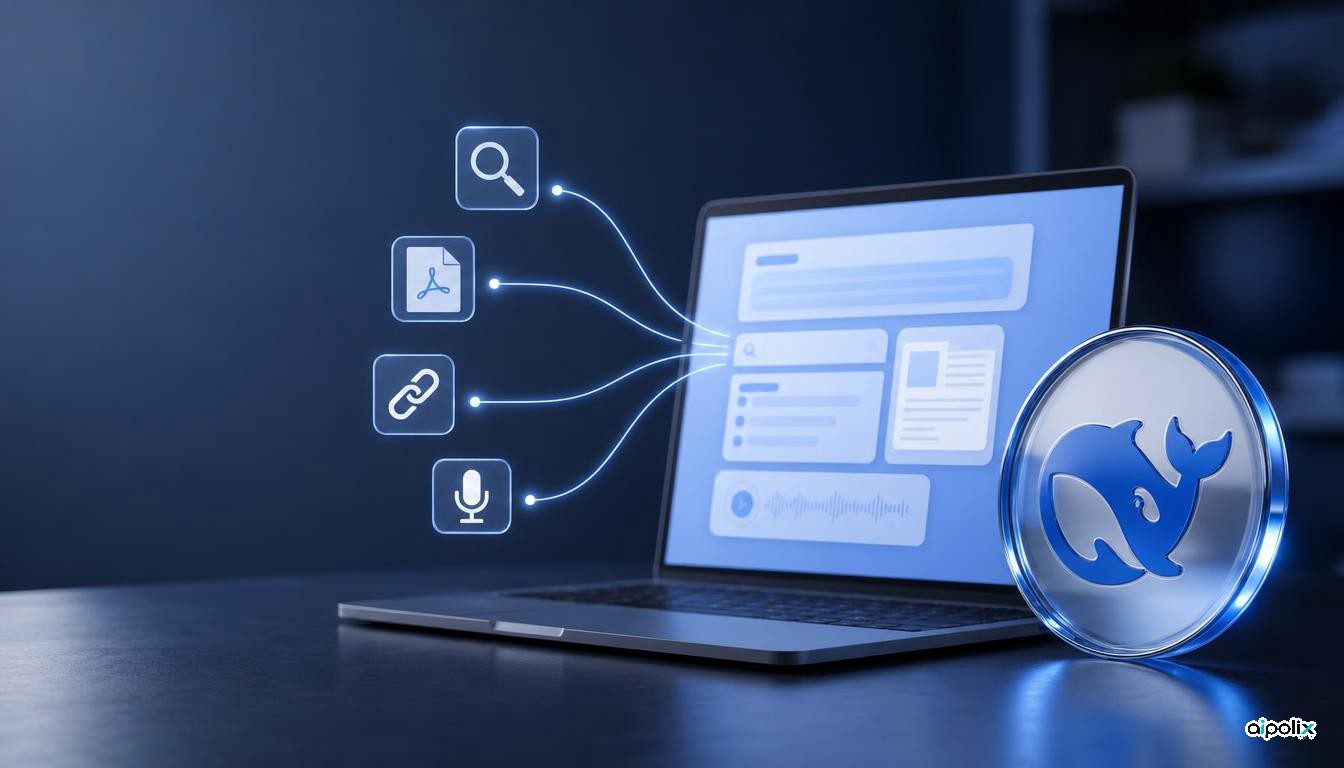
DeepSeek has opened the feature set of its own chat app to outside developers. In an announcement on its API documentation site dated November 13, 2026, the company said the search, file handling, link reading, safety screening and voice functions that power the DeepSeek App can now be called through the DeepSeek API, and it pitched the change as a way for developers to recreate the full app inside their own products.
The capabilities run on V4.1-Flash, exposed as the deepseek-flash model, and work across three API styles: the Anthropic-compatible Messages endpoint, Responses and Chat Completions. Developers switch them on with parameters rather than wiring up their own tools. With thinking disabled and the deepseek_web_search tool enabled, the model decides when to search the web or images and answers with citations. With thinking enabled, the same tool lets it search and read pages over several reasoning steps, which DeepSeek calls deep thinking search. A separate deepseek_read_url tool fetches links that appear in a user's message. File input accepts PDFs, Word and PowerPoint documents and images, which are parsed into the conversation context.
The architectural choice is the notable part. DeepSeek's chatbot guide says the service itself runs the searches and page fetches and assembles the context; the client only displays the returned blocks and passes them back unchanged in the next turn. That removes a layer of orchestration code that app builders usually write themselves, but it also means the tool loop runs on DeepSeek's side rather than under the developer's control.
DeepSeek also split the underlying pieces into standalone APIs: Search and Fetch, OCR, speech recognition (ASR) and text-to-speech (TTS). A safety-check parameter reviews model input and output and returns a refusal marker when it flags a risk. The company says public-facing apps must enable it and that developers remain responsible for content moderation, model registration where it applies and labelling of AI-generated content. Tool calls are billed on top of normal token charges.
To show the pieces working together, DeepSeek published deepseek-ai/chat-demo on GitHub under the MIT licence. The repository was created on November 12 and had about 3,700 stars by November 16. It is a static browser app with no backend: it stores the user's API key and settings in localStorage and conversations in IndexedDB, supports streaming, deep thinking, search with citations, attachments, voice input and read-aloud, and can import chat history exported from DeepSeek's own app. DeepSeek describes it as being for demonstration only.
Independent coverage has focused on the limits. Writing for Tech Times on November 16, Terrence Hill noted from DeepSeek's guides that speech recognition accepts at most 120 seconds of audio per request and does not stream, that text-only file parsing drops charts and images while the richer layout mode may miss some figures, and that the guides name no model behind the OCR and voice services. He also pointed out that routing search queries, documents and audio through a single Hangzhou-based provider puts all of that data under one legal jurisdiction. Korea's TokenPost, in a report by Simon Yoon, described the update as an expansion of DeepSeek's developer API around search, file and voice features.
The release turns DeepSeek's API from a bare model endpoint into something closer to a bundled platform, aimed squarely at developers building agents and retrieval apps who want search and document handling without maintaining their own pipelines. How useful it proves will depend on pricing, on the quality of a search index whose size DeepSeek has not documented, and on whether teams are comfortable handing tool execution and data flows to the vendor.