
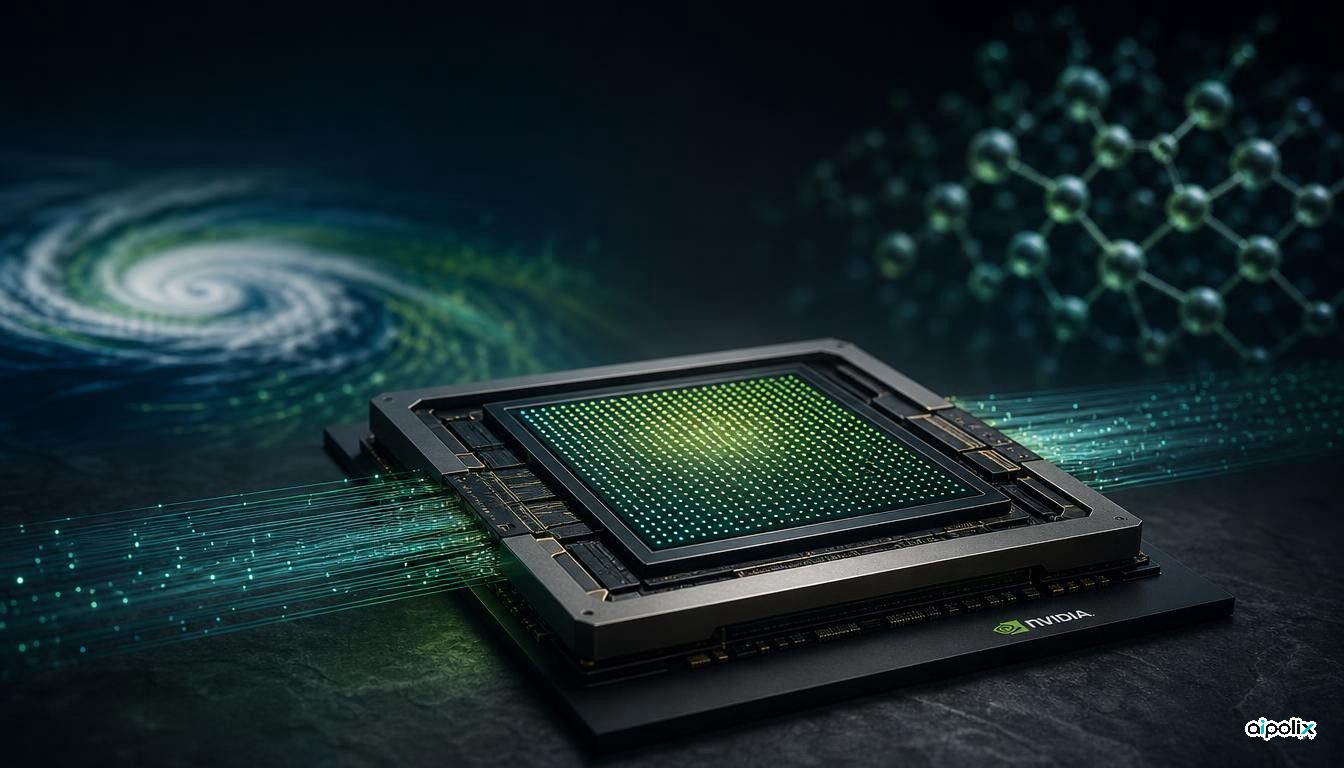
NVIDIA announced Rubin HPC on November 16, 2026 at the SC26 supercomputing conference. In a blog post by Dan Ernst, the company describes it as a new GPU in the Vera Rubin platform, designed to speed up simulation and data processing for science, engineering and analytics. NVIDIA says it expects Rubin HPC to be available in 2028.
The pitch rests on a hardware balance rather than a single number. NVIDIA says the chip carries more than 50,000 CUDA cores on one GPU, which it calls a record. It pairs them with what it describes as a sparse data acceleration capability, meant to keep those cores supplied with data, and with seventh-generation NVLink for faster GPU-to-GPU connections. The company frames this as scaling data movement and compute together instead of adding compute alone, so that the cores spend their time calculating rather than waiting.
NVIDIA argues that many scientific workloads share the same shape. An application reaches into a very large dataset, gathers a handful of scattered values, computes a result and repeats the process at enormous scale. Climate models, engineering simulations, genomic analysis and financial risk all fit that pattern, according to the post. NVIDIA lists sparse matrix operations, stencil computations, sorting and reductions as recurring patterns that a design built around data movement should accelerate across fields.
The blog ties the chip to the company's agent story. As AI agents help scientists and engineers explore more candidate materials, molecules and designs, those candidates need to be tested in simulation, which raises demand for GPU-accelerated simulation. NVIDIA says CUDA-X libraries already offer optimized implementations of algorithms that agents can call, and that together with Rubin HPC they would shorten the loop of hypothesis, simulation and refinement. Ian Buck, NVIDIA's vice president of hyperscale and high-performance computing, said faster simulation means faster discovery for agents working on science and engineering.
What the announcement does not include matters for readers planning purchases. The post gives no benchmark results, no memory capacity or bandwidth, no power figures, no pricing and no named system partners. The core claims, including the record core count and the benefits for agent-driven workflows, are NVIDIA's own and have not been independently measured. With availability set for 2028, the announcement signals direction for the high-performance computing roadmap more than a product that buyers can evaluate today.
NVIDIA made several other SC26 announcements on the same day, including Nemotron for Science, which is covered separately.