
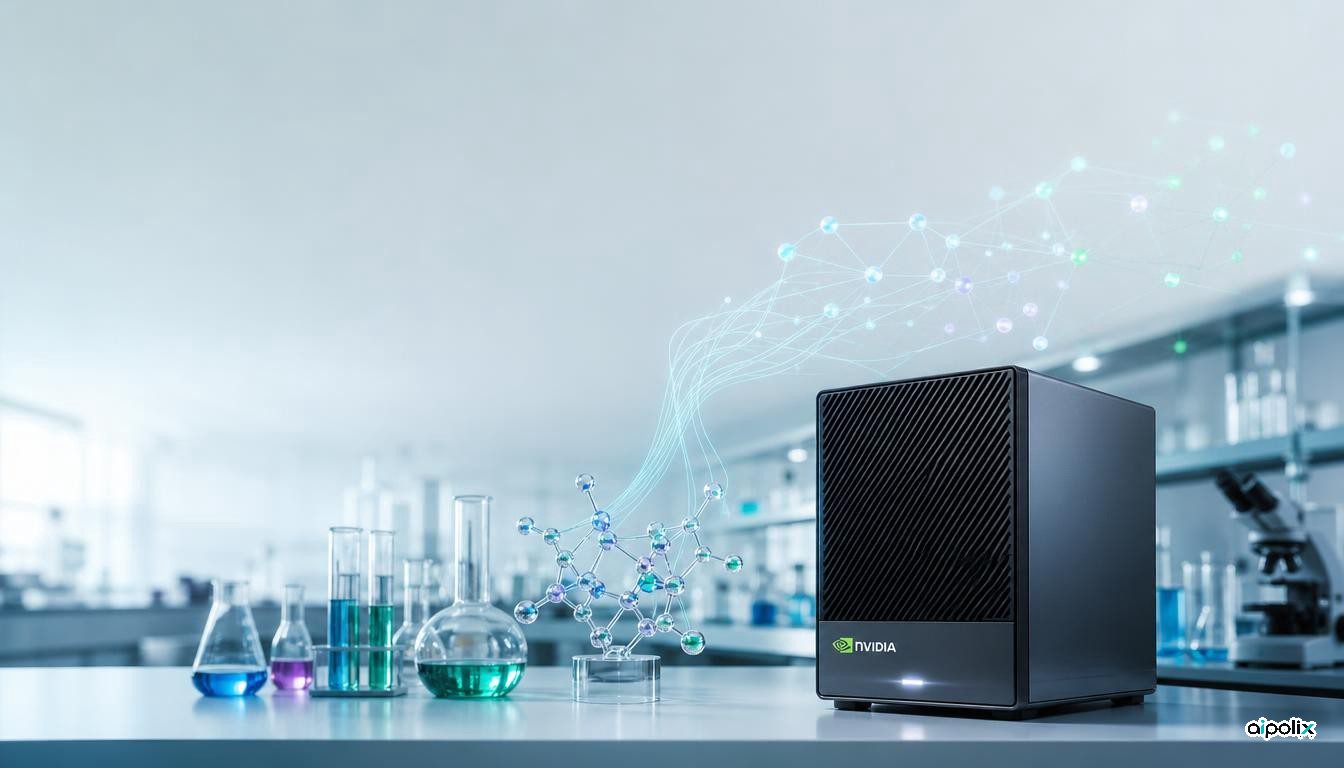
On November 16, 2026, NVIDIA introduced Nemotron for Science, a package aimed at researchers who want to build specialized agents for scientific work. It brings together scientific applications of the company's Nemotron 3.5 Super VL open model, evaluations, a new open chemistry dataset and post-training recipes. NVIDIA says researchers can adapt the model to tasks such as chemistry experiments and protein design, then place it in agent workflows that read scientific material, write code and call computational tools, including NVIDIA's CUDA-X accelerated libraries.
The dataset is LitmusBench v0.2, which NVIDIA describes as nearly 50,000 questions for training and evaluating language models on chemistry reasoning. It draws on molecular properties and experimental drug discovery data, and it is meant to improve how well models predict how molecules behave, including their solubility and how the human body processes them. NVIDIA says Nemotron 3.5 Super VL and LitmusBench v0.2 are available now on Hugging Face, and that the model has been optimized to run locally on a 128GB NVIDIA DGX Spark system.
The company points to three life-science users, and all of these results come from NVIDIA's announcement. Terray Therapeutics post-trained the model to extract reactants, products and reaction conditions from scientific diagrams and says it recovered about 76 percent of annotated reactions on the RxnScribe test, beating previously published results on two benchmarks. Lila Sciences used it to design lab protocols for its automated labs and says post-training with laboratory feedback nearly doubled accuracy on making quantum dots to 61 percent, against 54 percent for GPT-6 Astra at 10 to 20 times lower inference cost. Therna says post-training for mRNA therapeutic design nearly doubled accuracy in predicting protein-expression ranges compared with frontier models, and that scientists preferred its explanations to the base model's in 96 percent of comparisons.
Research institutions are also named. Argonne National Laboratory is integrating Nemotron into its StructBioReasoner multi-agent system for designing and evaluating protein-based therapeutic candidates. KTH Royal Institute of Technology built an agent that repairs broken GROMACS molecular dynamics setups, and NVIDIA says that in one overnight run on a single DGX Spark with reasoning enabled it fixed 81 percent of test cases, with each fix checked by GROMACS itself. RIKEN is offering Nemotron, including Nemotron 3.5 Super VL, on its RIKYU AI supercomputing platform through its RiVault inference gateway, and Jülich Supercomputing Centre is integrating it into drug and scientific discovery agents.
Ian Buck, NVIDIA's vice president of hyperscale and high-performance computing, said the package gives researchers open models, scientific data and post-training recipes to build agents that reason through scientific problems and use CUDA-X tools.
The release is a first-party announcement, and the benchmark comparisons, cost ratios and accuracy figures have not been independently reproduced. The comparison with GPT-6 Astra, for instance, comes from Lila Sciences' own task and an NVIDIA-reported figure. For builders, the verifiable pieces are the open weights and dataset on Hugging Face, which others can now test on their own scientific tasks.