
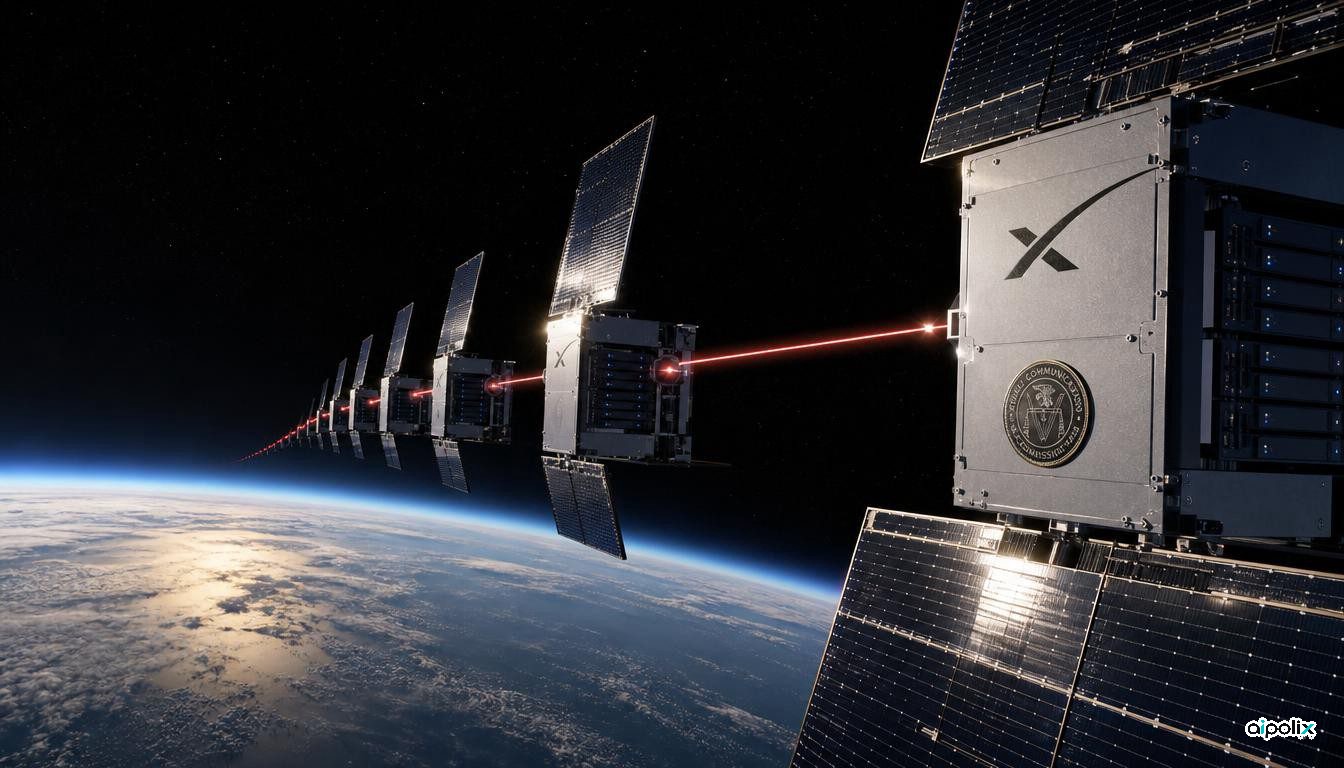
The U.S. Federal Communications Commission has authorized SpaceX to deploy up to one million satellites designed to work as data centers in orbit, the first time the agency has approved a full constellation built for AI computing. The order, adopted and released by the FCC's Space Bureau on November 25, 2026 as DA 26-1273, covers SpaceX's Starmind system and was announced by Chairman Brendan Carr.
The license is narrower than the headline number suggests. What the FCC formally granted is radio spectrum for backup and emergency telemetry, tracking and command in two Ka-band ranges, 18.8 to 19.3 GHz downlink and 28.6 to 29.1 GHz uplink, on an unprotected, non-interference basis. SpaceX plans to run the satellites' main traffic over optical laser links, including connections into Starlink, and asked for radio only as a fallback if those links fail. The order still requires coordination with federal and national security systems before some of that spectrum is used.
The planned constellation is spread across shells between roughly 500 and 1,002 kilometers, in 30-degree and sun-synchronous orbits. SpaceX told the regulator that near-constant solar power would let the satellites deliver far better cost and energy efficiency than ground data centers, and it intends to build chips for them at a planned Terafab facility, according to The Verge. The FCC framed the approval as a way to meet surging demand for AI compute and to strengthen American leadership in space and AI.
Instead of the old rules, the FCC applied its newer milestone schedule. SpaceX must have its first authorized satellite operating by November 25, 2033, 100,000 by 2035, half the constellation by 2038 and all of it by 2040, or the authorization lapses for the undeployed portion. The bureau deferred SpaceX's request to dispose of satellites above 600 kilometers in alternative orbits instead of through atmospheric re-entry, saying the company had not supplied enough information; SpaceX must file a modification before launching any satellite that will not re-enter.
The decision overrode petitions to deny from Amazon's Kuiper unit, now Amazon Leo, Viasat and the American Astronomical Society. The FCC dismissed environmental and optical-astronomy concerns as outside its authority. Amazon had argued in March that the plan was an ambition rather than a real program and that it would take SpaceX centuries to complete; Carr publicly rebuked Amazon at the time. CNBC quoted critics warning about light pollution and the risk of cascading debris collisions.
Scale remains the central uncertainty. According to NBC News, only about 17,000 satellites of all kinds circle the Earth today, and companies routinely file for many more than they end up flying; Starlink, for example, was licensed for 42,000 and has a little over 11,000 up. Starmind's economics depend heavily on the low launch costs SpaceX expects from its Starship rocket, which is still in development.
Others are pursuing the same idea. Google flew its first Project Suncatcher AI server satellite last month and has booked a dedicated Blue Origin launch for 2029, while Blue Origin has its own large constellation application pending. The Starmind order gives SpaceX a regulatory head start, but it does not resolve whether orbital computing can compete with terrestrial data centers on cost, cooling and reliability.