
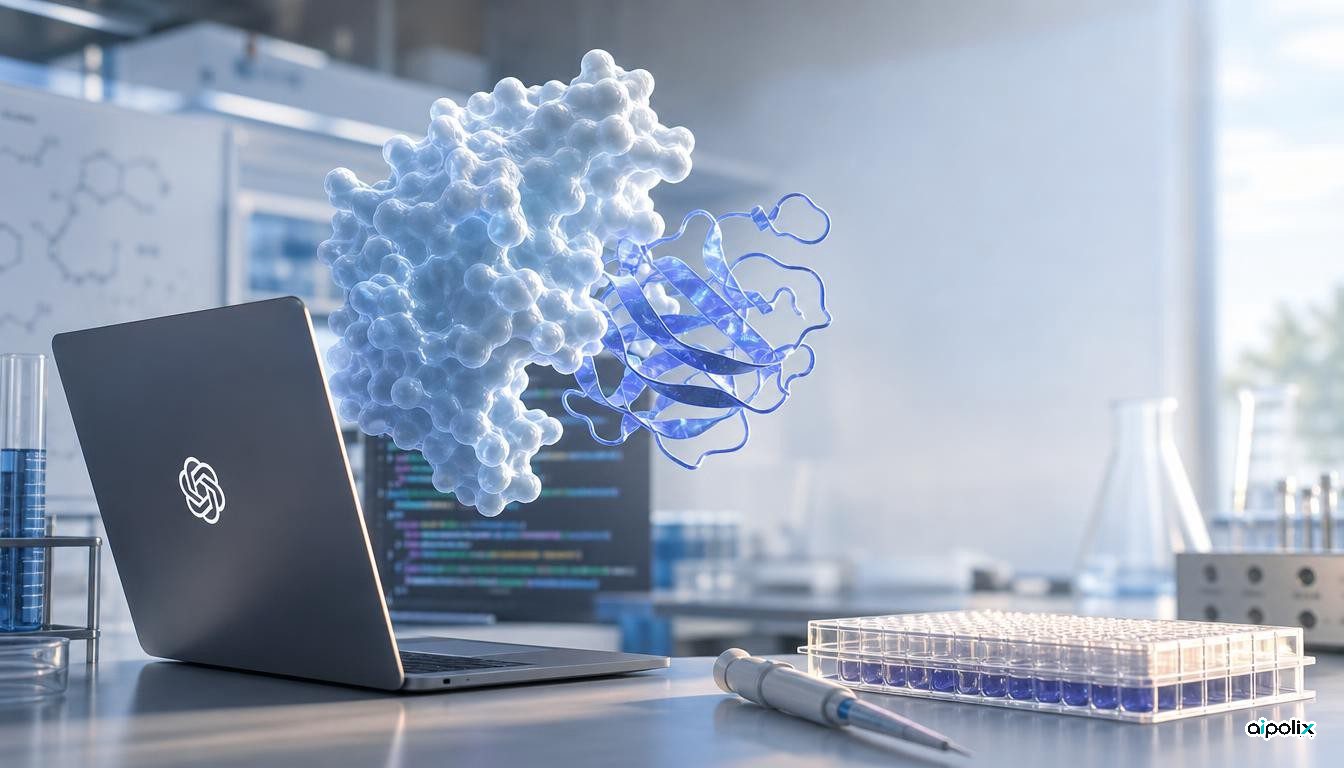
OpenAI said on November 24, 2026 that models in its GPT-6 family can design protein shapes and amino acid sequences on their own, using reasoning and ordinary coding tools rather than calling the specialized biology models that normally do this work. The company published a preprint, written with its Life Science Team and collaborators at Onava AI, that presents GPT-6 as a general foundation model for protein biology, and reports that designs produced this way were made and tested in a wet lab.
The central experiment asked a pre-release version of GPT-6.2 to invent small proteins, called minibinders, that latch onto a chosen target. Researchers supplied the target structure, marked the spot where attachment should happen, and let the model write code to propose three-dimensional backbones. Specialized tools still had a role: SolubleMPNN proposed the amino acid sequences for those backbones, and other protein models filtered which candidates were worth making. Of 322 minibinders tested against five targets, 35 showed evidence of binding, a rate of about 11%, with hits for PD-L1, IL-7Ra, TrkA, VEGF-A and IL-17A.
A second lab experiment reversed the task. Given structures of known binders with the original sequences withheld, GPT-6.2 proposed fresh sequences, and early screens showed 75 of 88 MDM2 designs binding, along with 26 of 42 for VEGF-A and 8 of 59 for PD-1. Several of those sequences differed from the withheld originals across roughly half their length. The team also redesigned the gripping loops of antibodies, where 128 of 182 designs kept binding to IL-4Ra and 179 of 272 fragments based on therapeutic antibodies still recognised PD-1 or PD-L1.
What makes the claim notable is the control surface rather than any single hit rate. Because the instruction is written in plain language, a researcher can ask for a particular binding interface, specify whether the new protein should be built from coils or strands, set how many of each, or pin down the chemical bond a small molecule forms with its target. OpenAI says the same model handled all of these without retraining, and reports near-perfect fidelity when told how many structural elements to include.
The company also publishes where the approach falls short. Predicting a full protein structure from sequence alone remains much weaker than dedicated predictors: average TM-score rose from 0.16 for GPT-5.6 to 0.26 for GPT-6.2 and 0.38 for an unreleased internal model, against roughly 0.93 for ESMFold2. OpenAI notes that some sequence-from-structure results may partly reflect memorised data or artefacts of how the test structures were produced, and that its own design campaign leaned on Boltz-2, OpenDDE and ESMFold2 to screen candidates, so end-to-end design without specialized help is not established.
Independent validation is thin at this stage. The lab work was carried out by Onava AI, a research partner named as a co-author, and the binding numbers have not been reproduced outside that collaboration. Binding is also only the first hurdle for a drug candidate, since specificity, stability, manufacturability and biological effect all come later. OpenAI acknowledges this and says the work falls under its Preparedness Framework because protein design capability carries biosecurity risk alongside medical promise.
For people building on these models, the practical signal is that a general reasoning model now sits close to task-specific tools at two stages of the protein design pipeline, backbone generation and sequence redesign, while still trailing badly at global structure prediction. That jagged profile matters more than a headline about artificial intelligence designing drugs, because it tells research teams which steps they can hand to a prompt and which ones still need the established specialized stack.