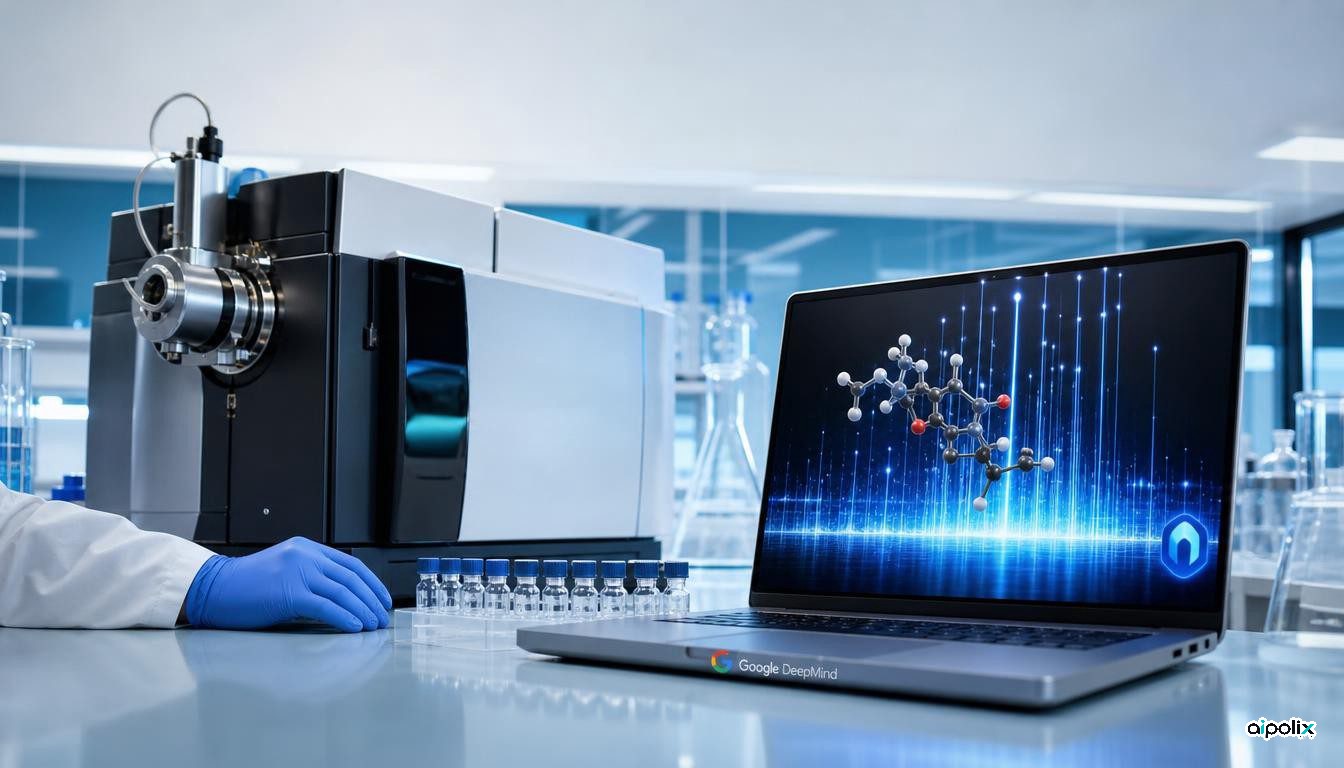
Google DeepMind has released Mass Spec Skills, a set of add-on skills for its Google Antigravity agent app that helps chemists work out which molecules produced the signals in a tandem mass spectrometry (MS/MS) run. Announced on November 24, 2026, the plugin lets Gemini drive established open-source chemistry software and public databases, then present its reasoning so a scientist can check each step.
The problem it targets is well known in metabolomics. A modern instrument can pick up tens of thousands of small-molecule signals in one sample, but matching spectra against reference libraries labels only about 5% of them on average, around 10% for human samples, according to DeepMind. Many of the unlabeled compounds already sit in chemical databases; nobody has recorded their spectra, so the structure has to be inferred from the fragments. Experts know the routine for doing that, but running it by hand for thousands of spectra is not realistic.
Mass Spec Skills packages that routine. The agent can clean a raw recording with matchms, search the GNPS and MoNA spectral libraries, estimate a molecular formula with SIRIUS, rank candidate structures from PubChem with MAGMa and MetFrag, and confirm the final answer with RDKit. Researchers describe the task and instrument tolerances in ordinary language, and the agent picks and chains the tools. Each step can also be called separately, for example just to denoise a spectrum or compare two isomers.
DeepMind's worked example is a negative-ion spectrum with no library match. The agent arrived at the formula C20H21ClN6O, pulled all 845 matching isomers from PubChem, and found that several fit the peaks equally well by mass. It then used fragmentation chemistry, specifically paired losses of hydrogen chloride and isocyanic acid that point to a central urea bond, to discard candidates that could not break apart that way and settle on a top structure.
The company also reports a benchmark on 100 compounds drawn from the Enamine REAL collection in MoNA, three attempts each. Without internet access or skills, Gemini 3.8 Flash, Gemini 4 Argon and Gemini 4 Carbon all stayed below 4% exact-match accuracy. With web access but no skills, hand-written search scripts broke often enough that the two frontier models failed on 25% to 33% of spectra and Flash failed on over 75%. With the skills installed, all three identified and verified the exact molecule in about 97% of attempts, and the lightweight Flash model matched the larger ones. DeepMind says the skills also cut generated tokens per attempt, by close to four times for Flash.
The plugin is available now in the Antigravity app, including for enterprise users signing in with Google Cloud credentials. DeepMind is also offering 10,000 scientists the top Antigravity usage tier free for six months, subject to eligibility and capacity. Researchers at the Technical University of Denmark and Princeton who tested it are quoted praising the speed and accessibility.
The limits are stated plainly. The benchmark covers compounds that already have reference spectra, so it measures retrieval and verification rather than discovery. Mirror-image molecules and some close isomers fragment almost identically and need other measurements such as retention time, ion mobility or NMR. For genuinely new natural products that are absent from every database, the agent can only propose a formula and partial structure as a starting point. All performance figures come from DeepMind's own evaluation.