
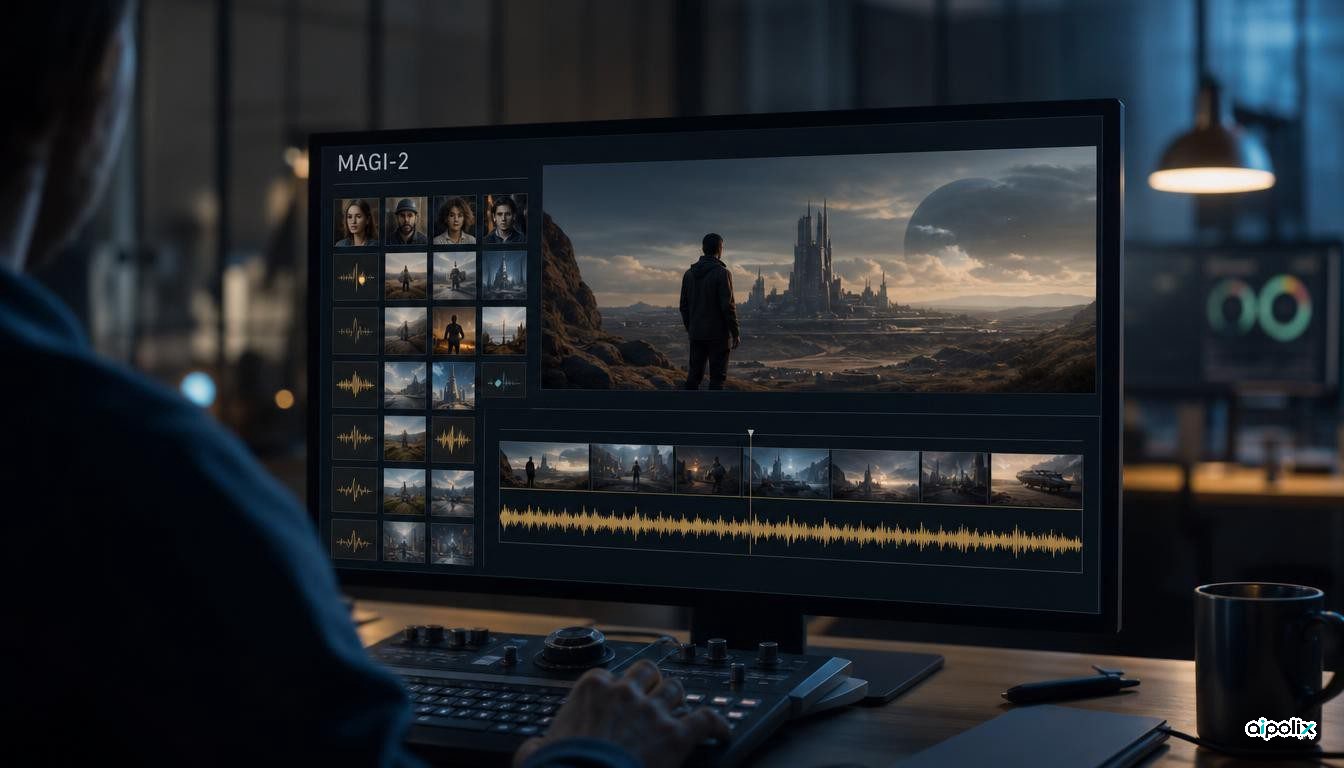
Sand.ai has released MAGI-2, the full-scale version of a video generation model it first showed as a research preview in August. The company's announcement, dated November 24, 2026, describes a mixture-of-experts system with 480 billion total parameters, of which roughly 28 billion are active for any given token, trained to produce video and sound together in a single pass. Chinese business outlets Beijing News and Beijing Business Today covered the launch on November 25, and the creative platform Higgsfield is offering the model to its users as a premiere partner.
The headline capability is length and fidelity in one generation. MAGI-2 produces clips of 4 to 30 seconds at 1080p and 25 frames per second, in six aspect ratios, with dialogue lip-sync, sound effects, ambient audio and music generated by the same backbone rather than added afterwards. A single request can combine up to 20 references: ten images, five video clips and five audio clips, used for example to fix a character's look, demonstrate a camera move and set a soundtrack. Users can place start and end frames, describe cuts at specific moments, and edit existing footage. According to the Chinese reports, prompts can run to 20,000 characters.
The scale-up is large. The August preview had about 114 billion total parameters and 6 billion active; Sand.ai says MAGI-2 is more than four times bigger and was pre-trained on roughly 4 trillion tokens, about three times the earlier data, after an annotation pipeline that labelled around one billion samples in three weeks. The architecture it credits for making this practical is Multi-Head Latent MoE, which splits each token into independent heads with their own routers and expert pools. That lets the training system exchange data between GPUs in fixed-size blocks before routing, so communication no longer grows with the number of experts selected. Sand.ai reports about a 22% training speedup over a single-head LatentMoE design at matched compute.
On quality, the company cites a 4-task average Elo of 1150.3 on Artificial Analysis Video Arena v2.1, up 151.8 points from the preview's 998.5, and Beijing News reported that the model reached first place on that leaderboard. Those figures come from Sand.ai and have not been independently reproduced. Price may matter as much as rank for commercial users: both Chinese outlets report a rate of 0.5 yuan per second of 1080p output, so a full 30-second clip costs about 15 yuan, and Beijing News adds the company's comparison that this is one tenth of the price of ByteDance's Seedance 2.5. Beijing Business Today also reports that MAGI-2 has been adapted to run on domestic accelerators from Hygon and Moore Threads.
The most unusual section of the announcement concerns behaviour Sand.ai says it did not train for. Probing the 480B pre-trained checkpoint with prompt rewriting switched off, the team saw early signs of visual puzzle solving, including filling in 9x9 Sudoku grids that obey the rules, of planning shots and reactions from a few story beats, and of translating dialogue into another language. After fine-tuning on several thousand curated clips, visual polish improved but those behaviours became harder to trigger. The company compares this to the alignment tax seen when language models are post-trained, and says it will evaluate general capabilities separately from aesthetics in future.
Openness is the main caveat. Sand.ai says it will open-source MAGI-2 and publish a full technical report, as it did for the preview, but gives no date or licence, so for now the 480B model is reachable only through hosted access such as Higgsfield and Sand.ai's own service. The company also lists known weaknesses: artifacts in very fast motion, overly smooth movement in mid and wide shots of 2D animation, and soundscapes that still lack layering.
If the weights do arrive, MAGI-2 would be one of the largest openly released video models and a direct test of whether sparse scaling lessons from language models carry over to audio-video generation. Until then it is best read as a strong, attributed claim from a lab with a record of publishing its earlier models.