
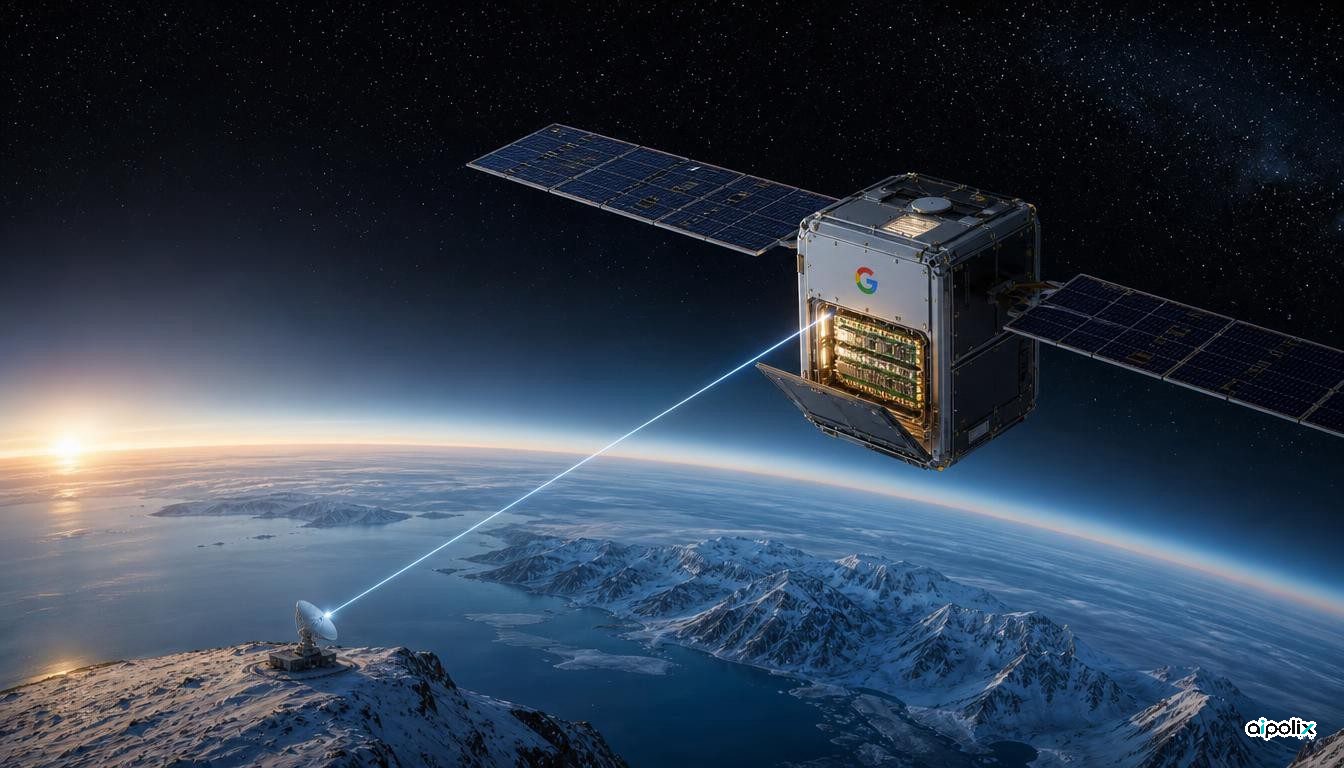
Google's experiment in putting AI chips into orbit has reached its first working milestone. In a Google Research post on October 30, Project Suncatcher lead Travis Beals said the prototype satellite launched four weeks earlier had completed commissioning and returned what Google calls the first AI response ever produced by a data center class TPU in space.
The test was deliberately modest. During a pass over a ground station, engineers sent a prompt to Gemma 4, the open model loaded onto the spacecraft, asking for a haiku about being in space, and the poem came back as the satellite flew over Svalbard in Norway. The team followed with space-themed limericks and with prompts asking the payload to report its own technical status. A Google spokesperson told TechCrunch the satellite was operating nominally. Before that, the commissioning checklist had involved powering up the host computer and the TPU trays and running early machine learning tests.
The hardware explains why the first job was a short poem. Built with satellite operator Planet on one of its standard platforms, the spacecraft carries four Google Tensor Processing Units and generates up to about 1 kW of power, according to TechCrunch. Only one TPU can run at a time, and only in short bursts: TechCrunch now puts them at about 20 minutes, while Google described 15-minute sessions at launch, to stay within the craft's power and thermal limits. NPR reported that this prototype sits in a standard orbit and relies on batteries, unlike the sun-synchronous design envisioned for later satellites, and that Google hopes to keep the mission running for a year.
The real purpose of the mission starts now. Google says the next round of tests will measure how the TPUs cope with thermal stress and radiation in orbit. Radiation can flip bits in memory and silently corrupt data, and TechCrunch reports that Google's earlier particle-accelerator tests on the ground suggested the effect would be small for inference but a bigger problem for training. If the chips hold up, Google and Planet plan to launch two satellites built more specifically for compute in 2027, with more power and laser links between them.
That second step goes to the heart of Suncatcher's design. Google's long-term idea is clusters of solar-powered satellites flying close together, each carrying many TPUs and exchanging data optically, so that they can share large workloads the way servers in a data center do. TechCrunch notes that this sets the project apart from rivals such as Starcloud and Cowboy Space, which plan to run inference on individual satellites, and from SpaceX's own plans, whose spacecraft are expected to orbit too far apart to pool processing.
The economics remain distant. In a peer-reviewed paper in Joule published alongside the launch, Suncatcher researchers estimated, according to TechCrunch, that SpaceX would need about 1,800 Starship flights to reach the learning-curve cost reductions such systems would require, and Google frames the effort as a moonshot aimed at infrastructure that could make sense in the 2030s.
For now the result shows only that a commercial AI accelerator can boot and serve an open model in low Earth orbit. Whether TPUs can run reliably for months under radiation, and whether orbital compute can ever compete on cost with ground data centers, are the questions the coming tests and the 2027 pair are meant to answer.