
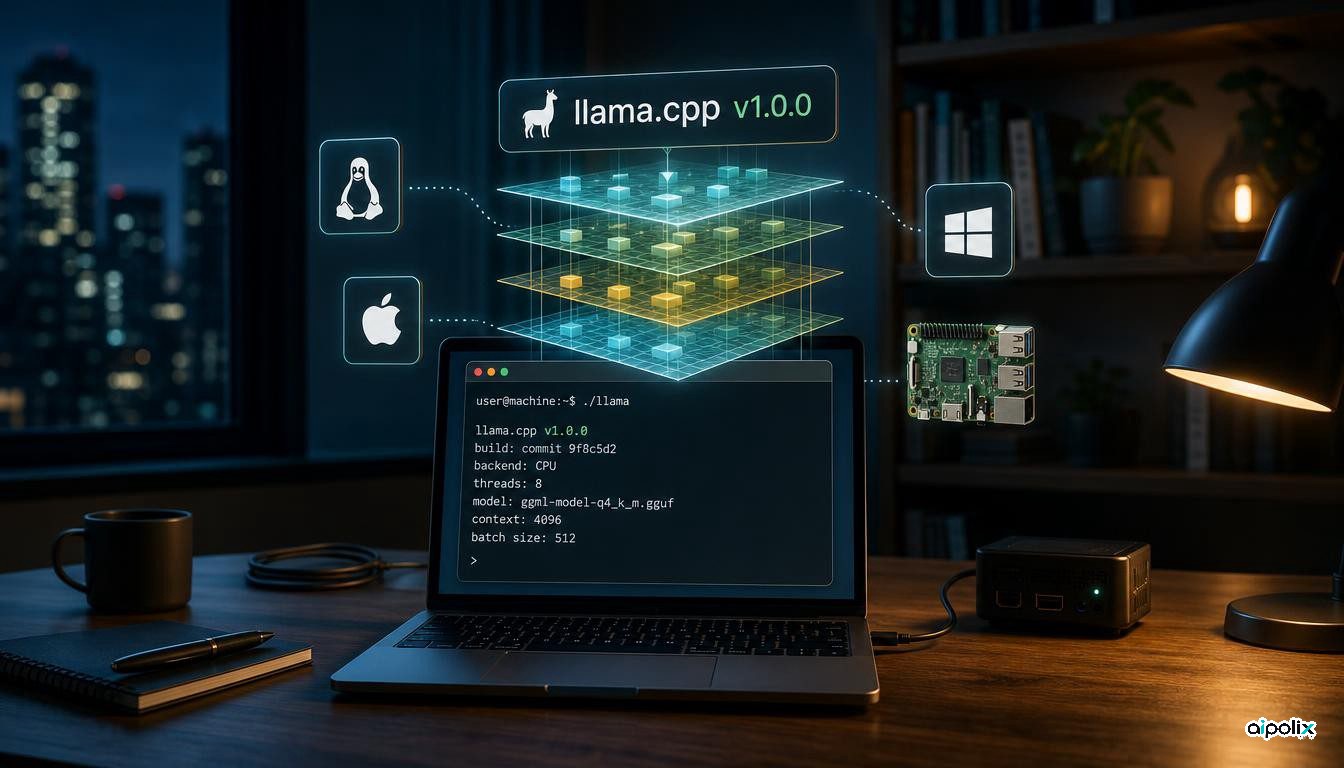
The team behind llama.cpp published version 1.0.0 of both llama.cpp and its underlying tensor library ggml on November 13, with a post on the Hugging Face blog written by Daniel Bevenius, Georgi Gerganov and merve. The number matters less than the promise attached to it. From now on, the projects say, changes that break the API or the binary interface will be signalled by a major-version bump, so that the many applications built on top of the libraries can see where the boundaries are.
llama.cpp is a C and C++ implementation for running language models, including multimodal ones, on hardware ranging from consumer laptops to enterprise servers, using quantization and optimized backends to make inference cheap. The team says the project is about three and a half years old and that many downstream applications already depend on it. Version 1.0.0 applies to the two libraries, libllama with its public headers in the llama.cpp include directory and libggml with its headers under ggml/include. GitHub shows tags named v1.0.0 for both repositories on November 13, following a long run of build-numbered llama.cpp releases such as b12360.
The post spells out the versioning rules, which cover every ggml-org project that uses semantic versioning. A breaking change to the public C API in an include directory raises the major number. A backward-compatible feature, a backend update, support for a new model or an added API call raises the minor number. A bug fix with no API change raises the patch number. For developers who link against libllama, that last distinction is the practical gain: model and backend work, which is where most changes land, should no longer force a rewrite on every update.
The announcement also addresses packaging. The team lists pre-release artifacts for Linux, macOS, Windows, Android and iOS, Docker images for Linux, and packages through Debian, Homebrew, conda-forge, MacPorts and Winget, plus an XCFramework for iOS and macOS. It points packagers to a discussion thread explaining how to add ggml-org projects to their release pipelines, which suggests the team wants more distributions to track tagged versions rather than rolling builds.
On development practice, the authors write that they continue to adapt and integrate language models into their own workflow, but that keeping a high-quality codebase, staying in control of the architecture and understanding implementation details remain priorities. They say they are investing more in continuous integration, using Hugging Face's HF Buckets and HF Jobs to scale the testing capacity behind every change that lands on the master branches. Hardware support from NVIDIA, AMD, Qualcomm, Arm, IBM and Intel allows self-hosted runners across the major platforms. The post says llama.cpp supports more than 150 architecture variants and all mainstream speculative decoding methods, and that each ggml backend can be built as a dynamic library and loaded at runtime.
This is a maintainers' announcement of a release policy, not an independent assessment. The post does not list new features in 1.0.0, and it makes no performance claims. Its significance is organizational: it ties the project's public interfaces to an explicit compatibility rule, which downstream projects will test when the next major version arrives.