
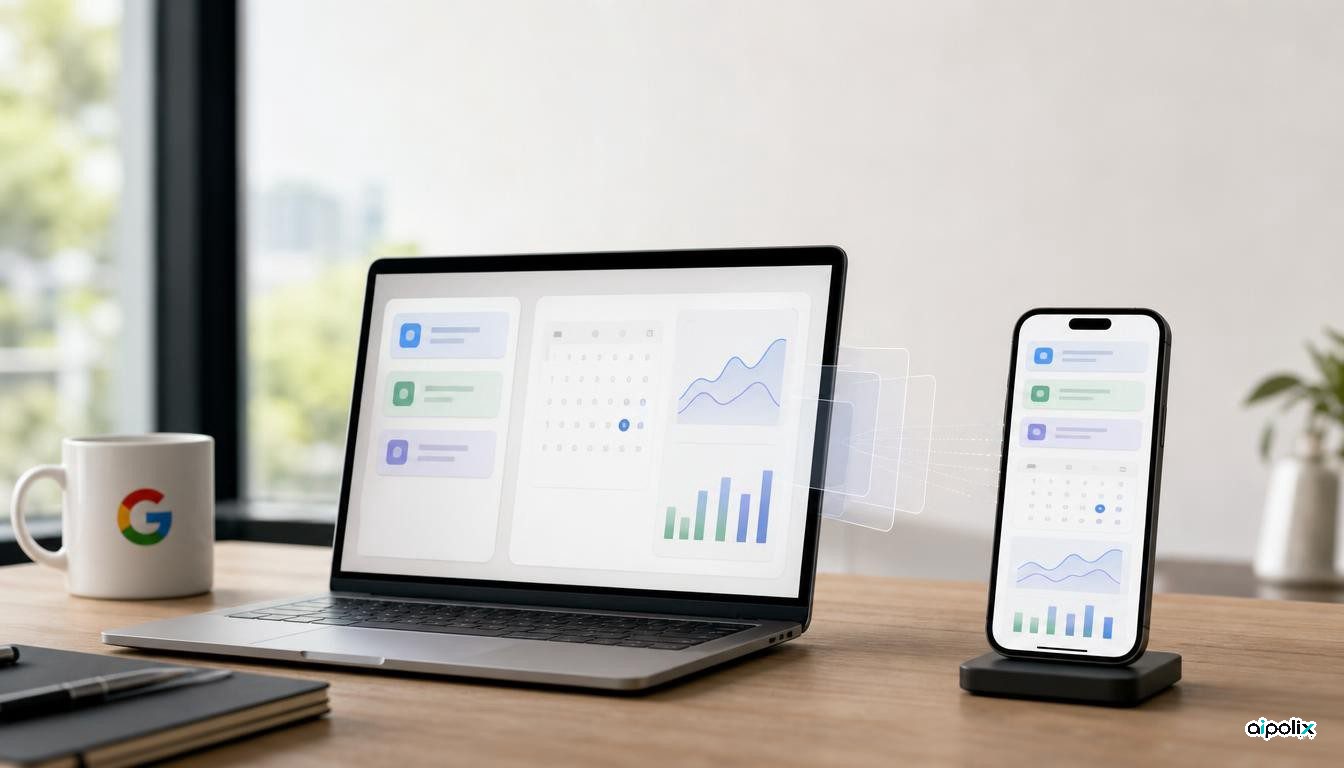
Google released A2UI 1.0 on November 11, 2026, calling it the first stable version of its open protocol for generative user interfaces. In a post on the Google Developers Blog, the A2UI team, with product manager Vishal Motwani, described the idea plainly: today's agents mostly answer in text, which is a poor way to compare three products or approve a detailed plan, so the agent should describe an interactive screen instead and let each application draw it.
The protocol works by separation of roles. The agent sends structured A2UI messages that say what to show, such as a form to confirm or a chart, and the host application renders them with its own native components. Google says agents can only place components that a company has registered from its design system, and that data binding happens on the server so sensitive values never reach the model. Those security properties are Google's description and were not independently tested here.
Version 1.0 adds three things. The protocol is now stable and gains bidirectional function calls, so a flight or reservation picker can check availability on the spot, along with accessibility support and extensions for extra metadata. Open-source renderers cover React, Angular and Lit on the web, Flutter across mobile, web and desktop, and SwiftUI on iOS, while the Jetpack Compose renderer for Android remains at version 0.9.1 with 1.0 promised soon. New agent SDKs for TypeScript and Dart join the existing Python one and handle skill generation, message translation and error correction, with swappable inference formats to reduce latency and, in Python, macros for component expansion and data binding. The web and Flutter renderers also run inside MCP Apps, so A2UI screens can appear in assistants that support them, which Google names as Claude and Gemini.
Google lists early adopters. Atlassian is using A2UI in Jira so an agent that needs a missing detail from a team can ask with an interactive card inside the work item. Alation renders feeds of metric cards and charts that show up both in Claude and in its own app. ByteDance released an A2UI renderer for its Lynx framework in June 2026 and is adapting to 1.0, and Bloomberg is named among companies building with the protocol. Inside Google, Gemini Notebook uses option and review cards when a user asks for a slide deck. Gemini supports A2UI 0.9.1 today and lets organizations register agents that answer with it, and Google says it is working on moving Gemini Enterprise to 1.0 while other product teams have unreleased features in development.
Outside coverage so far is mostly descriptive. SD Times and Digital Influence both reported the release on the same day and repeated Google's account of the changes. CopilotKit, a company that worked with Google's team, published its own guide saying A2UI travels over its AG-UI protocol and that it ships a generative UI product with a catalog of 70 components built on the release. That is an ecosystem signal rather than an independent evaluation.
Builders should read the claims with that in mind. The adopter descriptions come from Google's post, the Android renderer and Gemini itself still lag behind version 1.0, and no independent measurements of latency, safety or developer effort were found. The practical significance is a stable, vendor-backed target for agent interfaces that also works alongside MCP Apps, which may reduce the pull toward building a separate screen layer for every assistant.