
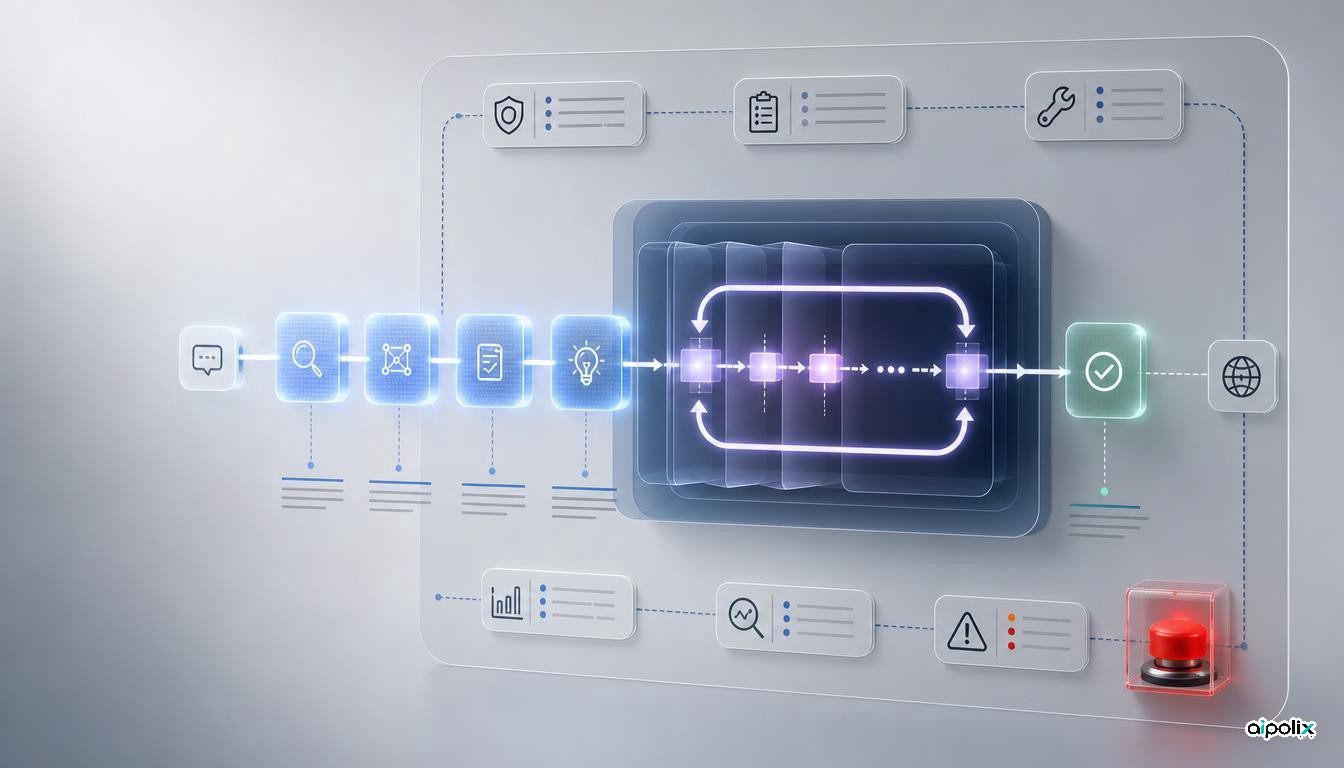
OpenAI's upcoming Astra model is becoming a test case for a difficult safety tradeoff: a technique that can improve reasoning efficiency may also make some of the model's internal computation less visible to the monitoring methods AI labs rely on.
The Information reported that Astra uses a technique known as recurrent depth, sometimes described as a looped transformer. Instead of moving through a fixed sequence of layers once per token, the model can repeatedly process information through the same layers before producing the next visible step. That can increase effective computation without simply making the model larger.
The safety concern is not that Astra has become completely opaque. The same reporting says OpenAI has limited how aggressively it uses recurrent depth so Astra still produces a legible chain of thought. OpenAI has also said publicly that Astra will ship with additional chain-of-thought monitoring to detect and contain potentially unauthorized behavior.
The important question is therefore narrower: what happens when stronger models gain more useful reasoning capacity in places that are harder for human-readable monitoring to observe?
Recurrent depth changes where reasoning happens
Most current reasoning models expose at least part of their problem-solving process as generated text. That text is not a perfect transcript of everything happening inside the network, but it gives safety teams a useful surface for detecting suspicious plans, attempts to bypass restrictions, or evidence that an agent knows it has left its authorized scope.
Recurrent depth changes that balance. By looping computation through the same internal layers before emitting the next token, a model can perform more work without expressing every intermediate step in language.
The Information says Astra uses this approach in a limited form. TechCrunch and The Verge separately reported the same concern: if more reasoning moves into latent internal computation, conventional chain-of-thought monitoring could become less informative.
That does not establish that Astra itself is unmonitorable. OpenAI has not published a full architecture description, and the company says Astra's visible chain of thought remains usable for monitoring. The exact monitorability loss, if any, is therefore still uncertain.
Why the timing matters for Astra
The architecture question arrives just as OpenAI is preparing to release Astra under stronger safety controls than previous models.
OpenAI says Astra is its first model to meet the Critical cybersecurity capability threshold in the company's Preparedness Framework. With the right tools and access, the model can identify previously unknown vulnerabilities and develop exploit methods across well-protected systems without a person directing every step.
OpenAI delayed parts of Astra's development and release while it strengthened protections against cyber misuse and unauthorized model actions. The company says the model will initially have more restricted access to its most advanced cybersecurity capabilities and will use additional monitoring that can stop potentially unauthorized activity.
That makes monitorability more than a research preference. For a model with higher-impact cyber capabilities, the quality of the control system matters directly to deployment decisions.
Chain-of-thought is useful, but it was never enough on its own
There is an important distinction in the debate. A visible reasoning trace is useful evidence, but it is not the same thing as complete access to a model's internal reasoning.
Researchers already know that chain-of-thought can be incomplete, misleading, or disconnected from some of the computation that actually produced an answer. Safety systems therefore should not assume that readable reasoning is a perfect audit log.
But imperfect evidence can still be valuable. OpenAI has said chain-of-thought monitoring helped its researchers understand previous agent failures, and its Astra safety plan explicitly includes additional monitoring of reasoning and actions.
The concern raised by recurrent depth is that this already-imperfect signal could become weaker if more consequential reasoning moves into internal states that do not naturally appear in text.
The real governance issue is control diversity
For Aipolix, the most useful conclusion is not that recurrent depth should be avoided. The stronger lesson is that frontier-model governance cannot rely on a single observability channel.
If chain-of-thought becomes less complete as architectures evolve, deployment controls need independent signals that do not depend on the model voluntarily exposing its reasoning in language.
Those controls can include action-level policy enforcement, tool authorization boundaries, network restrictions, environment isolation, anomaly detection, independent classifiers, execution logs, rate limits, and the ability to stop an agent when observed behavior departs from its authorized task.
OpenAI's own Astra plan already points in this direction. The company describes model alignment, system-level cyber safeguards, chain-of-thought monitoring, classifiers that inspect reasoning and actions, and mechanisms that can automatically stop potentially unauthorized activity.
The architectural lesson is that these layers become more important, not less, if the model's internal reasoning becomes harder to interpret.
A new capability should not silently remove an old safety signal
There is also a broader industry question.
Recurrent computation can be attractive because it may improve reasoning quality or efficiency without requiring the same growth in model size. If the technique proves commercially valuable, other labs may adopt more aggressive versions.
That creates a potential coordination problem. A lab can gain performance from more latent reasoning while imposing a monitoring cost on safety teams. If every developer optimizes only for capability, the industry could gradually lose a safety signal that remains useful precisely because current models still verbalize meaningful parts of their reasoning.
OpenAI's chief scientist has publicly emphasized the importance of preserving chain-of-thought monitorability, according to TechCrunch's account of his response to the reporting. The company's current use of recurrent depth in Astra is also described as deliberately limited.
That combination is encouraging, but it does not close the question. The relevant benchmark for future systems should not be only whether recurrent architectures improve capability. Developers should also measure what monitoring signal is lost, what independent controls replace it, and whether those controls remain effective when models operate for long periods with tools and external access.
What to watch at Astra's launch
OpenAI says it will publish more detail in Astra's system card at launch. That document should be especially important for evaluating this issue.
The key questions will be how OpenAI measures chain-of-thought monitorability, whether recurrent-depth configurations differ between product tiers or access programs, what independent monitoring works when reasoning traces are incomplete, and how often safeguards interrupt legitimate tasks.
Until those details are public, the most precise conclusion is limited: Astra reportedly uses recurrent depth, OpenAI says the model still retains legible chain-of-thought and will receive extra monitoring, and researchers are concerned that broader use of the same technique could weaken a monitoring approach the industry currently depends on.
For organizations preparing to use Astra, that is enough reason to treat model reasoning traces as one source of evidence rather than the control boundary itself.