
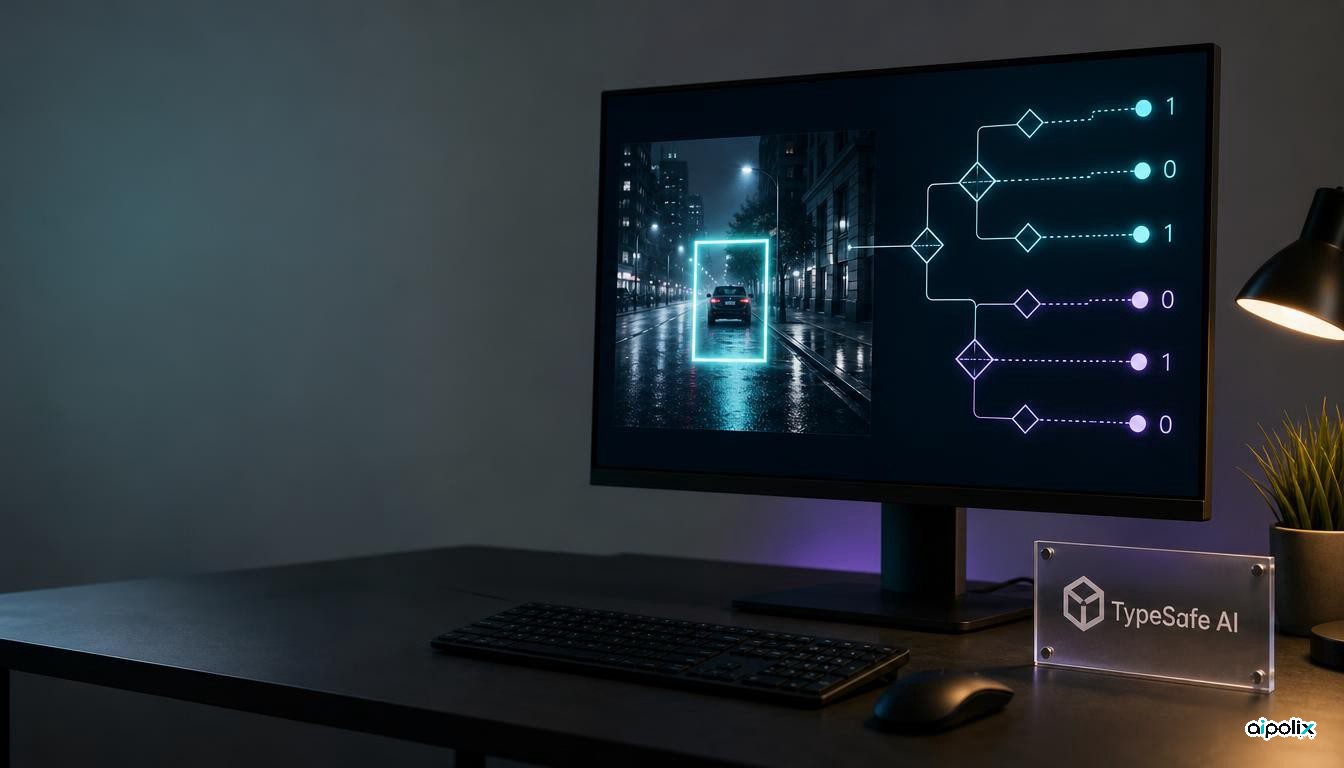
TypeSafe AI has released Jev 1.14, the second public version of the model that made the startup one of the most talked-about AI companies of the autumn. The company announced the update on October 14, 2026, during a live town hall streamed from its Discord, and followed it with a blog post titled "Jev: For the builders AND dreamers". Alongside the new model version, TypeSafe switched on three experimental capabilities: image inputs, a new answer type called box, and a far longer context window.
Jev is not a chatbot. It is what TypeSafe calls a System One model: instead of writing prose, it answers narrowly typed questions about a piece of state, such as a yes or no probability, a pick from a list of options or a position on a rubric. Developers use it for routing, classification and other decision points inside software. The company launched Jev on September 15 and announced an $870 million Series A at a $7.5 billion valuation on October 9.
TypeSafe describes the 1.14 model itself as deliberately unflashy. According to the company, most tasks should get slightly better, with the largest gain expected in multilingual support. The new version is available under the jev-preview name, and TypeSafe said its jev-latest alias would move to 1.14 about a week after launch. The previous version, 1.13, stays available, and the company said it plans to give 60 days of notice before retiring it and to publish a formal deprecation policy.
The experimental features sit behind what TypeSafe calls danger zone flags, request headers that developers must set on purpose. The first is image support. TypeSafe says the existing 1.13 model was already multimodal and that images can now be placed anywhere its JSON interface accepts text, including the state, the instructions or the grading criteria. The company itself warns that every model, Jev included, does worse on images than on text, and recommends splitting visual questions into the simplest possible steps.
The second addition is box, an answer type that returns a single bounding box for an object in an image. TypeSafe presents it as its first type that is not just a smart yes or no and as a preview of what System One models may support beyond simple decisions; it is limited to Jev 1.14. The third is long context. TypeSafe says Jev always supported more context than it allowed in production and that it had capped requests on purpose because reliability drops as inputs grow. Developers can now lift that cap, though the company still advises against it. LiteLLM puts the default limits at 64,000 tokens per request, and OpenRouter lists a 262,144 token window for the model.
Third-party tooling moved quickly. LiteLLM, the open source gateway used to route requests across model providers, published day-zero support for images, box questions and long context on October 15. OpenRouter lists Jev 1.14 with a price of $0.042 per million input tokens and no charge for output, served only by TypeSafe. TypeSafe also added an opt-in that lets customers flag problem queries to help find weak spots, while stating that it still does not train on customer queries.
The post also shares TypeSafe's own internal intelligence measurements, compared only against open weight models. The company frames these numbers as a best guess that may change, says they are likely biased in its favour, and tells developers to trust their own evaluations instead. No independent benchmark of Jev 1.14 has been published, so claims about its accuracy, its image performance and its long-context reliability rest on TypeSafe's word for now.
For developers already using Jev, the practical change is a slightly better default model plus a set of opt-in capabilities that TypeSafe itself says are not yet ready for production. The release also signals the company's direction after its large funding round: incremental, stable improvements rather than dramatic launches, with structured outputs such as bounding boxes pointing to where System One models could go next.