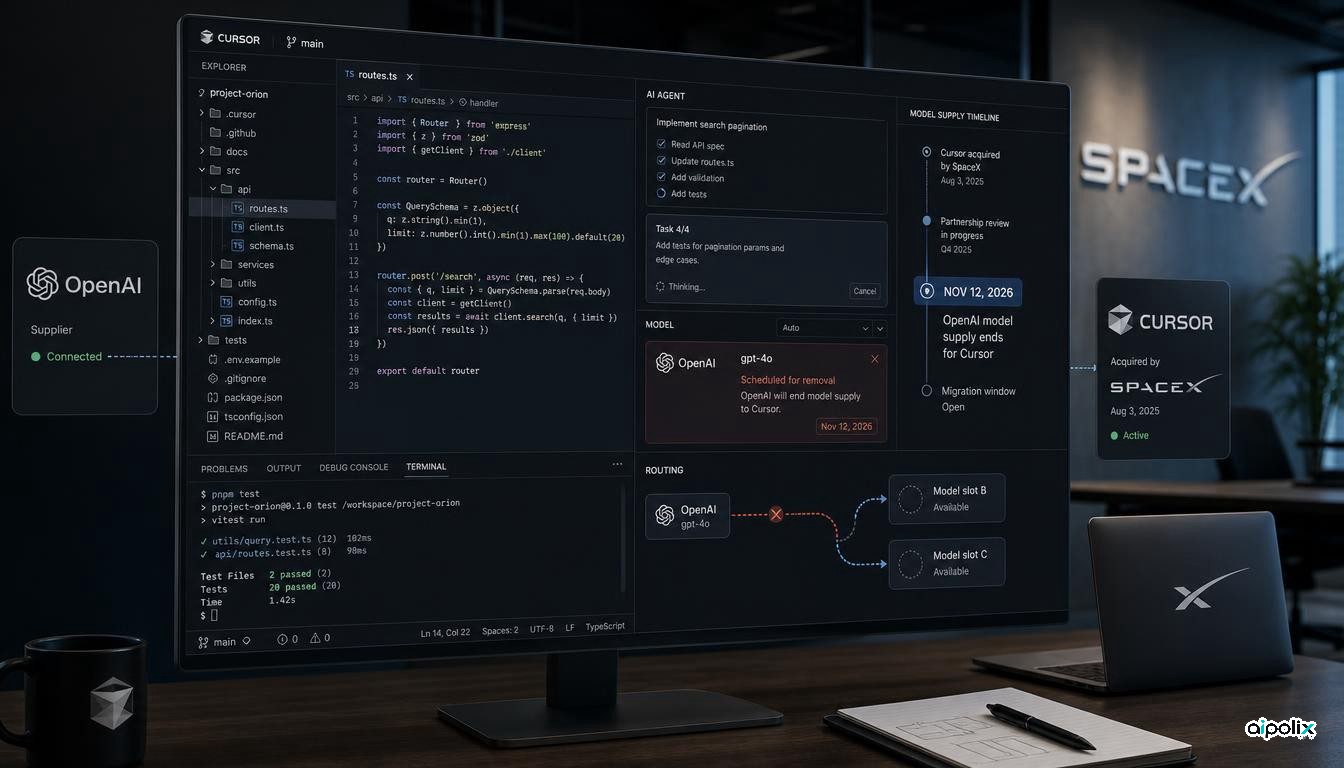
OpenAI says it will wind down the contract that supplies its models to Cursor after the coding-tool company was acquired by SpaceX, proposing a November 12, 2026 shutoff date. The move is immediately relevant to developers because Cursor is a multi-model coding environment, and access to OpenAI models is part of the product choice that teams make when they standardize agentic development workflows. OpenAI is giving the maximum notice allowed by the contract rather than cutting access immediately.
The decision is not framed as a model-performance or pricing change. In its official announcement, OpenAI says it cannot be confident that SpaceX will use its technology within OpenAI's terms of service, citing its prior contractual experience with Elon Musk's companies. Reuters independently reported the planned termination and said SpaceX had not immediately commented. The practical result is a scheduled change in the supplier layer underneath one of the most widely used coding-agent products.
A model-provider dispute becomes a developer-platform dependency
Cursor's value proposition has increasingly depended on letting developers choose among models while keeping their repository context, agent workflows, rules and integrations inside one development surface. That architecture can make the model layer look interchangeable, but OpenAI's decision shows that commercial and policy relationships between vendors can still alter what is available inside the tool.
OpenAI says the proposed cutoff date is November 12 and that the notice period is intended to maximize the time developers retain access to its models through Cursor. That gives Cursor and its users a migration window. It does not guarantee what replacement models, routing defaults or commercial terms Cursor will offer by then, and OpenAI's statement does not say that existing Cursor projects will stop working as a whole.
For engineering leaders, the distinction matters. A coding-agent platform can preserve prompts, repository indexes and workflows while changing the underlying model, but behavior is not perfectly portable. Different models vary in tool use, patch style, latency, context handling and how they respond to repository instructions. Teams that have validated workflows specifically around an OpenAI model should treat a provider change as something to regression-test, not as a transparent backend swap.
The trigger is governance and contract confidence, not a technical failure
OpenAI's stated reason is governance. The company says large partners typically operate under custom contracts intended to enforce terms of service and safety at scale. It argues that SpaceX's acquisition of Cursor changes the counterparty risk enough that OpenAI no longer wants to continue the arrangement.
That explanation is an attributed company position, not an independently established finding that SpaceX violated the Cursor contract or would misuse OpenAI models. Reuters reported the same decision and the absence of an immediate SpaceX response, but the current evidence does not establish the other side's account. The safest reading is narrower: OpenAI has decided that the contractual relationship no longer meets its risk threshold.
This matters beyond the corporate dispute because coding agents increasingly sit inside systems with repository access, credentials, CI permissions and deployment tools. Model providers therefore care not only about API volume but also about how downstream platforms enforce policy, identity and usage boundaries. The OpenAI-Cursor split is an example of those governance dependencies becoming visible to end users.
Cursor now has to manage model continuity under new ownership
The acquisition by SpaceX also changes the strategic context. Cursor is no longer an independent coding-tool company negotiating with model vendors from a neutral position. It sits inside an organization that also develops Grok and Grok Build. That does not prove Cursor will become a single-model product, but it creates an obvious incentive for tighter integration with SpaceXAI's own stack.
Developers should separate that strategic possibility from what is confirmed. The confirmed event is the planned end of OpenAI model supply through the existing contract. There is no evidence in the cited sources that Cursor will remove other third-party models, force Grok as the only option, or change repository-data policies. Those questions remain open.
The migration risk will also differ by team. Individual developers who choose models session by session can switch quickly. Enterprises that benchmarked a particular model, approved it through security review, or built cost and quality controls around it have more work. They may need to re-run code-generation evals, inspect agent permission behavior and update internal documentation before a new default becomes acceptable.
What engineering teams should do before November
Teams using Cursor with OpenAI models should first identify which workflows actually depend on those models. That includes agent modes, automated code review, repository-wide changes, CI repair and any custom benchmark where model identity was part of the approved configuration. The goal is to distinguish preference from dependency.
Second, teams should run the same representative tasks on plausible replacement models before the cutoff. Measure completion quality, test-pass rates, patch size, latency, token use and human review burden. A replacement that looks cheaper per token can become more expensive if it requires more retries or produces larger review costs.
Third, enterprises should review whether vendor-risk assumptions changed with Cursor's ownership. The OpenAI announcement is itself a signal that contractual trust between suppliers can affect product availability. Procurement and architecture reviews should therefore ask which components are portable, which policies are enforced by Cursor versus the model provider, and how quickly a model can be replaced without losing traceability.
The broader lesson is that multi-model agent platforms are not immune to supplier concentration. They reduce some lock-in at the user interface, but availability still depends on contracts between infrastructure layers. OpenAI's planned withdrawal from Cursor turns that abstract dependency into a dated migration event that developers can prepare for now.