
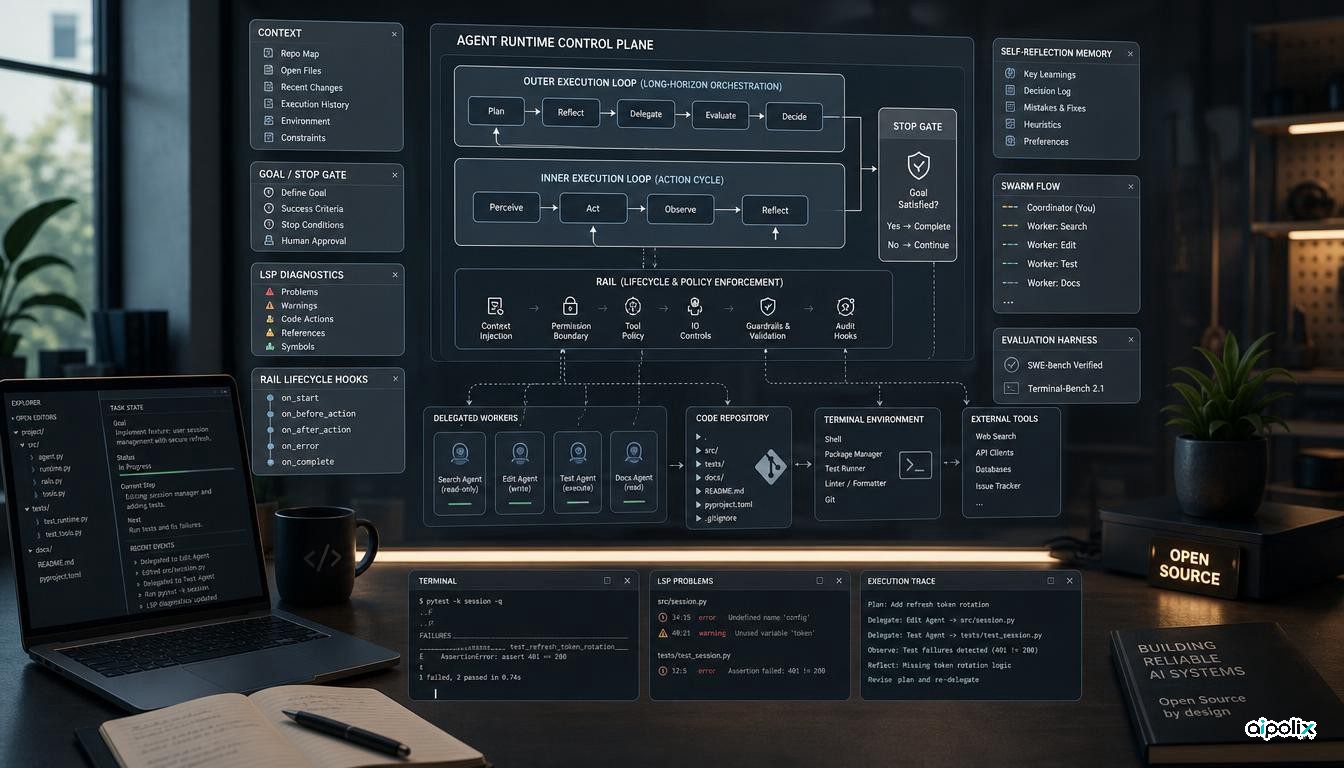
openJiuwen has published a new research paper that treats the coding-agent harness as a first-class systems layer rather than a thin wrapper around a model. The work matters because long-horizon coding performance increasingly depends on how a harness manages context, tools, task continuation, diagnostics, delegation and stopping, not only on which model sits underneath it. The paper describes a shared execution substrate for single agents, delegated sub-agents and multi-agent flows, while the public JiuwenSwarm repository provides an inspectable implementation path.
The authors report 82.6% on SWE-bench Verified and 87.19% on Terminal-Bench 2.1. Those figures are notable, but the more useful engineering question is what they actually establish. The paper itself cautions that leaderboard systems differ in models, prompts, tools and implementations. That caveat is central: the strongest practitioner takeaway is not that one harness has definitively beaten another, but that orchestration has become a measurable part of the agent system that needs its own controlled evaluation.
The harness becomes a control plane
openJiuwen separates execution into an Inner Loop for model and tool interaction and an Outer Loop for task-level continuation. Cross-cutting capabilities are attached through a mechanism called Rail, which uses lifecycle hooks and explicit ordering rather than embedding each capability into a separate execution path. The same execution semantics are reused across standalone agents, delegated sub-agents and Swarm Flow.
That design targets a real engineering problem. Coding agents now accumulate planning, memory, context management, security checks, human intervention, retries and delegation. If every new capability changes the core execution loop, the harness becomes difficult to reason about and harder to test. A common substrate can make those behaviors easier to compose, but it also turns harness configuration into a control surface that deserves versioning, observability and regression testing.
The repository shows that the project is not only a conceptual paper. JiuwenSwarm exposes multi-agent collaboration, deterministic Swarmflow workflows, tool permissions, distributed execution and an Auto Harness mechanism aimed at optimizing the harness without changing model weights. The repository is Apache-2.0 licensed and installable, which improves reproducibility compared with a paper that only reports benchmark results.
Runtime adaptivity changes framework state, not model weights
The paper's second idea is runtime adaptivity. Instead of retraining the model, openJiuwen changes framework-controlled state as a task unfolds. Context Management compresses, reduces or offloads older information; Goal Mode controls acceptance and stopping; LSP-driven feedback injects semantic diagnostics; Self-Reflection stores reusable experience from completed trajectories.
That distinction is important for teams building agents on third-party models. It suggests that some long-horizon improvements can come from the control plane around a fixed model, which is operationally faster to iterate than fine-tuning. It also creates a separate failure surface. A context manager can hide the wrong evidence, a stopping rule can terminate too early, and a diagnostic loop can overreact to static signals that do not capture architecture or business correctness.
For production evaluation, the harness therefore should not be treated as invisible infrastructure. Teams need tests for context retention, stop conditions, tool permissions, retry behavior and diagnostic injection in addition to testing the model itself.
The headline benchmark gap needs a claim audit
The paper reports that openJiuwen with GPT-5.6 Sol reaches 87.19% on Terminal-Bench 2.1, compared with a selected Claude Code leaderboard result of 83.8%. Read alone, that looks like a 3.39 percentage-point harness advantage. It is not a controlled estimate of the harness effect because the two systems use different backbone models and can also differ in prompts, tools and implementation.
The paper includes a more informative model-matched comparison using Fable 5. In that setting, openJiuwen reports 84.04% while Claude Code reports 83.8%, a difference of only 0.24 percentage points. The authors explicitly say that matching the model reduces one confounder but does not eliminate differences in prompts, tools or agent implementations.
SWE-bench Verified is somewhat cleaner because openJiuwen and the strongest selected comparison both use Claude 4.5 Opus, and openJiuwen reports 82.6% versus 79.2%. Even there, the comparison is still system-level rather than a controlled ablation of the harness. The paper acknowledges that broader studies and more detailed ablations are needed to isolate the contributions of individual mechanisms.
This changes how the results should be used. The benchmark evidence supports the claim that openJiuwen is competitive as a complete agent system. It does not yet establish that Rail, Goal Mode, context adaptation or any other individual mechanism causes the reported gain.
What engineering teams should benchmark
A useful evaluation should keep the model, reasoning effort, tool set, token budget and environment as fixed as possible, then vary harness components one at a time. That would show whether context adaptation, LSP feedback, stopping logic, reflection or multi-agent coordination actually contributes to completion rate, latency, cost or reliability.
Teams should also measure failure behavior, not only aggregate pass rates. Long-horizon agents can fail by looping, forgetting constraints, exhausting budget, overusing tools, stopping before acceptance criteria are met or carrying stale context forward. Those failure modes map directly to the control mechanisms openJiuwen is trying to formalize.
The practical implication is broader than this project. Agent evaluation is moving toward a full-stack discipline. A model score alone is insufficient when the harness controls what the model sees, which tools it can use, when it retries and when it stops. Reproducible agent engineering will increasingly require model-matched comparisons and harness ablations, especially when project claims attribute gains to orchestration.
Why the paper is worth watching
openJiuwen is still a preprint, and the current evaluation is limited to SWE-bench Verified and Terminal-Bench 2.1. The authors themselves call for broader controlled studies across more benchmarks, models and configurations. There is no basis yet for treating the system as universally superior or production-proven.
What makes the work publishable is the combination of an inspectable open-source implementation, a concrete harness architecture and benchmark evidence that can be audited rather than repeated at face value. The strongest contribution is the framing of runtime control as an engineering layer that can be changed independently of model weights.
For developers and architects, that creates a more precise evaluation question: not "which coding model is best?", but "which model-plus-harness configuration produces reliable outcomes under a fixed budget and control boundary?" That is a harder benchmark to run, but it is much closer to how production agent systems actually behave.