
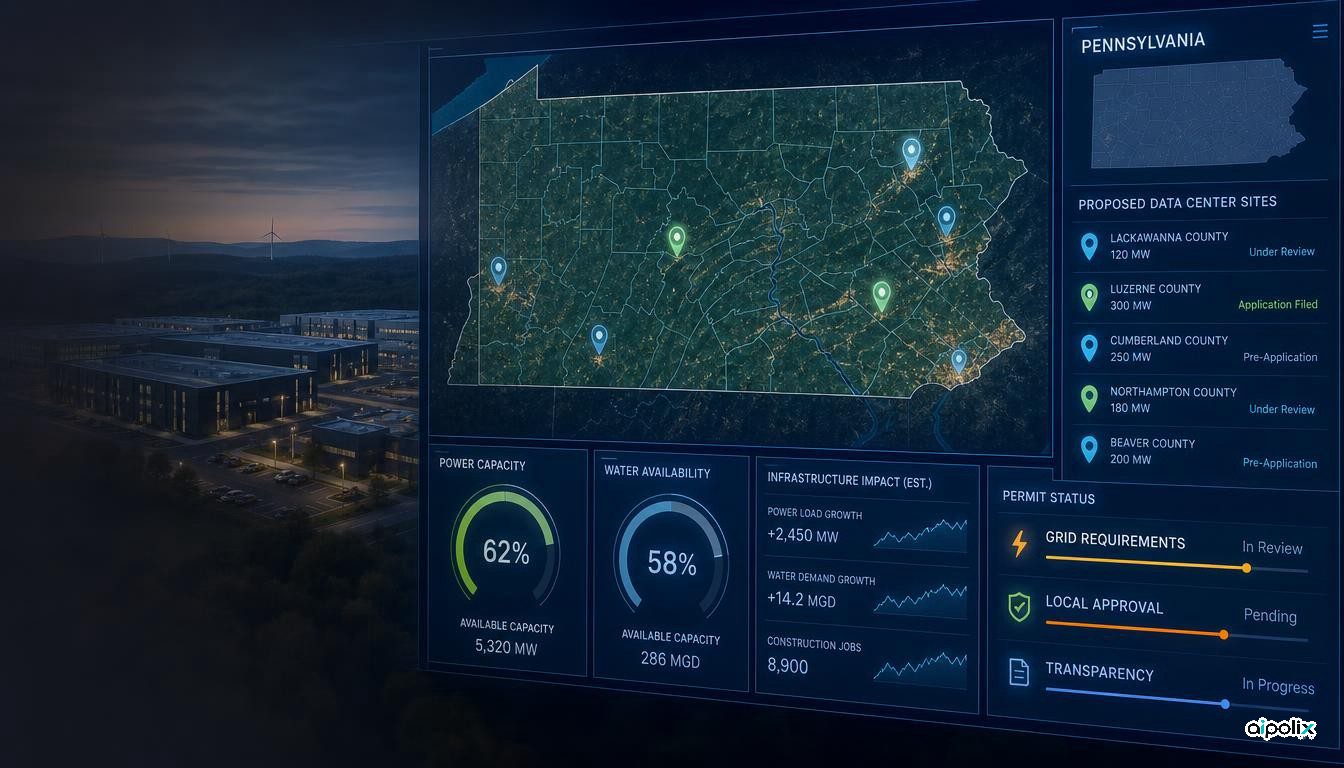
Pennsylvania Governor Josh Shapiro has signed an executive order that turns the state’s previously announced data-center standards into binding conditions for new projects seeking state permits and support. Executive Order 2026-05 and the governor’s announcement direct state agencies to require developers to commit legally to the Responsible Infrastructure Development, or GRID, requirements before permits can be issued.
The change is unusually direct for the current wave of AI infrastructure expansion. Pennsylvania says its Department of Environmental Protection will review new data-center permit applications only after developers attend a pre-application meeting and sign a Consent Order and Agreement containing enforceable GRID commitments. Projects must also secure required local approvals before the state issues permits.
The order covers several pressures created by large AI data centers. Developers must address energy affordability, environmental protection, community engagement, workforce commitments and transparency. Operators will have to report energy and water consumption to the state, including peak hourly energy use, annual natural-gas consumption, annual water use and maximum-day water demand. The administration also says infrastructure costs generated by data centers should not be shifted onto ordinary ratepayers.
Two additional changes make the policy harder to treat as voluntary guidance. Pennsylvania removed data-center projects from its Permit Fast Track program, and the order says nondisclosure agreements are not permissible for data-center projects. The state also plans to tie eligibility for an existing computer data-center equipment tax exemption to compliance with GRID requirements.
The scale of the policy reflects how quickly proposals have accumulated. The governor’s office says publicly sourced databases show more than 100 proposed data-center projects in Pennsylvania, while 58 projects have engaged with the environmental department at some level. Fifteen have submitted at least one permit application and only five have received all permits needed for a first development phase. The state says no AI data center is currently operating in Pennsylvania.
The order arrives as AI companies and cloud providers compete for power, land and interconnection capacity. Pennsylvania is attractive because of its natural-gas resources, existing power infrastructure and location near major East Coast markets. Reuters noted that Amazon announced a $20 billion investment in the state last year, while public resistance to data-center development has been growing nationally.
For AI infrastructure developers, the important shift is from broad political support to project-level obligations. A proposal that cannot secure local approval or make enforceable commitments on power costs, environmental protection and community benefits may now fail before normal permitting is complete. That makes Pennsylvania a useful case study for how regional governments can convert public concern about AI infrastructure into concrete development constraints.
The policy is also a reminder that AI compute expansion is no longer only a chip-supply or capital-spending story. Electricity pricing, water consumption, local zoning, tax incentives and transparency rules are becoming part of the deployment stack. As data centers become one of the largest physical interfaces between AI companies and local communities, those constraints can determine where capacity is actually built.