
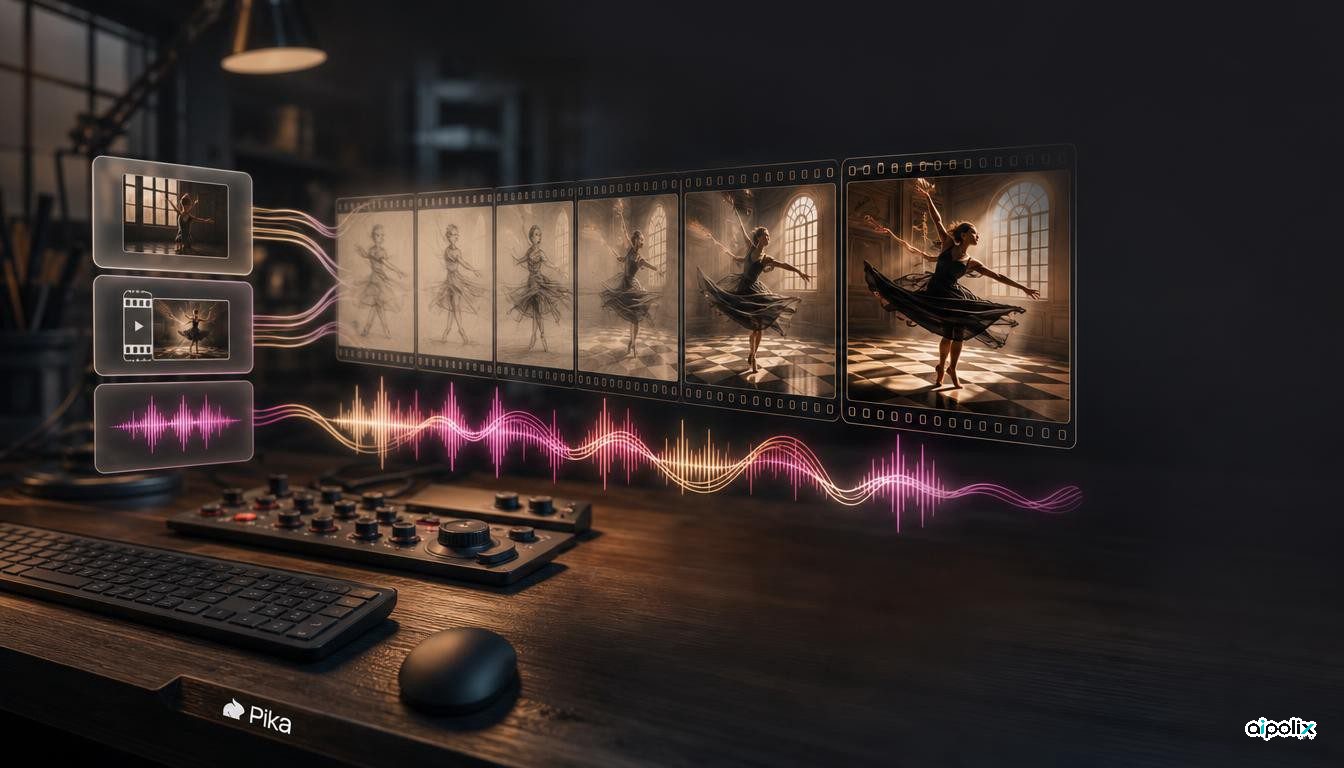
Pika, the generative video start-up, has released Pika H3 Flex, a video model with built-in sound, and published its weights for anyone to run. The company announced the model on October 29, 2026, with the generator adapters on Hugging Face and the inference code on GitHub the same day, and says Flex is reaching its consumer creation product on November 2.
Flex is not a model trained from scratch. Pika post-trained MiniMax's open video-and-audio model H3 in three stages: supervised fine-tuning on an in-house dataset curated for aesthetics, a distillation method called Projected Distribution Matching Distillation that cuts sampling from 50 denoising steps to six, and reward learning with ReFL and DPO, trained as separate low-rank adapters and merged into one. The release consists of two adapters, one for text and first- or last-frame conditioning and one for multimodal references, which accepts up to 12 inputs: nine images, three video clips and three audio clips.
Running locally, the open release produces 5- to 15-second clips at 480p or 768p and 24 frames per second, with mixed 32 kHz stereo audio. The package downloads about 210 GB of MiniMax H3 base components plus the adapter and needs an NVIDIA GPU. Higher-resolution output at 1080p, 2K and 4K, separate audio stems for dialogue, music and effects, prompt enhancement and Pika's accelerated serving stack stay on the company's hosted API. Pika says it will also open-source its 1B-parameter upsampler later. The adapters are distributed under the MiniMax H3 Community License, while the inference code is Apache 2.0.
Pika's own figures are ambitious. It says Flex ranked first among open-weight models and seventh overall on DesignArena's text-to-video leaderboard at launch, scored highest on five automated visual and audio quality metrics against MiniMax H3, Fal H3 Max and HeyGen Video, and generates faster than real time on its hosted stack, at about 1.8 times the speed of Fal H3 Max. Its human preference study gave Flex the lead on anatomy, composition and audio synchronisation, while rival systems were preferred for physics, multi-scene narrative and lighting. Pika prices hosted generation from $0.01 per output second.
An early independent test offers a more mixed picture. A creator who ran 75 renders on a single RTX 5090 in ComfyUI found that Flex had the clearest sound of three fast MiniMax H3 variants, but rendered a 15-second clip in roughly four minutes, about 1.5 times slower than a four-step alternative, and showed more held frames, a form of stutter. That test used one character and no blind listening panel.
Adoption is early: by November 2 the GitHub repository had about 500 stars and the Hugging Face page roughly 330 likes. The model is also available through ComfyUI templates and Diffusers.
The release shows a pattern that is spreading in open video: smaller companies taking a capable open base model, post-training it for speed and control, and releasing the adapters while keeping premium finishing features behind a paid API.