
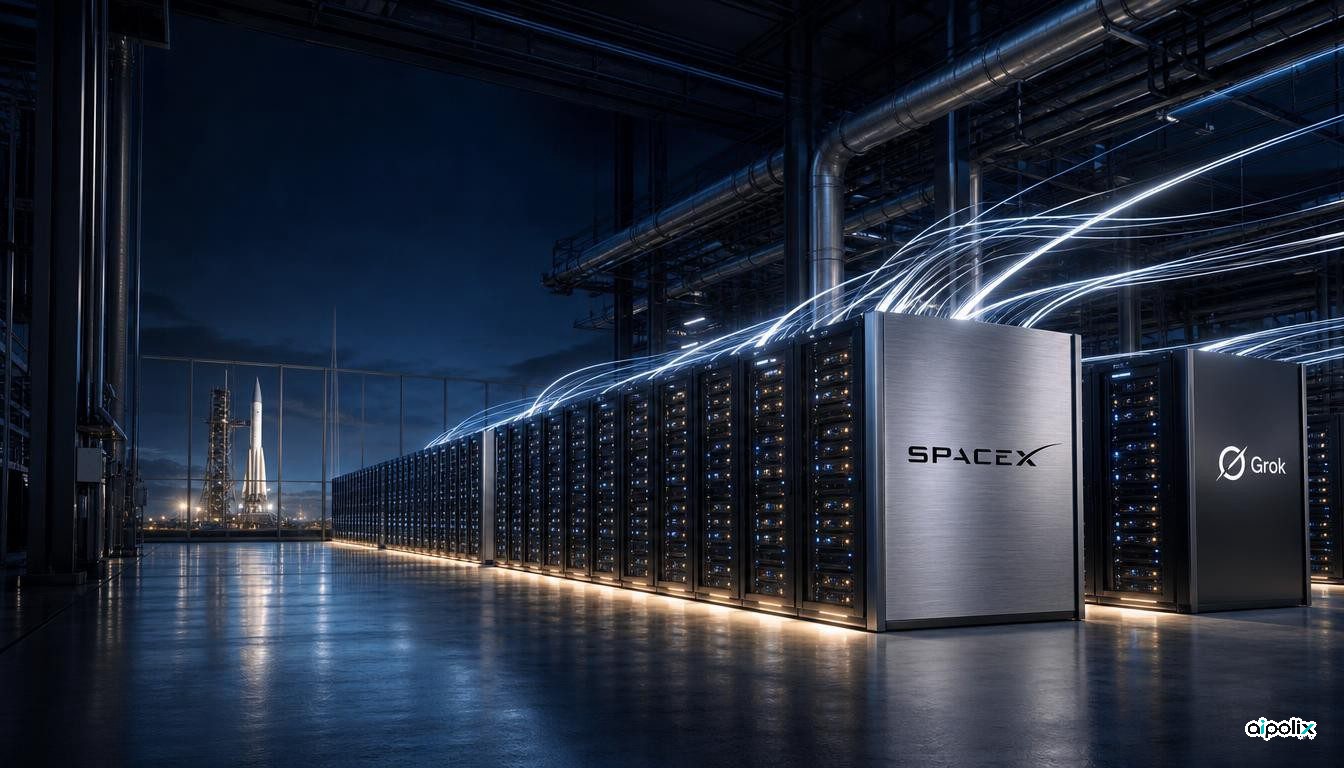
Artificial intelligence is now the largest business at SpaceX. In third-quarter results filed with the US Securities and Exchange Commission on Tuesday, October 20, 2026, Elon Musk's company said its Super Intelligence (SI) segment generated $7.56 billion in revenue for the three months to September 30, compared with $2.56 billion in the April to June period and $813 million a year earlier. That is more than half of group revenue of $14.6 billion, which rose 161% from $5.6 billion.
The segment, which combines the Grok models, the social network X, the Cursor coding tool and a fast-growing compute operation, also turned an operating profit of $431 million after losing $1.26 billion in the prior quarter. SpaceX said the result already absorbs $1.2 billion of share-based compensation tied to the Cursor deal. Most of the revenue, $7.02 billion, came from what the company calls SI solutions and infrastructure, with advertising contributing $538 million.
SpaceX credited three drivers: newly activated cloud services agreements, the Cursor acquisition and wider use of Grok by businesses and consumers. Reuters reported that the money comes mainly from renting data center capacity to other AI developers, naming Anthropic, Google and Reflection AI as customers, which makes the unit look more like a cloud provider than a model lab. The company said nameplate compute reached 1.7 GW at the end of September, against 1.4 GW three months earlier and 0.6 GW a year before, as it builds out its COLOSSUS II site.
Cursor is already a visible part of the numbers. SpaceX closed the purchase on August 14, 2026 at an implied equity value of $60 billion, with GAAP purchase consideration of $42.5 billion and a further $23.4 billion of equity awards linked to future service. Between closing and the end of the quarter, Cursor added $608 million of revenue. The filing also says SpaceX introduced Grok Bot, which it describes as an always-on agentic system.
The build-out is expensive. SI capital expenditure was $16.4 billion of the group's $19.6 billion total in the quarter, and TechCrunch reported that chief financial officer Bret Johnsen expects $35 billion to $40 billion of capital spending in the fourth quarter. At group level, SpaceX posted net income of $4.4 billion compared with a $1.1 billion loss a year earlier, though it remains slightly loss-making for the first nine months of 2026.
Analysts had expected less. Fortune, citing Visible Alpha consensus, said SI revenue beat forecasts of $6.47 billion, while Reuters put the consensus for total revenue at $12.72 billion according to LSEG data. Shares rose about 2.5% in extended trading, Reuters reported. Johnsen guided to first-quarter 2027 revenue of $33 billion to $37 billion, according to TechCrunch, and Musk predicted on the investor livestream that annual recurring revenue would reach between $500 billion and $1 trillion by the end of 2027.
Those outlook figures are management projections, not results, and Musk's recurring revenue forecast in particular has no published basis. The quarterly profit also depends on accounting choices: SI adjusted EBITDA of $5.0 billion excludes depreciation and stock compensation, and SpaceX has cautioned that the unit will need sustained investment before it can make money consistently.