
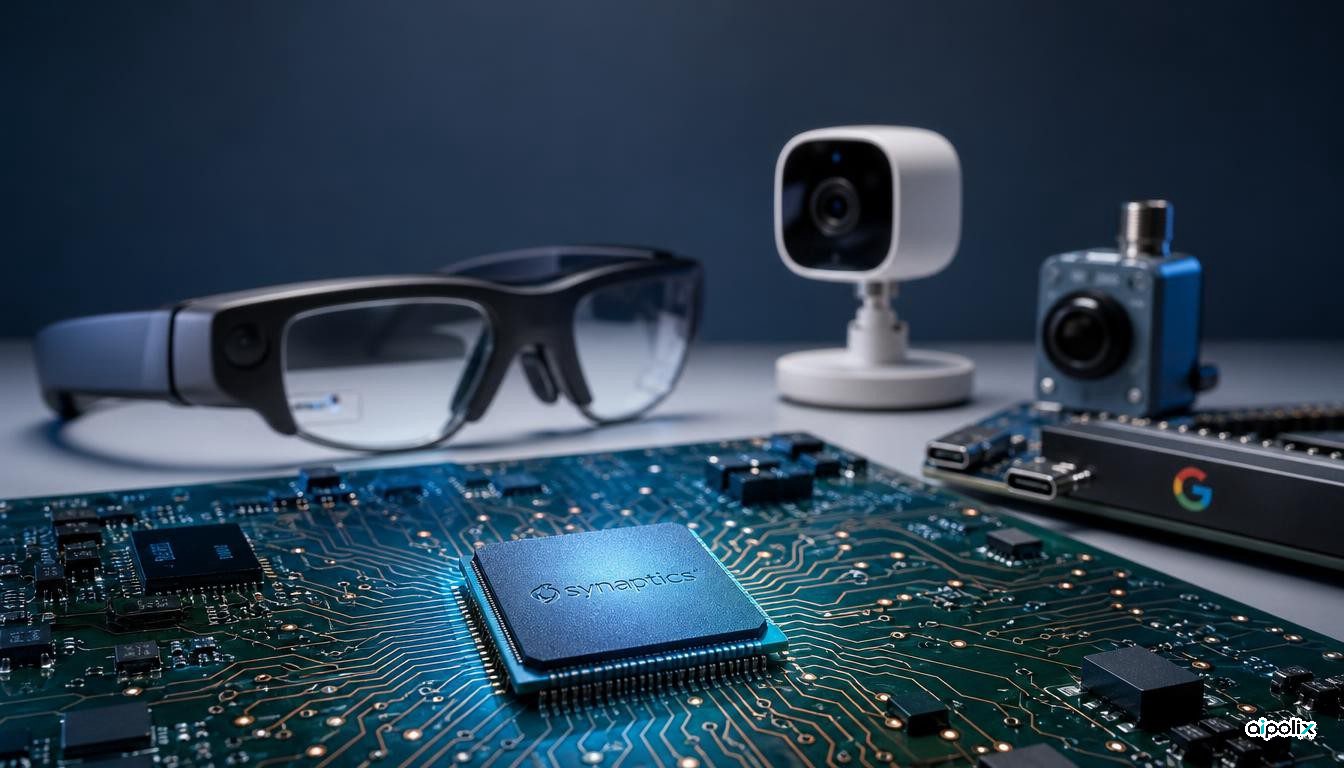
Google's effort to put an open AI accelerator design into everyday devices has reached commercial silicon. At its Tech Day in San Jose on October 20, 2026, Synaptics unveiled the Astra SR200 series, a family it calls xMCUs: microcontrollers meant to run multimodal AI on battery-powered gadgets, smart cameras and factory equipment without a separate applications processor.
There are three pin-compatible parts sharing one SDK. Synaptics rates the SR210 at 200 GOPS for always-on voice and sensing, the SR230 at 300 GOPS with vision and display support, and the SR250 at 400 GOPS with two vision and display paths. Each combines an Arm Cortex-M85 running at up to 800MHz with a low-power Cortex-M52, which Arm says is the first time the two cores have been paired. An optional Cadence HiFi 5 DSP handles audio work.
The AI engine is Synaptics' Torq NPU, which integrates Google Research's Coral NPU. Google released the Coral design as open source under Apache 2.0 in October 2025, so chipmakers can build it in without royalties, and VentureBeat reports that Synaptics is its first commercial silicon partner. Google Research director Billy Rutledge said the SR200 brings the second generation of Coral IP, with a RISC-V vector core, into silicon. At an October 14 preview reported by R&D World, Google Research vice president Avinatan Hassidim claimed the design uses 40% less energy than rival processors and averages under 6 milliwatts for on-device inference, without naming workloads or comparison chips.
Memory is the other selling point. The chips carry up to 8MB of SRAM plus custom DRAM that Synaptics says can scale to hundreds of megabytes while drawing about a third of the power of typical system DRAM. Software runs through the open-source Torq compiler, built on MLIR and IREE, with Zephyr RTOS support. Synaptics also targets PSA Level 3 and CC EAL4+ security certification.
Developers can start now on cheaper hardware. Synaptics made the Coralboard SL, based on its existing Astra SL2619 with a 1 TOPS NPU, generally available through DigiKey, where VentureBeat found it listed at $99.79. A Coralboard SR built on the SR250 is announced but not yet shipping. Synaptics says Google's Gemma 3 270M runs at 12 to 16 tokens per second on its platform, depending on quantization.
The SR200 parts are still sampling, and Synaptics has disclosed neither chip prices nor a volume production date. Quotes from Sonos, Verisure, Jorjin and Accton describe existing work or interest rather than confirmed SR200 products. Synaptics CEO Rahul Patel said the chip will appear in Google devices, but did not say which or when. The launch also lands in a crowded field that includes STMicroelectronics' STM32N6 and Renesas' RA8P1, and while Synaptics' proposed $5.7 billion sale to onsemi is pending.