
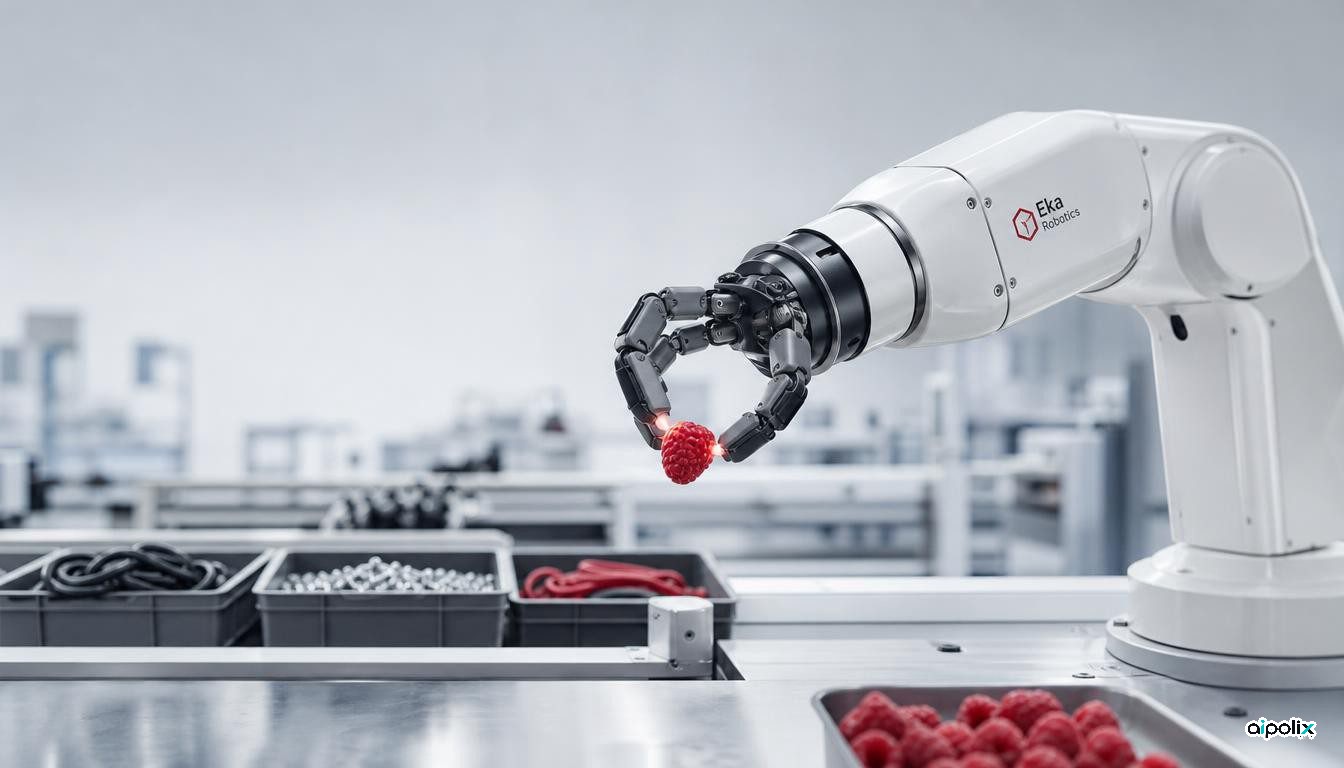
A robotics startup that bets on force sensing over camera-heavy learning has become a unicorn. Eka Robotics closed a $150 million Series A that values it at $1.45 billion after the money, TechCrunch reported on Tuesday, October 20, 2026. Andreessen Horowitz and F-Prime led the round, and a16z published its own investment note the same day confirming that it led the Series A.
Eka was founded by Pulkit Agrawal, an MIT professor who runs the Improbable AI Lab at CSAIL, and Tuomas Haarnoja, a former Google DeepMind researcher and co-creator of the Soft Actor-Critic reinforcement-learning algorithm. Its central product is what it calls a vision-force-action (VFA) model. Most current robot foundation models link language, images and motor commands; Eka's model leans on the forces a robot hand feels during contact, with vision used mainly to find where an object is.
The company designs the model, sensors, controller and hand together, so that a grasp beginning to slip can be corrected or resistance during an insertion can change the motion instead of triggering a fault. Rather than learning from hours of human demonstrations, Eka trains its control policies with reinforcement learning inside a physics simulator, which lets virtual robots rehearse huge numbers of variations and failures. According to TechCrunch, the founders say minutes of simulation can yield thousands of hours of practice, though they kept the method largely secret.
The performance figures come from Eka and its investors. a16z says the system manages as many as 1,500 picks an hour during lab bin-picking and induction work, about two and a half times human speed, and TechCrunch cites a company claim of more than 95% pick reliability for objects up to 1 kg. University of Illinois professor Kris Hauser, who saw a demonstration, told TechCrunch the robot adapted to many objects without retraining. Agrawal says the gripper costs under $1,000 and is rated for 5 million duty cycles, short of the roughly 20 million cycles expected of standard industrial arms.
The money arrives as investors pour capital into physical AI. Eka is starting with two industrial uses, pick-and-place and wire handling, and is running undisclosed pilots with industrial customers. a16z frames the opportunity as making dexterous manipulation a general capability, so factories would not need a separate engineering project for every new object or material.
Big questions remain. Every result so far is from labs and demonstrations, not production lines. Hauser warned that running reliably for a year with integrators on real assembly lines will be the hard test, and that it is not yet clear how far the approach generalizes beyond pick-and-place. Eka has not published its own announcement or technical paper, and other investors in the round were not named.