
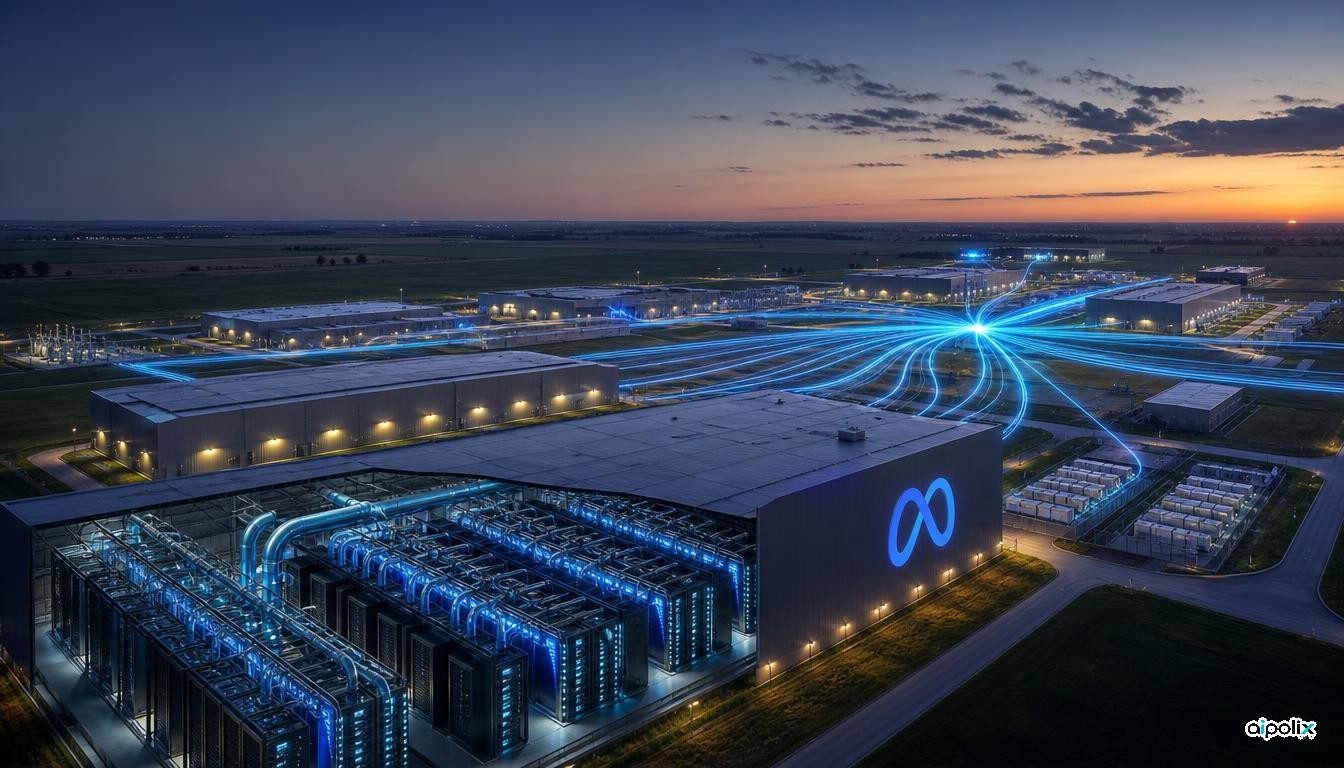
Meta has given the most detailed public look yet at Prometheus, the AI supercluster under construction at its New Albany, Ohio campus. In an engineering post dated October 19, 2026, four Meta infrastructure leads say the first phase is finished and was used to train the company's Muse foundation models, including the Muse Wonder frontier models it launched this month, and that the site is being expanded toward roughly 1 million GPUs.
The scale is the headline. Two years ago the campus handled ordinary web traffic. Today, according to Meta, it links hundreds of thousands of GPUs spread over conventional halls, purpose-built AI buildings and quick-to-erect temporary structures, tied together with fiber so that they operate as one machine. Meta describes the full project as gigawatt-class.
Two NVIDIA rack generations are running now. Catalina uses GB200 NVL72 hardware in a two-rack layout that Meta chose so every GPU gets 800G of scale-out networking, double the standard configuration. Clemente moves to GB300 NVL72 in a single rack, with 288GB of HBM per GPU and about 135kW of power per rack. A third platform, San Miguel, will bring NVIDIA Vera Rubin NVL72 racks above 170kW each, which Meta expects to deliver 10% to 20% better performance per watt than Clemente.
Networking is split by distance. Inside each building, an Ethernet back-end fabric connects as many as 20,736 GPUs, now built on Meta's own 51.2T Minipack3 switches running its FBOSS software. Between buildings, an aggregation layer of Arista 7800 chassis with Broadcom Jericho3 chips joins sites from 2km to more than 100km apart, using 800G-ZR coherent optics for the longest links. StorageReview and Converge Digest, both covering the post, highlight the cross-building design as the key departure from single-site clusters.
Much of the post is about keeping huge jobs alive. Meta says interruptions peaked near 1,000 a day per 8,000 GPUs in mid-2025 and have since fallen 99%. During Muse Wonder training it measured more than 85% goodput for pre-training and more than 90% for reinforcement learning, and mean time between interruptions has since passed 54,000 GPU-hours on the way to a goal near 100,000. Each 72-GPU rack runs jobs on 64 GPUs and keeps eight as hot spares, with about 2% extra racks held in reserve. A power-capping system called Dynamo Dimmer smooths the 30% to 40% load swings that synchronized training creates.
The figures are Meta's own and the company did not disclose total power draw, GPU counts per phase or costs. Still, the account shows how hyperscalers are stitching many buildings into a single training system as single-site power runs short. Meta says the lessons will shape Hyperion, its next supercluster in Richland Parish, Louisiana.