
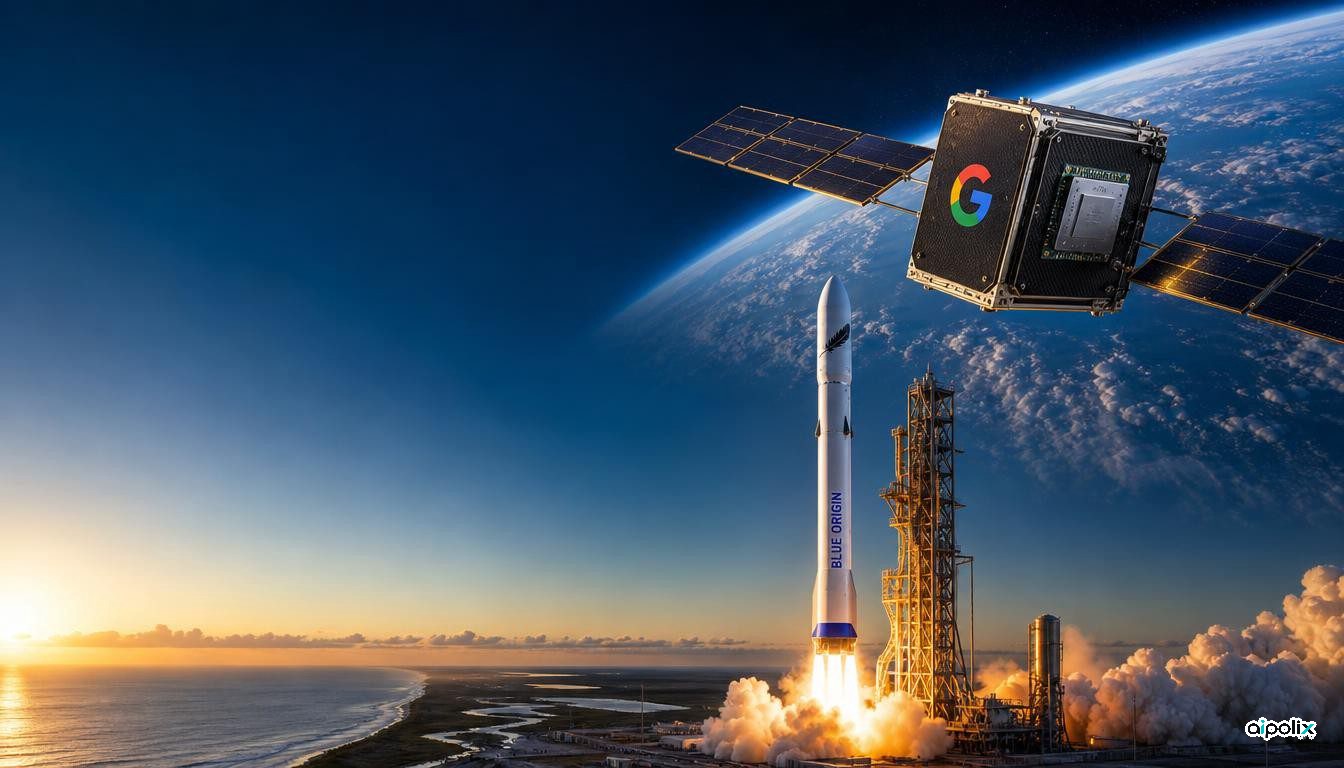
Google and Blue Origin said on November 19, 2026 that they have agreed a launch services deal for Project Suncatcher, Google's research effort to scale machine learning compute in orbit. Blue Origin's heavy-lift New Glenn rocket is targeted to fly in the first quarter of 2029 and place Google's satellites into sun-synchronous orbit. Google describes it as the first dedicated heavy-lift launch for the project. Travis Beals, the senior director leading Suncatcher, wrote the announcement on Google's blog.
Each satellite in the mission is designed to carry roughly the computing capacity of a single data center rack. Suncatcher's premise is that a network of solar-powered satellites fitted with Google's Tensor Processing Units, the company's AI chips, could tap the constant sunlight available in orbit to run machine learning workloads. Beals calls the project a long-term moonshot and describes the Blue Origin launch as a crucial milestone on the roadmap for the future of compute.
Blue Origin framed the agreement from the launch side. Jordan Charles, its senior vice president for New Glenn, said the project represents the ambitious missions the rocket was built to support, and that heavy-lift capacity and large payload volume give customers flexibility to bring new capabilities to orbit.
The deal follows a smaller first step. Google flew its first AI server satellite in October on a SpaceX Falcon 9 rideshare mission, in a partnership with Planet that put a Google TPU on a Planet satellite. According to The Verge, that prototype booted its TPUs and used an onboard Gemma 4 model to send an AI-generated haiku back to Earth. Google's own post says the Blue Origin launch builds on ongoing work with other satellite and launch partners, so the New Glenn mission is one part of a wider programme rather than the whole of it.
Much of the detail that would let outsiders judge the plan is missing. Neither company has said how many satellites will fly, what the contract is worth, how the satellites will be powered and cooled at rack scale, or how they will connect to ground networks. Via Satellite noted the same gap in its report. A launch date three years out also leaves room for schedule changes on either the rocket or the payload.
The announcement matters mainly as evidence of intent. A dedicated heavy-lift booking means Google is planning for satellites far larger than a rideshare payload, and it ties a space-based compute roadmap to a specific vehicle and window. Whether orbital TPUs can match terrestrial data centers on cost and reliability is still an open question that this agreement does not answer.