
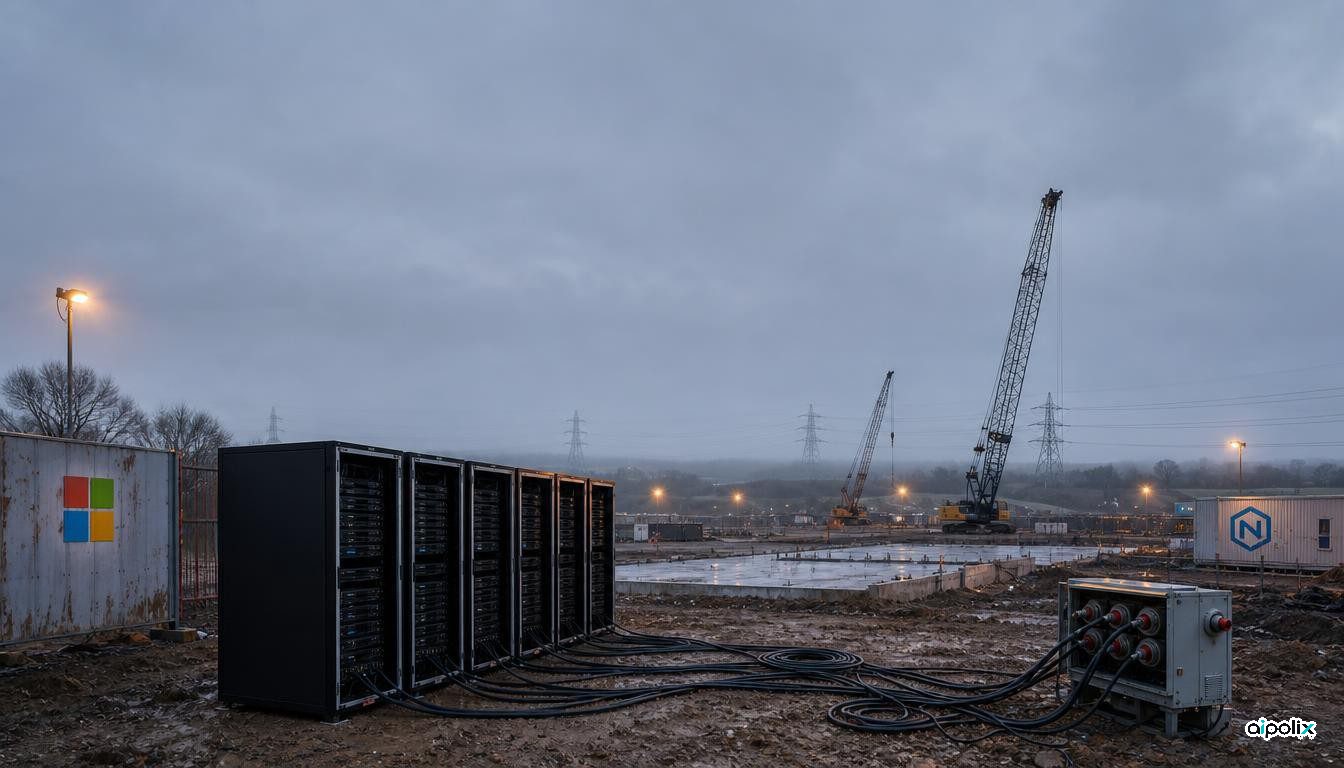
Microsoft has walked away from the AI data centre that was meant to give Britain its largest supercomputer. According to the Telegraph, which broke the story on Sunday, October 18, 2026, the company recently terminated its agreement with Nscale for the planned campus in Loughton, Essex. The Guardian reported separately that Microsoft had informed Nscale it was pulling out, leaving the British infrastructure provider without its only publicly announced customer for the site.
The project carried unusual political weight. When Nscale and Microsoft unveiled it in September 2025, alongside a wave of US technology investment in the UK, Nscale said Loughton would deliver 50MW of AI capacity, scalable to 90MW, and initially house 23,040 NVIDIA GB300 GPUs to be delivered in the first quarter of 2027 to serve Microsoft's Azure customers across the country. Satya Nadella described it at the time as the UK's largest supercomputer. Keir Starmer's government had already showcased the site as the largest UK sovereign AI data centre in its 2025 AI strategy.
Power is the central problem. The Telegraph reported that the project had suffered repeated delays and that grid officials had told Nscale they did not expect to supply electricity to the site until the 2030s. That echoes reporting from September, when the Guardian said UK Power Networks had indicated sufficient capacity might not be available until the early to mid-2030s. A 90MW connection is roughly equivalent to the consumption of 315,000 homes, and Ofgem said in June that 315 data centres were queueing for grid connections, representing 73GW of demand against a national peak of about 45GW.
Microsoft has not explained its decision publicly. Reuters, which relayed the Telegraph report, said the newspaper did not specify why Microsoft withdrew and that Microsoft did not immediately respond to a request for comment outside business hours. The Guardian attributed the exit to concerns about power supply and said it understood Microsoft remains involved in another Nscale project in Norway.
Nscale's response did not dispute the report. A spokesperson said the company's relationship with Microsoft remains strong and long-term, described the setback as a London-wide grid issue with no effect on its other contracts, and said Nscale is exploring alternative power sources for Loughton as well as other expansion sites in the UK. In September, the Guardian reported that Nscale was also investigating on-site generation and ways to speed up the connection process.
The timing is awkward for Nscale. Reuters noted that the Nvidia-backed company filed for a US initial public offering last month, with Microsoft and Anthropic expected to be major customers according to its prospectus, and it put the company's total contracted value at more than $103 billion, up from $100 million roughly two and a half years ago. The Guardian said losing the Loughton anchor tenant could weigh on a listing that has been discussed at a valuation of around $35 billion. Nscale competes with neocloud providers such as CoreWeave, Nebius, Crusoe and Lambda.
The episode is a concrete example of grid access, rather than chips or capital, becoming the binding constraint on AI infrastructure in Britain. It also shows how quickly headline commitments can unravel when power timelines slip by several years. Several questions remain open: whether Microsoft will shift the planned UK capacity to another location or provider, whether Nscale can secure a new tenant or on-site power for Loughton, and how its IPO disclosures will treat the change. None of the companies has published financial details of the terminated agreement.