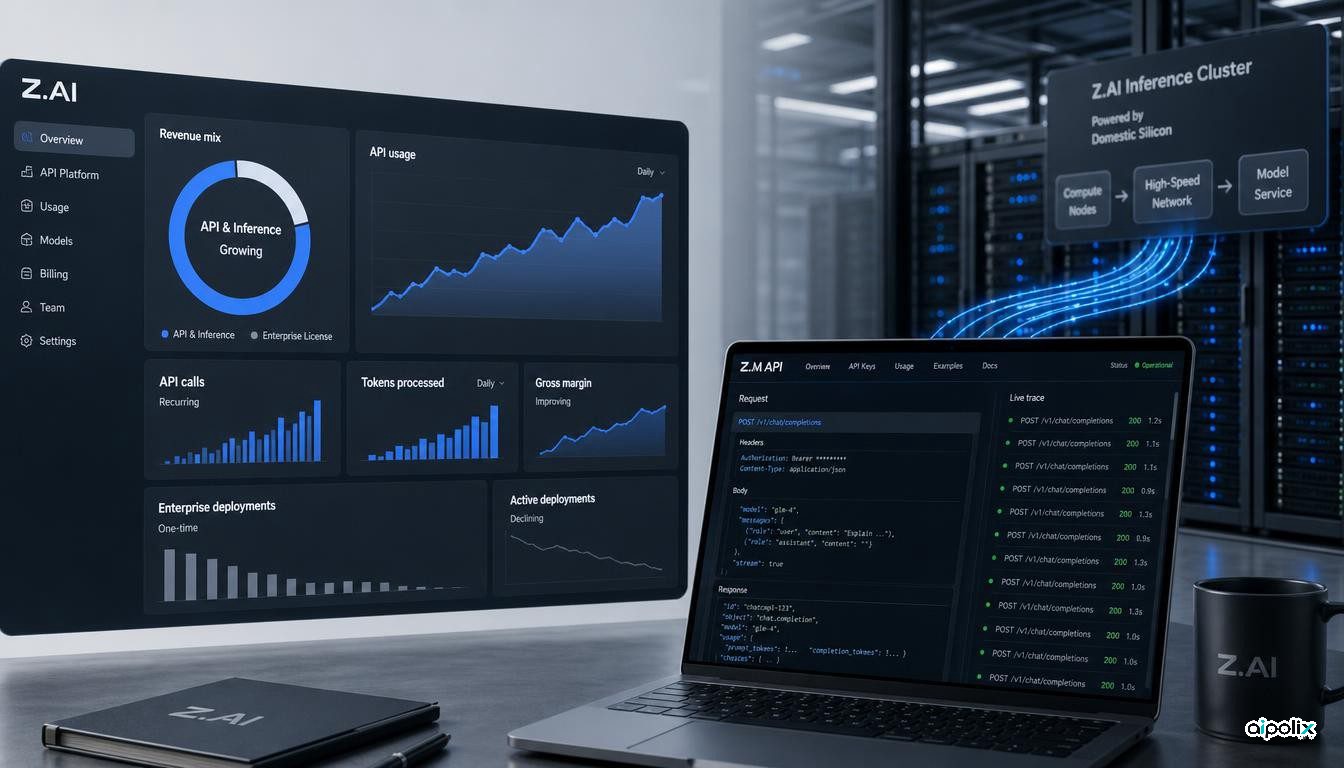
Z.AI's first-half results show a commercial shift that matters more than the headline 400% revenue growth. The company, formerly known as Zhipu AI, reported RMB953.9 million in revenue for the six months ended June 30, up 399.7% year on year. But the more important change is where that revenue now comes from: open-platform and API services rose to RMB825.2 million, or 86.5% of total revenue, compared with 15.2% a year earlier, while enterprise general-purpose model deployment revenue fell 54.6%.
That changes the business question around independent model labs. It is no longer only whether they can train competitive models. It is whether they can turn inference into a recurring service with improving gross economics while continuing to fund expensive research. Z.AI's interim-results announcement provides unusually detailed evidence on that transition, while Reuters independently reported the revenue surge and the narrowing statutory loss.
Revenue moved from deployments to recurring inference
Z.AI reported total first-half revenue of RMB953.9 million, up from RMB190.9 million in the same period of 2025. Open-platform and API revenue increased 2,735.7% to RMB825.2 million and represented 86.5% of the total. Enterprise-level agent revenue rose to RMB55.6 million, while enterprise-level general-purpose large-model revenue fell to RMB67.0 million from RMB147.6 million.
The mix matters more than the growth percentage. A year ago, Z.AI still depended heavily on project-style enterprise deployments. In the first half of 2026, the company says it deliberately scaled back on-premise model licensing in favor of continuously invokable services, subscriptions and eventually task-level delivery. Revenue is therefore becoming more closely tied to repeated model usage than to one-time software delivery.
This is not automatically a stronger business. Usage-based services expose a model provider to inference costs, utilization volatility and price competition. But the reported mix indicates that Z.AI has crossed an important commercialization threshold: customers are paying repeatedly for model access at a scale large enough to dominate company revenue.
Unit economics are more useful than user counts
The filing says token invocation volume on Z.AI's MaaS platform had increased more than 40 times from the beginning of 2026 by the date of the announcement. Coding Plan invocation volume had risen more than 23 times. At the same time, the company says its average API selling price increased by about 101%, while the gross margin of the open-platform and API business rose to 24.6%.
Those figures are company-reported and should not be treated as an independent measure of market power. They do, however, provide a more useful commercial signal than user counts or benchmark rankings. Z.AI is reporting that both usage and effective pricing increased while the gross margin of its core API business improved.
The company also reported that inference cost per token fell 80% from the beginning of the year after deploying a cluster of more than 100,000 domestic chips. That claim is not independently audited as a technical benchmark, and the filing does not provide enough detail to compare the cluster directly with imported GPU systems. Still, when read alongside the revenue mix, it shows why infrastructure efficiency is becoming inseparable from model-company economics. If API revenue is the dominant business, small changes in cost per token can materially change gross profit as invocation volume scales.
Coding is the commercial wedge for agentic services
Z.AI explicitly links its revenue transition to coding and long-horizon agent behavior. The company says coding became the first scaled entry point for token consumption and cloud revenue, and that it is using the same planning, tool-use and error-recovery capabilities to expand into cybersecurity, data analytics and other professional workflows.
That framing should be treated partly as management strategy rather than established external fact. But the financial statements provide one concrete anchor: open-platform and API revenue is now the dominant line, while enterprise-level agent revenue is growing from a smaller base. The company also says newer cybersecurity, legal, finance and education co-work pilots have not yet generated material revenue beyond the broader progress in cybersecurity.
For developers and enterprise buyers, this suggests a useful distinction. The model vendor's near-term economics still depend primarily on API consumption, even when the product narrative is moving toward agents that sell completed outcomes. Agentic task delivery may be the strategic destination, but the current monetization engine is still recurring inference.
Rapid growth has not removed the capital burden
The growth numbers do not mean Z.AI has reached financial self-sufficiency. Research and development expense increased 33.6% to RMB2.13 billion in the first half, more than twice total revenue. The statutory loss for the period narrowed 12.1% to RMB2.07 billion, while adjusted net loss increased 12.1% to RMB1.96 billion.
This creates a clear tension in the model-lab business. Gross economics can improve at the service layer while total economics remain dominated by model development and infrastructure investment. The company can therefore show better API margins and narrower statutory losses without yet proving that the overall model-development cycle is sustainably funded by operating revenue.
That distinction matters when evaluating fast-growing AI vendors. Revenue growth alone can make a company look commercially validated. A more complete test asks whether recurring inference revenue is growing faster than the cost base required to maintain model competitiveness, and whether the gross profit generated by usage can eventually absorb research and infrastructure spending.
What this says about independent model labs
Z.AI's results offer a rare public view into a model lab that is neither a US megavendor nor a private startup. The most important evidence is not that revenue grew nearly fivefold. It is that the business mix flipped from enterprise deployment toward API consumption while the company reported higher API pricing, improving API gross margin and lower inference costs.
The Aipolix analysis is that the competitive boundary for independent model labs is moving from model quality alone to a three-part systems problem involving capability, distribution and inference economics. A lab can have a strong model and still fail commercially if it cannot generate recurring demand or serve that demand efficiently. Conversely, strong usage growth is not enough if research spending remains structurally disconnected from gross profit.
Z.AI has not solved that equation yet. Its losses remain large, several performance claims are self-reported, and much of the company's agentic expansion is still in pilot stages. But the interim filing provides measurable evidence that its commercialization model is changing from selling deployments to selling continuous intelligence. For practitioners and industry observers, that is a more consequential signal than another leaderboard result.