
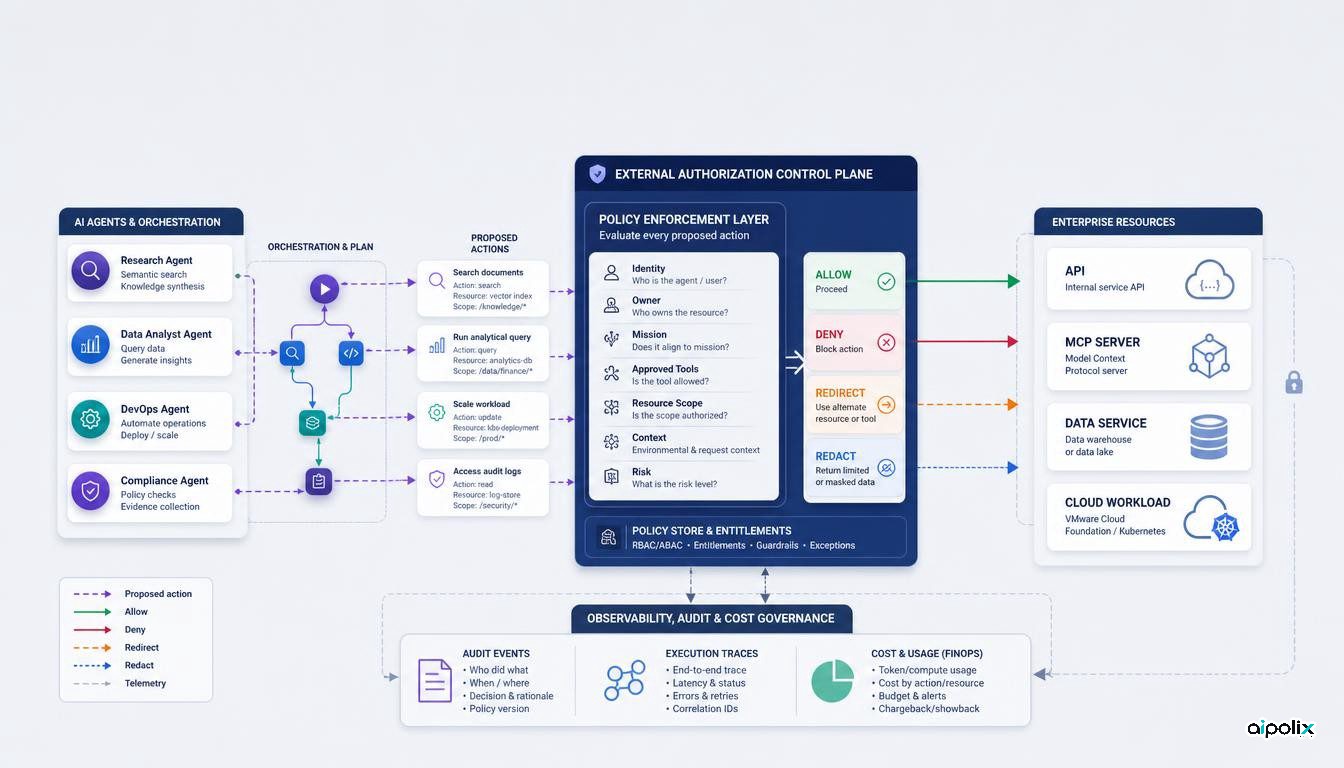
Broadcom has introduced AgentMinder, a generally available control layer for enterprise AI agents that evaluates each attempted action before it reaches a model, MCP server, API, or other resource. The product assigns agent identity and evaluates requests against an owner, declared mission, intent, approved tools, authorized resources, context, and risk.
That matters because many agent deployments still put most policy logic inside the agent runtime itself: prompts, tool allowlists, framework permissions, or application-specific middleware. AgentMinder's more consequential design choice is to move authorization into a control plane that can sit outside the individual agent framework. The architectural question is therefore less whether Broadcom's product is the right implementation and more whether enterprises should treat autonomous agents as principals whose actions need independent policy enforcement.
Authorization moves closer to the action boundary
In its announcement, Broadcom says AgentMinder verifies agent identity and authorizes each action against declared mission, intent, context, and current risk before the request reaches an enterprise resource. The company says the gateway can make allow, deny, redirect, or redact decisions.
Independent coverage from SiliconANGLE describes the same pattern as an additional control plane independent of the agent runtime. It also reports that AgentMinder is generally available immediately.
For architects, the useful distinction is between deciding what an agent should do and enforcing what it may do. A model can still plan, reason, and select tools, but the final permission decision can be made by a separate component that has its own policy and identity context. That separation is familiar in other security domains, but agent systems often collapse the two layers into the same orchestration code.
Identity becomes a first-class agent primitive
The product's identity model is more important than the marketing label around "intent." If an enterprise wants to control autonomous actions consistently, it needs to know which agent is acting, on whose behalf, for which mission, with which approved resources, and under which policy version.
That creates an operational requirement that is easy to overlook. Agent identity cannot be only a display name or a prompt field. It needs durable provenance across orchestration systems, tool calls, retries, subagents, and background jobs. Otherwise an external authorization layer can receive rich-looking metadata that is not trustworthy enough to enforce policy.
This is where the design can become difficult in multi-agent systems. A parent agent may delegate to a subagent, a workflow may switch models, or a background job may resume hours later. The authorization context must survive those transitions without granting broader rights than the original task required.
Runtime governance and FinOps start to converge
Broadcom's CloudHealth post adds another dimension: the same identity and mission metadata can be used to attribute AI spend and apply economic controls such as routing, budgets, and circuit breakers.
That suggests a broader control-plane pattern. Security policy and cost policy are both decisions about whether a requested action is acceptable under current context. An organization could block a dangerous tool call, redirect a low-priority inference request to a cheaper model, or stop a runaway workflow when its budget is exhausted. The mechanisms differ, but they depend on the same underlying telemetry: actor, mission, resource, action, and policy.
The practical implication is that agent observability should not be designed as a separate after-the-fact dashboard. If identity and mission metadata are needed for authorization and cost control, they should be created at task inception and propagated through every action so that enforcement and audit records describe the same execution.
The hard part is trustworthy policy context
AgentMinder can enforce only what it can reliably observe. "Mission" and "intent" are especially challenging because they are semantic concepts, not immutable network attributes. If the agent itself can freely rewrite the description that determines its permissions, the policy boundary weakens.
A durable enterprise design therefore needs explicit rules for where mission metadata originates, who can change it, how delegated tasks inherit or narrow it, and how policy versions are recorded. High-risk actions may also need deterministic constraints that do not depend on a model's interpretation of intent.
This is the main architectural consequence of the release. Moving governance outside the agent runtime can reduce dependence on any single model or framework, but it also turns metadata provenance into security infrastructure. The external control plane is only as strong as the identity and context it can trust.
What teams should evaluate
The immediate evaluation question is not whether a gateway can block a demo request. Teams should test whether policy survives real workflow complexity: subagents, asynchronous jobs, retries, model switching, MCP tools, API credentials, and partial failures. They should also verify whether the enforcement layer produces audit evidence that can reconstruct why an action was allowed, denied, redirected, or redacted.
Broadcom's launch is one implementation of a wider enterprise pattern: autonomous agents are beginning to look less like application features and more like software principals that need identity, authorization, telemetry, and budget controls. If that pattern holds, the agent runtime will not be the final security boundary. The enforcement plane around it will be.