
DeepSeek has published dsh-superagent, an open-source research prototype of a coding agent that stays online, watches a team's GitHub repository and, optionally, its Feishu chats, and takes on work when an authorised person asks for it. The code appeared in the deepseek-ai GitHub organisation on October 31, 2026 as a single commit under the MIT licence, and the DeepSeek Harness team followed on November 1 with a long design article, "Exploring Super-agent Design: Towards a More Autonomous Agent System", posted on its official X account. DeepSeek labels the release research code for reference only and says it is not an official DeepSeek product.
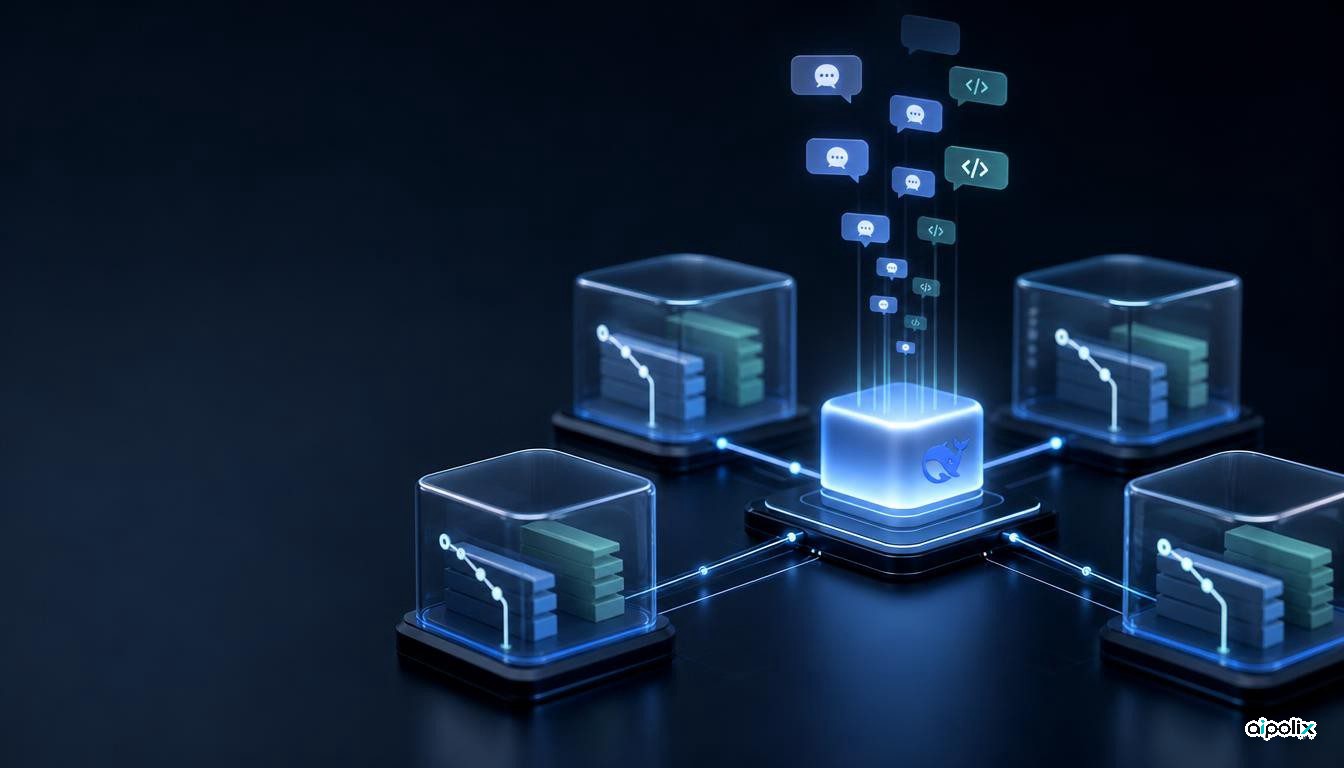
The argument behind it is about human attention rather than model capability. The team writes that today's agents treat one session as the unit of work, and that in its experience a person can follow only three to five active sessions at once. Its answer is a two-level design: a long-lived Router session that handles all conversation with people, keeps the global context and dispatches tasks without executing them itself, and a layer of Worker sessions, each with an isolated context and a full tool set, dedicated to a single task. Workers never talk to people directly; they report to the Router, which answers in the original conversation.
In the prototype, which is packaged as a bundle for DeepSeek Harness, the company's open-source agent software now in public preview, events from GitHub or Feishu become Triggers. A request that qualifies opens a Ticket, a unit of authorised work carrying an immutable Mandate that records why it may proceed, and each Ticket runs in its own session and working directory. Later comments on the same pull request go straight to the subscribed Worker without another pass through the Router. A local web panel lists only the items that need a person.
Proactive behaviour is deliberately gated. Work nobody asked for needs a rule the team has written, and the default accept mode, observe, only records what the agent would have accepted; operators are told to switch to auto after reviewing those decisions. The documentation is blunt about risk: both agent presets run with full access as the operator's operating-system user, a Worker can read the operator's home directory, and DeepSeek recommends a dedicated OS account and a separate GitHub account for the agent.
The article reports preliminary experiments on synthetic workloads: about 300 chat and CI messages per run, roughly 20 of them real requests, with coding replaced by a tool that only consumes time. DeepSeek says the Super-agent design finished tasks in 12.4 minutes at the median and 15.7 minutes at the 95th percentile, against 29.5 minutes at the 95th percentile for a single session with a subagent tool and a neutral prompt, which never delegated in five runs. The team calls the results indicative only, and they measure scheduling, not code quality. Several ideas in the article, including a Watchdog session, compute separated from state and an asynchronous ReAct loop, are not part of the prototype.
The repository collected more than 10,000 GitHub stars within two days, and the announcement post had passed 1.9 million views by November 2. MarkTechPost and Funded Weekly reported the release; neither tested the software, and no independent evaluation has been published.
For teams building agent infrastructure, the release matters less as a product than as a public design reference from a major model lab: a documented pattern for always-on, event-driven agents with explicit authorisation, at a moment when coding agents are moving out of chat windows and into shared team workflows.