
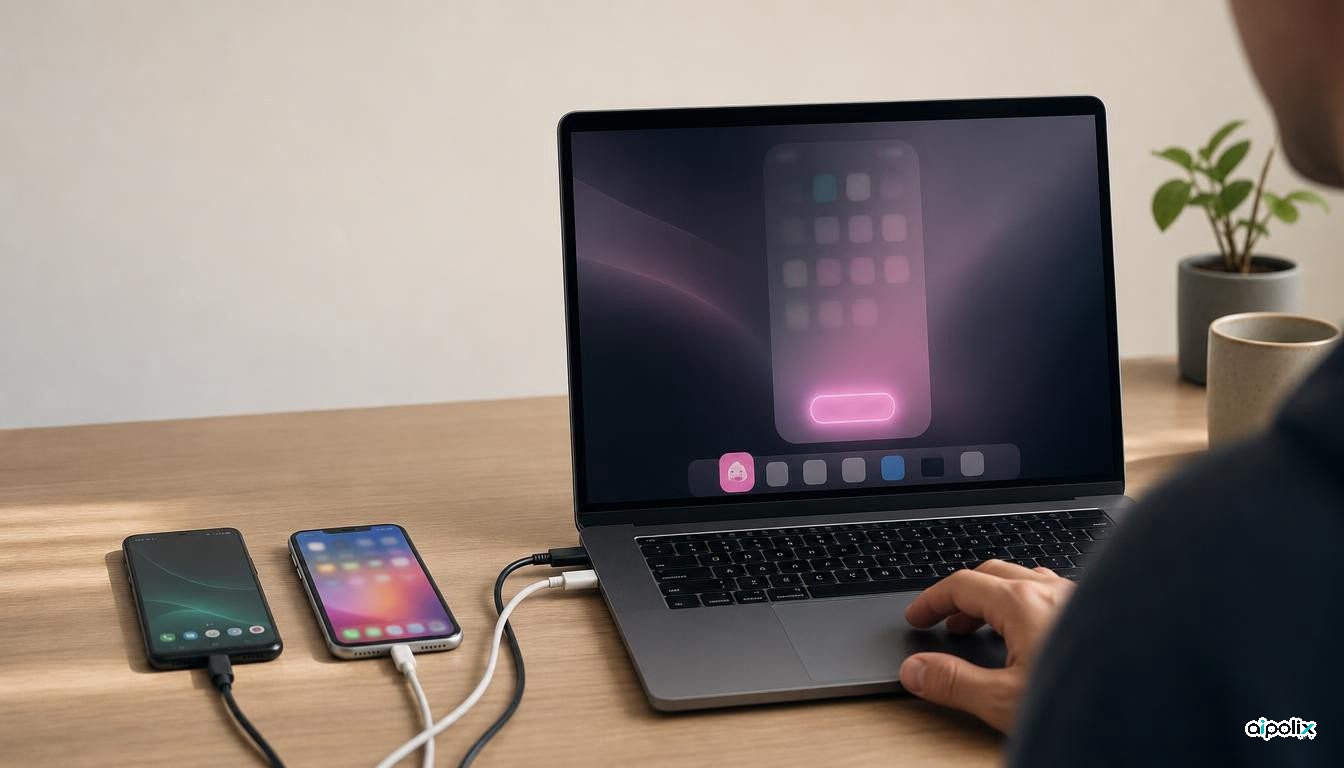
DIYgod, the developer behind the RSSHub feed service and the Folo reader, has released Pinky, an open-source desktop app that lets AI agents operate a real iPhone or Android phone. The DIYgod/pinky repository was created on GitHub on November 6, 2026 under the Apache-2.0 licence. The project calls itself pre-alpha, yet it had 1,189 stars by the morning of November 9 according to the GitHub API, after shipping dozens of builds in its first three days.
Pinky runs on macOS, Windows and Linux and reaches the phone over USB or Wi-Fi. It exposes the device to agents as an MCP server through the pinkyctl mcp command, and its settings screen can register itself with Claude Code, Claude Desktop, Codex, Cursor, VS Code, Copilot CLI, Windsurf and Gemini CLI. The app contains no language model of its own. The user watches a live mirror of the phone, can click into it to pause the agent and take over, and gets every run recorded as plain-language steps, screenshots and a screen recording that can be exported as an HTML report kept on the computer.
The central design choice is that approvals are enforced by Pinky's gateway rather than by instructions in the agent's prompt. By default, payments, trades and transfers wait for a click in Pinky's window, and users can extend that to sent messages, deletions, orders, calls and app installs. Banking, wallet and password-manager apps are hidden from agents, and agents cannot type into password or one-time-code fields. A code review published by Tokenstrom found that only the desktop interface can grant an approval, that unanswered requests are denied after 60 seconds, and that each approval is tied to the session, device, tool and arguments and can be redeemed once.
Device support is broad for a three-day-old project. Android 10 to 17 works, with a companion app that speeds up screen reading, and on Android 13 and later the agent operates on a hidden second display so the owner can keep using the phone. iPhones need iOS 17.4 or later: from iOS 27, Pinky talks to the phone through the protocol behind Xcode's Device Hub with nothing installed on the handset, while older versions need the WebDriverAgent helper built from Xcode, which must be re-signed every seven days with a free Apple ID. The interface is drawn natively on the GPU with the MyGo toolkit instead of Electron, which keeps the download between 16 and 22 MB.
Phones are an obvious next target for agents that already work in browsers and terminals, because messaging, delivery and banking apps often have no web equivalent. Tokenstrom compared Pinky with Open-AutoGLM, mobile-mcp and several Android control servers and concluded that most either let the model decide when to ask for confirmation or offer no payment approval at all. VibeHacker and Hamidun News also covered the launch, the latter working from DIYgod's announcement on X.
The limits are spelled out, partly by the project itself. The README warns that an agent allowed to run shell commands could reach an Android phone directly through adb and skip Pinky's rules, so it recommends running such agents in a sandbox or plugging the phone into a different computer. Tokenstrom noted that the finance-app blocklist relies partly on keyword heuristics and missed several German banks, and that the iOS 27 route leans on Device Hub interfaces it could not find officially documented for remote input, so an Apple update could break it. Claude Code is the only agent the author has tested end to end on real phones.
For developers building agent workflows, Pinky is a concrete example of moving the human-approval step outside the model, where text injected into a screen cannot talk its way past it. How much that protection is worth will depend on whether agents are properly isolated from the phone, and on testing across far more devices than the handful listed in the repository so far.