
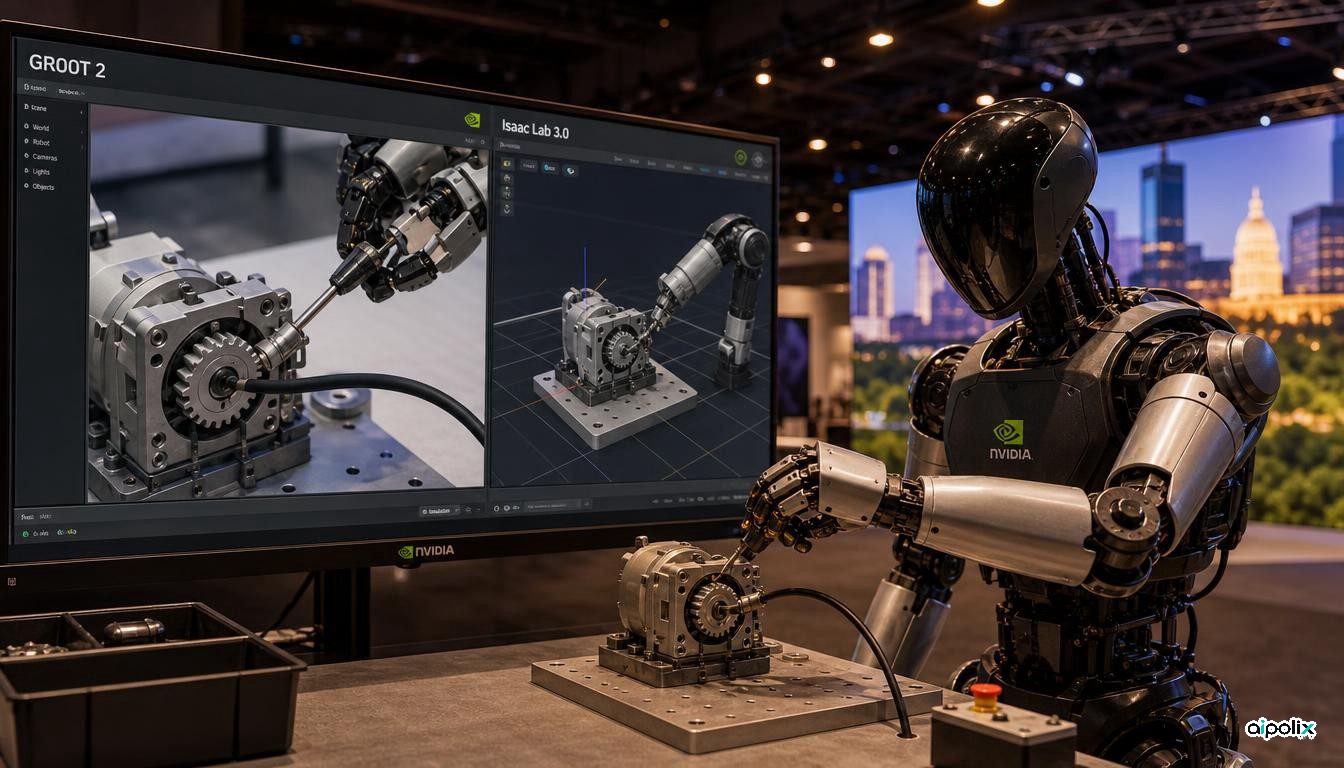
NVIDIA said on November 9, 2026 that it is introducing new open robotics technologies at the Conference on Robot Learning in Austin, Texas, in a blog post by Sasa Docca. The centerpiece is GR00T 2, which NVIDIA describes as an open frontier world action model built on NVIDIA Cosmos and trained on diverse robot and human data, including 100,000 hours of NVIDIA open-source human egocentric data. The company says the model is meant to help robots learn dexterous manipulation rather than only locomotion, a shift it says is taking center stage at CoRL alongside agentic robotics.
NVIDIA reports several of its own evaluation figures for GR00T 2. It says the model completed 40 of 50 evaluated tasks at least once without task-specific demonstrations, transfers skills learned from human demonstrations across different robot bodies, and reached 71 percent average success across 50 tasks with one demonstration per task, rising to 95 percent with five. Agents can use an application programming interface and supporting tools to run skills in sequence and recover from errors, the post says. NVIDIA also says GR00T 2 ranks among the top three models across the RoboCasa365, RoboLab, RoboDojo and MolmoSpaces benchmarks, with multiple leaderboard wins.
Early testers named in the post include Nexuni, which is trying the model for robotic laundry handling, Foxconn, which is applying it to factory automation for server manufacturing, and Siemens, which is evaluating it across industrial use cases. MicroAGI is using a version post-trained with reinforcement learning to swap Ethernet cables with a YAM robotic arm, and plans to show an agentic workflow at the conference. NVIDIA is also publishing a Video to Data workflow that turns human video into simulated robot demonstrations, and the EgoHand model, which reconstructs three-dimensional hand motion and, NVIDIA says, passed 40,000 downloads on Hugging Face in the two weeks since launch, trained with data from Noitom Robotics.
Simulation is the other half of the announcement. Isaac Lab 3.0, the latest release of NVIDIA's open-source robot-learning framework, lets researchers use agents to set up training environments, switch between the NVIDIA PhysX and Newton physics solvers, choose renderers, and apply a new reinforcement post-training library to foundation models such as GR00T. Tighter integration with Newton, an open-source physics engine, is said to model deformable objects such as cables and cloth and complex articulated hands. NVIDIA says Isaac Lab 3.0 with Newton reached up to 2.5 times the training throughput of Isaac Lab 2.3 with PhysX on a vision-based dexterous manipulation benchmark. Partners cited include Skild AI, which announced a Newton-based solver called STEEL, Flexion, FieldAI, Dyna Robotics, Walden Robotics and Dexmate.
Two new open benchmarks are meant to measure industrial dexterity. DexBench, developed by RLWRLD with NVIDIA and built on Isaac Lab-Arena, covers 15 tasks across four scenes in retail, logistics, manufacturing and hospitality. VABAR, from UC Berkeley and NVIDIA, evaluates robots across six industrial tasks with standardized variations and success metrics. Isaac Lab-Arena itself, an open framework for running policies across many simulated variations, is arriving at CoRL in a 0.4 developer preview. A related research note describes AlphaNIST, a single policy trained in Isaac Lab on all 20 tasks of the NIST Assembly Task Board; NVIDIA says it reached more than 98 percent training success, compared with 81 percent for separate per-task policies, using about 39 times less GPU time, with a method called Success-Guided Sampling from the University of Washington and NVIDIA.
The post also highlights agentic robotics. UC Berkeley's Graph-as-Policy framework uses agents to connect individual skills into robot programs, test them in NVIDIA Isaac simulation and refine them from failures. Ken Goldberg, a professor of robotics at UC Berkeley and a lead on VABAR and that framework, is quoted saying agentic robotics is the most exciting technological development since the internet in 1995. Ambi Robotics, Bosch Research and Siemens are exploring the approach. Two NVIDIA papers, GRAIL and RoboTTT, are among six finalists for CoRL Best Paper Awards. All capability, benchmark and throughput figures above are NVIDIA's or its partners' claims; the blog does not publish independent third-party tests of GR00T 2 or Isaac Lab 3.0.