
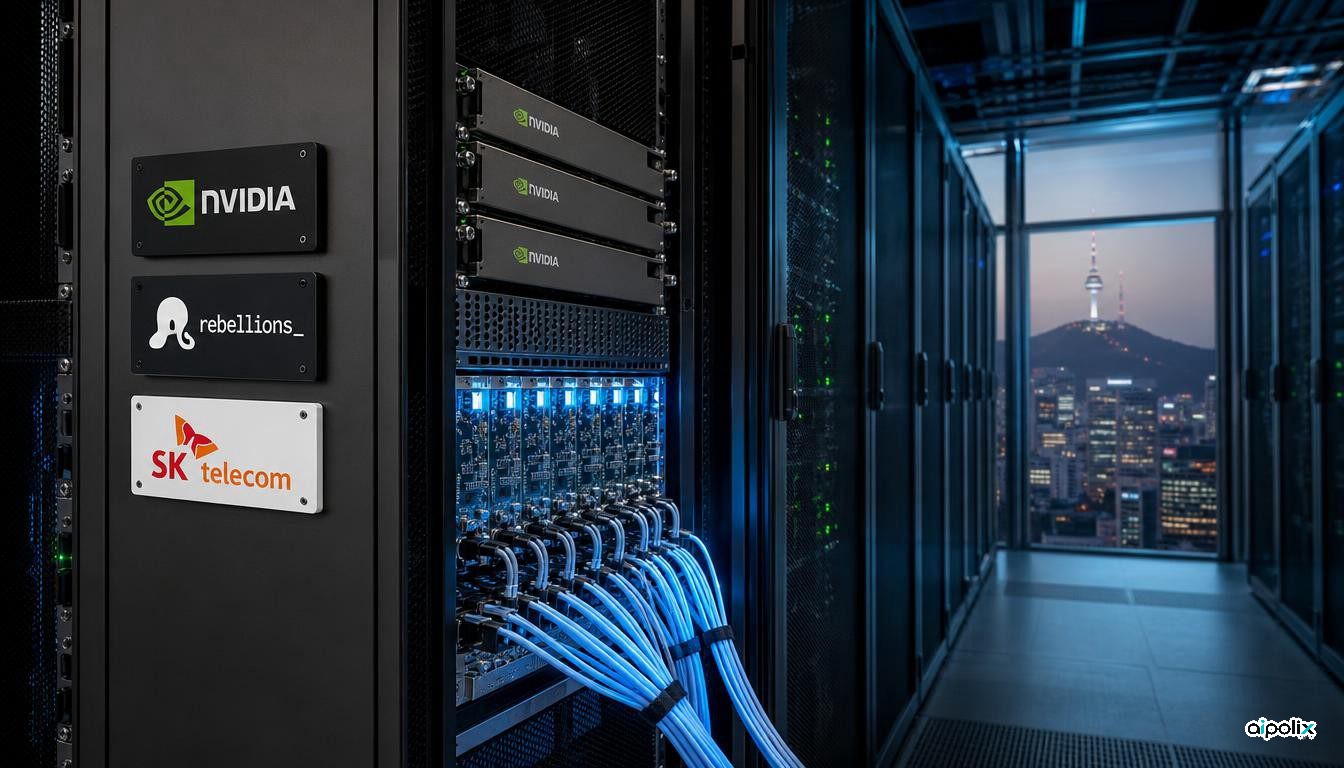
NVIDIA, the Korean AI chip startup Rebellions and the telecom operator SK Telecom announced a collaboration on November 8, 2026 aimed at building inference infrastructure for Korea's sovereign AI push. Under the plan, Rebellions will connect its next-generation Rebel R200 neural processing units to NVIDIA's platform through NVLink Fusion, the program that lets chipmakers attach their own processors to NVIDIA's scale-up networking.
The systems would be built on NVIDIA's MGX rack architecture, which gives the partners common rack footprint, power delivery and cooling designs along with access to an established network of server makers and component suppliers. SK Telecom plans to deploy the resulting racks in its AI data center and link them to its own foundation models, including A.X K2, and to public services developed under Korea's AI for All project. Korea's Ministry of Science and ICT (MSIT) is backing the effort.
The companies also intend to develop an approach to disaggregated inference, which splits the stages of producing an answer across the processors best suited to each stage. In their plan, NVIDIA GPUs would handle prefill and Rebellions NPUs would handle decode, with the stated goal of improving throughput and power efficiency. Rebellions describes the R200 as tuned for low-latency, energy-efficient inference on frontier models, including multitrillion-parameter mixture-of-experts designs.
The timeline is long. The announcement says R200 systems are expected to be ready for deployment in 2028, and the language throughout is one of plans and aims rather than shipping products. No financial terms, rack counts or capacity figures were disclosed.
A companion NVIDIA blog post by Jesse Clayton places the deal inside a wider agreement with MSIT that spans semiconductors, data centers, talent, startups, models, agents and security. It says the work lays the groundwork for other Korean NPU and XPU companies to explore the NVLink Fusion ecosystem, adds training, certification and hackathon programs, and says NVIDIA will work with three selected consortia and four Korean foundation model builders under AI for All, using NVIDIA Dynamo software to scale inference.
Jensen Huang, NVIDIA's founder and CEO, said NVLink Fusion lets Korea's chipmakers tie custom ASICs into NVIDIA's AI factory platform. Bae Kyung-hoon, Korea's Deputy Prime Minister and minister of science and ICT, said the arrangement allows Korean-developed NPUs to enter the computing infrastructure market alongside NVIDIA, and that the government will support it, including cooperation on physical AI and securing GPU supply.
Everything above comes from NVIDIA's own announcement and its partners' statements. The efficiency and latency benefits are design goals rather than measured results, and no independent testing of R200 hardware or of the prefill and decode split has been published.