
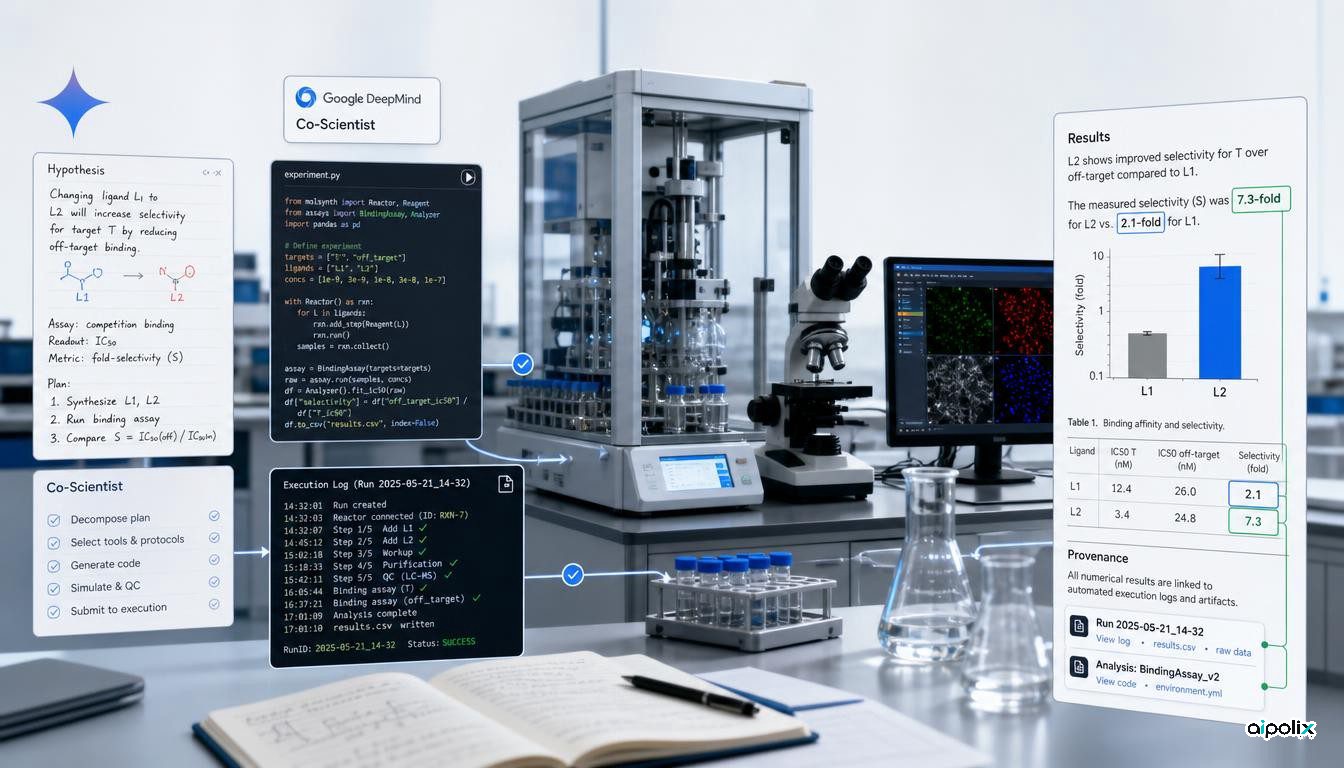
Google DeepMind researchers have extended Co-Scientist from a system that mainly generates and evaluates scientific hypotheses into an execution-grounded research framework that can plan experiments, write and run code, interact with laboratory equipment, analyze results and produce manuscripts. The new work spans materials science, synthetic biology and computer science, with different levels of human involvement in each domain.
The most important change is not that an AI system can propose another scientific idea. It is that the research loop now has an explicit connection between generated claims and what was actually executed. That makes the work relevant not only to AI for Science, but also to agent architecture, provenance and verification.
From hypothesis generation to execution-grounded research
The original Co-Scientist work focused heavily on hypothesis generation and scientific reasoning. Google's Gemini for Science announcement earlier this year positioned Co-Scientist as a multi-agent system that generates, debates and evaluates hypotheses.
The new arXiv preprint, submitted on August 27, 2026, extends that loop into experimentation. The authors describe a three-stage workflow covering ideation, experimentation and paper generation. Depending on the task, the experiment stage can produce code, machine-readable laboratory procedures or other executable artifacts, then use the resulting observations as evidence for later analysis.
This does not mean Co-Scientist is a fully autonomous laboratory scientist. Autonomy varies substantially across the experiments. In the materials work, humans still load samples and precursors, operate parts of the physical workflow and perform characterization. In computer science, by contrast, one experiment proceeds autonomously after the initial research objective is supplied.
That distinction is central to interpreting the results.
Real laboratory work, but with humans still in the loop
In materials science, the system was connected to a semi-automated chemical vapor deposition workflow. It proposed a safer precursor route for bottom-up MXene synthesis and helped guide repeated experimental refinement.
The researchers report producing a lamellar two-dimensional material with structural similarities to the Ti3C2Tx MXene lattice. However, they explicitly state that further experiments are required to confirm the atomic structure. That makes the result interesting, but not a confirmed discovery of the target material.
The team also used Gemini 3 Deep Think to adapt semiconductor growth recipes to the constraints of a specific laboratory setup. According to the paper, this enabled single-attempt growth of monolayer MoS2, MoSe2 and WS2. Humans still handled precursor loading, so the workflow combined machine-generated control with physical human intervention rather than replacing the laboratory operator entirely.
In synthetic biology, Co-Scientist built an image-based prediction pipeline for engineered E. coli colonies across different IPTG concentrations. Its predictions matched unpublished wet-lab measurements on three of four reported morphological dimensions. The authors also note that the experiment is closer to interpolation within a known regime than to predicting an entirely new biological system.
Agent_H exposes the limits of benchmark optimization
The computer science experiment is especially useful because it shows both what autonomous search can achieve and where automated evaluation can mislead.
Given a research objective and a constrained development environment, Co-Scientist designed an inference-time architecture called Agent_H for medical question answering. The resulting system uses multiple stages for triage, decomposition, parallel candidate generation, selection, critique, verification and response optimization.
On HealthBench Hard and HealthBench Professional, the paper reports that Agent_H outperformed six frontier-model baselines after the authors corrected for response-length effects.
But blinded physician evaluation produced a much more cautious result. Three board-certified physicians compared Agent_H with Gemini 3.1 Pro across nine clinical dimensions. Agent_H showed a statistically significant advantage in only one dimension: lower potential for clinical harm.
The gap matters. A system can optimize an automated benchmark without producing an equally large improvement in human expert judgment. The paper therefore provides its own example of why agent evaluation cannot be reduced to leaderboard performance.
The reliability layer may be the paper's most reusable idea
The strongest architectural contribution is the attempt to connect manuscript claims back to execution evidence.
Autonomous research agents have an obvious failure mode: a system that is rewarded for producing successful results can generate plausible claims about experiments that did not actually happen. Co-Scientist adds reliability modules that penalize fabrication and near-plagiarism, while a separate verifier cross-checks numerical claims against execution logs and generated experimental artifacts.
In a double-blind study, 30 domain experts produced 450 reviews covering 150 autonomously generated papers. The authors report that fabricated key results appeared in 4% of papers when the reliability modules were active, compared with 46% when those modules were removed and 90% for the comparison baseline. Completely fabricated data was reported at 0% for the protected Co-Scientist configuration versus 44% for the comparison system. Near-plagiarized content fell from 60% to 16%.
Those are large differences, but they remain results from the authors' own evaluation setup and have not yet been independently reproduced. The paper is also a new arXiv preprint rather than an independently peer-reviewed publication of this specific extension.
The authors still identify residual problems. Generated manuscripts can selectively report favorable results, and plausible methods descriptions can diverge from the code that was actually executed. In other words, verification substantially reduces the problem but does not eliminate the need for traceability and human review.
Safety is treated as part of the research loop
The system also adds safety controls for potentially harmful research directions. The authors report that an integrated safety architecture rejected 98.7% of unsafe directions in their evaluation.
That number should be interpreted as an author-reported result within a defined test setup, not a general guarantee of laboratory safety. The more important architectural signal is that safety gating is placed before execution rather than treated only as moderation of the final manuscript.
For scientific agents that can write code or control equipment, that placement becomes increasingly important. The risk boundary is the action itself, not just the text describing it.
Why this matters beyond AI for Science
The broader lesson is relevant to agent systems outside research.
Co-Scientist is moving toward a pattern where an agent's final claims are not trusted simply because the model generated a convincing explanation. Claims are checked against execution traces, experimental artifacts and observed results.
That is the same design principle production agents increasingly need in software engineering, operations, finance and regulated workflows: separate generation from evidence, preserve provenance, and make important outputs traceable to actions that actually occurred.
The paper does not demonstrate a fully autonomous scientist, and several headline results remain preliminary or highly task-specific. What it does demonstrate is a more mature agent architecture in which scientific reasoning, execution and verification are joined into one feedback loop.
That shift may prove more important than any single experiment reported in the paper.