Google is turning its Antigravity coding environment into a workbench for robot software. On November 17, 2026, the Gemini Robotics team announced a Robotics plugin for Google Antigravity in a Google Developers Blog post bylined by Alex Gruenstein, a distinguished software engineer, and Gabe Cohen, senior director of product management for robotics. The plugin's code sits in a new Apache 2.0 repository, google-deepmind/robotics-antigravity-plugin, created the day before.
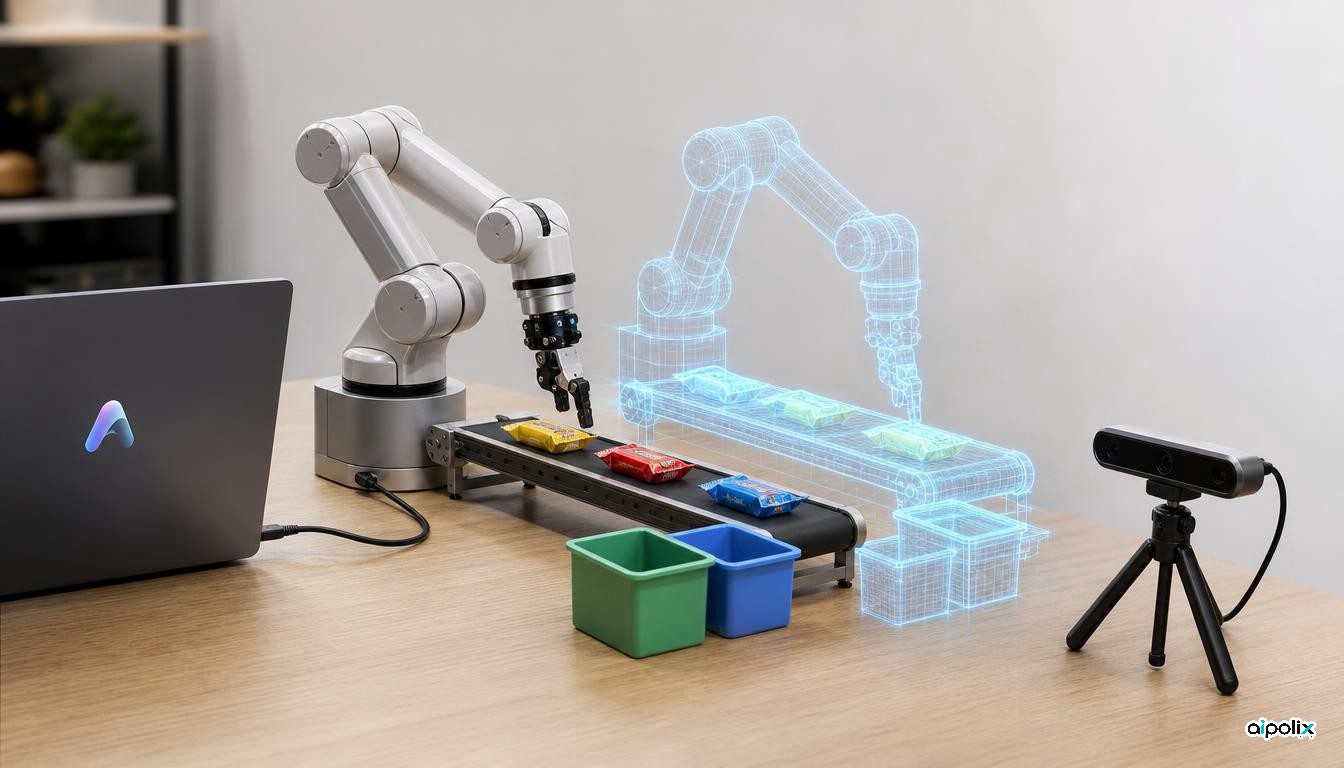
The plugin is a bundle of agent skills that the model calls on the developer's behalf. Bring-up skills install drivers, find cameras, calibrate an arm and run test motions, starting from a USB connection. MuJoCo skills build, check and render simulated scenes inside Antigravity, from a text description, a product link, documents or photos of a real workspace; Google calls the practice of reshaping such scenes through chat "vibe sim". Perception and control skills use the model's spatial understanding to locate objects, plan grasps and steer the arm in a closed loop, and application skills tie it together so that the controller tested in simulation is the same code that later drives the real robot. Developers can also stay entirely in simulation without any hardware.
The intended model is Gemini 4 Hydrogen, the fast Gemini 4 variant Google released the previous week. Google says Hydrogen scores 58 on the Artificial Analysis Robotics 0.1 benchmark, in which a model controls a real six-axis arm through eight tabletop tasks such as pouring a drink or packing blocks, a result it describes as similar to Gemini 4 Argon at a lower price per token. As TAO's Bart Hillerich pointed out in his November 18 write-up, that figure is a mean task score out of 100 with partial credit, not the share of tasks fully completed. Google also says Hydrogen beats its specialised Gemini Robotics ER 2 models on spatial reasoning questions in the public ERQA benchmark and suggests ER 2 users try it instead.
The launch post walks through company-run demonstrations rather than independent trials. An I2RT YAM arm with an external depth camera went from being plugged into a laptop to calibrated and ready in about ten minutes, and similar flows brought up a low-cost SO-ARM101 arm and an industrial FR3 Duo. In a longer example, a developer turned a whiteboard sketch of a snack-sorting conveyor into a MuJoCo cell, validated grasps over several simulated runs and then had a real arm sorting snacks off a moving belt within about an hour. Other demos pair two YAM Pro arms with a small web shop that packs its own orders, and set the FR3 Duo playing chess.
Access has some conditions. Inside Antigravity, the plugin is installed from the Customizations menu, on the Build With Google shelf, and Antigravity is limited to paid Google AI Pro and Ultra subscribers. The repository also documents installation from GitHub with the agy command line or through npx skills, but only the marketplace version bundles the seven MuJoCo skills; GitHub users must add them from the MuJoCo repository, and skills that call Gemini perception models need a Gemini API key. Hydrogen itself is available in the Gemini API's Interactions API and in Google AI Studio.
The repository adds a plain safety warning: users are responsible for operating their robots safely, should stay next to a moving arm, keep the workspace clear and keep a way to cut power within reach. TokenPost, in a report by Simon Yoon, and the technology site NeoTeo both covered the launch on November 18, mainly restating the official material.
The plugin is a notable test of a broader idea: that general coding agents, rather than specialised robotics stacks, can handle the drivers, calibration, simulation and control code that make robot projects slow to start. How well that holds up outside Google's own demos, and on arms beyond the handful it shows, remains to be seen.