
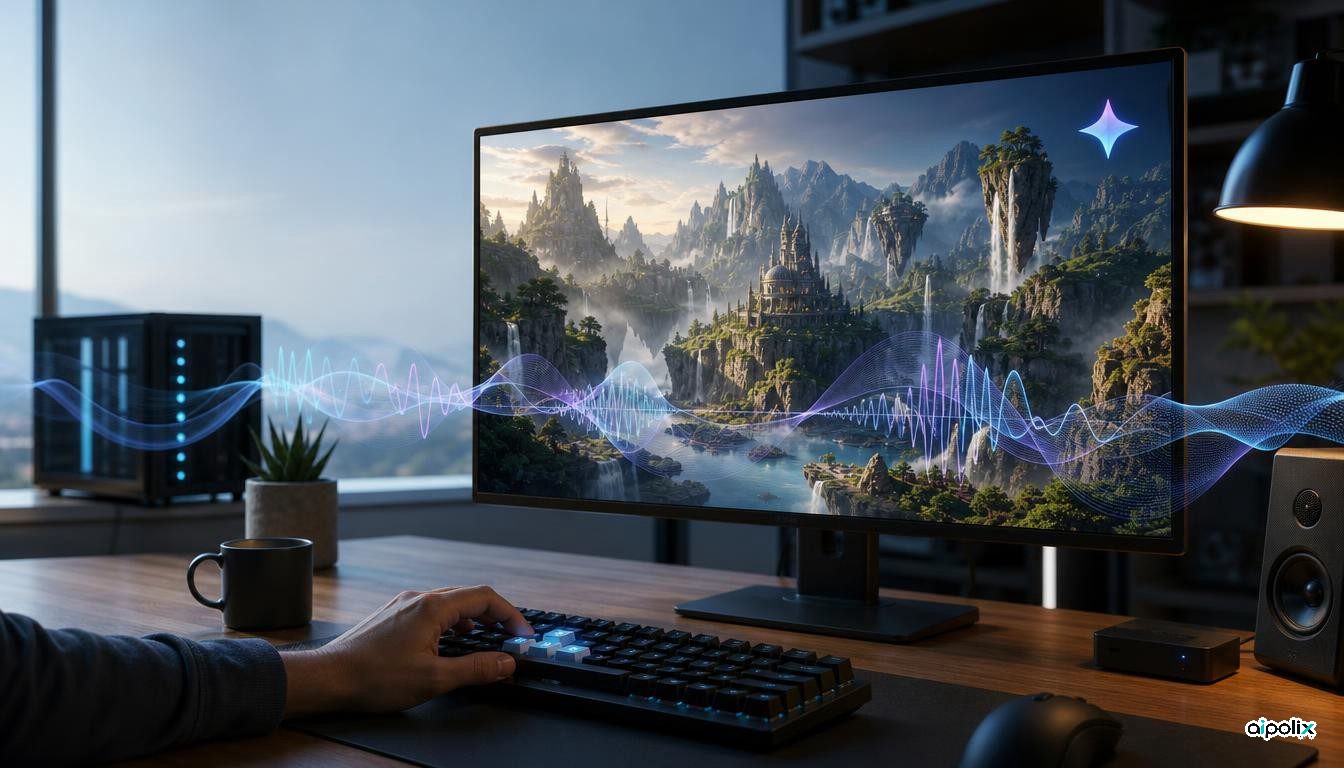
Google on November 19, 2026 made Genie 4 available to developers through the Gemini API and Google AI Studio, one day after the model's first launch. The model, named models/genie-4 in the API, generates interactive worlds in real time rather than fixed video clips, and it is served through the Interactions API in the v1beta channel.
According to Google's announcement, a developer can start from a text prompt, a reference image or both, and the model then produces a continuous world at 720p and 24 frames per second with synchronized native audio. The sound ranges from ambient soundscapes and effects to character dialogue. While the session runs, the user navigates with real-time keyboard controls and can change weather, lighting, objects or events with live text prompts. Google says Gemini reasoning keeps the world state consistent as these changes arrive.
The Gemini API changelog adds technical detail. The output is 16:9 video with 48 kHz stereo audio, streamed over WebRTC and WebSockets, and a reference image must be 16:9. Sessions can be steered with the WASD or arrow keys and with text events sent in the middle of a session. The changelog labels the release generally available and says it is offered on the paid tier only.
Pricing is $1.50 per million input tokens and $9.00 per million text output tokens. Video output costs $17.50 per million tokens, which Google converts to roughly $0.10 per second of generated world, with the stereo audio included in that price. A continuous interactive session is therefore billed mainly by its duration, which makes cost planning different from a typical text request.
Google suggests three uses: prototyping interactive experiences, visualizing designs for spatial concepts, and training robotics and AI agents. Google AI Studio offers an interactive canvas and starter apps so developers can try the model before writing code, and the company points to pricing and API documentation for those who want to build. Every output carries an imperceptible SynthID watermark, which Google included as a reminder of its provenance approach for generated media.
The release moves a world model from a consumer showcase into a developer product with a published price, which lets teams estimate what real-time simulated environments would cost for agent testing and prototyping. Google has not published benchmark comparisons, latency figures or session length limits in the sources reviewed, so the practical quality and cost at scale remain to be tested by early users.