
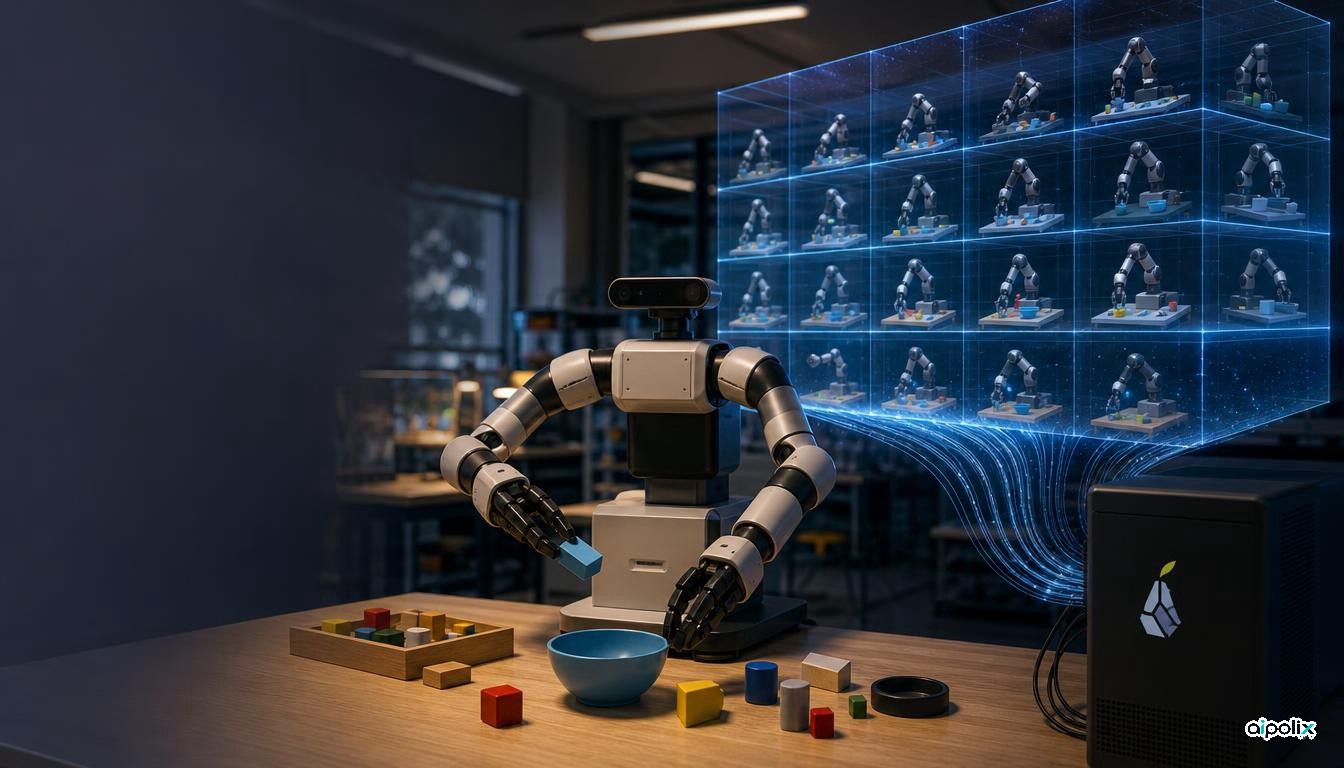
Researchers around MIT's Han Lab have published a recipe for teaching a general reasoning model to drive robot arms the way computer-use agents drive a desktop. The paper, "Training Reasoning Models in Simulation to Natively Use Real Robots" (arXiv 2611.18562, submitted November 13, 2026), lists Jiaming Tang, Zhuoyang Zhang and Junxian Guo as equal first authors, with Fangzhou Zhao, Yilong Zhao, Zekai Li, Xingyang Li, Yuyang Zhao, Song Bian, Zhijian Liu and Song Han, from MIT, UC Berkeley, UC San Diego, NVIDIA and Inco AI. The same day the group opened mit-han-lab/pear on GitHub under Apache 2.0: PEAR, short for Post-training Engine for Agentic Robotics, is the training infrastructure behind the work.
The approach removes the usual robotics scaffolding. In each round the model looks at camera frames and the arm's state, reasons in a chain of thought and writes the next end-effector pose as text; inverse kinematics and the arm's own controller then move it there. There are no perception tools, grasp or motion planners or skill libraries, so the model has to find objects, plan how to reach them and notice failed moves by itself. It learns only from whether a task succeeds, through what the authors call Robot-Use RL, run entirely in simulation and without human demonstrations.
The starting point is the open-weight Qwen3.8-27B. On the LIBERO benchmark, the authors report that training raised success from 1.6% to 74.4%, close to OpenAI's GPT-6 Astra and GPT-6.1 Sol at their maximum reasoning effort, which scored 80.6% and 76.2% in the same harness-free loop. The comparison with π0.5, a vision-language-action model fine-tuned on demonstrations, is more mixed. π0.5 scores higher on LIBERO itself, but when LIBERO-Pro keeps a familiar scene and asks for a different task, the authors say π0.5 drops to 0.75% while their model holds 57.4%. π0.5 still leads when instructions are merely reworded or objects restyled.
The paper's main argument is that skills learned in simulation transfer. Trained only on LIBERO's single-arm Franka tasks, the model reached 39.9% on RoboDojo's general_pickup task with a dual-arm ARX robot, against 10.7% for the base model, and 37.3% zero-shot on the RoboLab-120 benchmark after further simulated training, against 5.4%. On a real dual-arm YAM robot, with no real-robot data at all, the authors report success in 60% of their trials, where the base model never succeeded. They also report no measurable loss on nine reasoning, coding and vision benchmarks.
The release is unusually complete for a robotics paper. Besides the training engine, which runs asynchronous reinforcement learning on veRL with GRPO, offloads the KV cache with LMCache and schedules MuJoCo and Isaac Sim on the same Ray cluster, the group has posted the trained Qwen3.8-27B-PEAR model and quantized and draft-model variants on Hugging Face, plus deployment code for a vLLM server on a single RTX 5090 or GB300 and a robot station that drives YAM or SO-101 arms.
The authors are also direct about the limits. The 27B model often lacks knowledge of the robot it controls, so harder tasks only work when the prompt describes the embodiment and the task in detail. It cannot yet plan chunks of motion reliably and outputs one pose at a time, which makes results depend on the quality of the controller and stretches complex motions over many rounds. All numbers come from the authors' own evaluations, and the real-robot result rests on their own small set of trials.
If the results hold up, PEAR suggests robot control could become another post-training skill for general foundation models, trained much like computer use, rather than the preserve of specialised action models trained on costly demonstrations.