
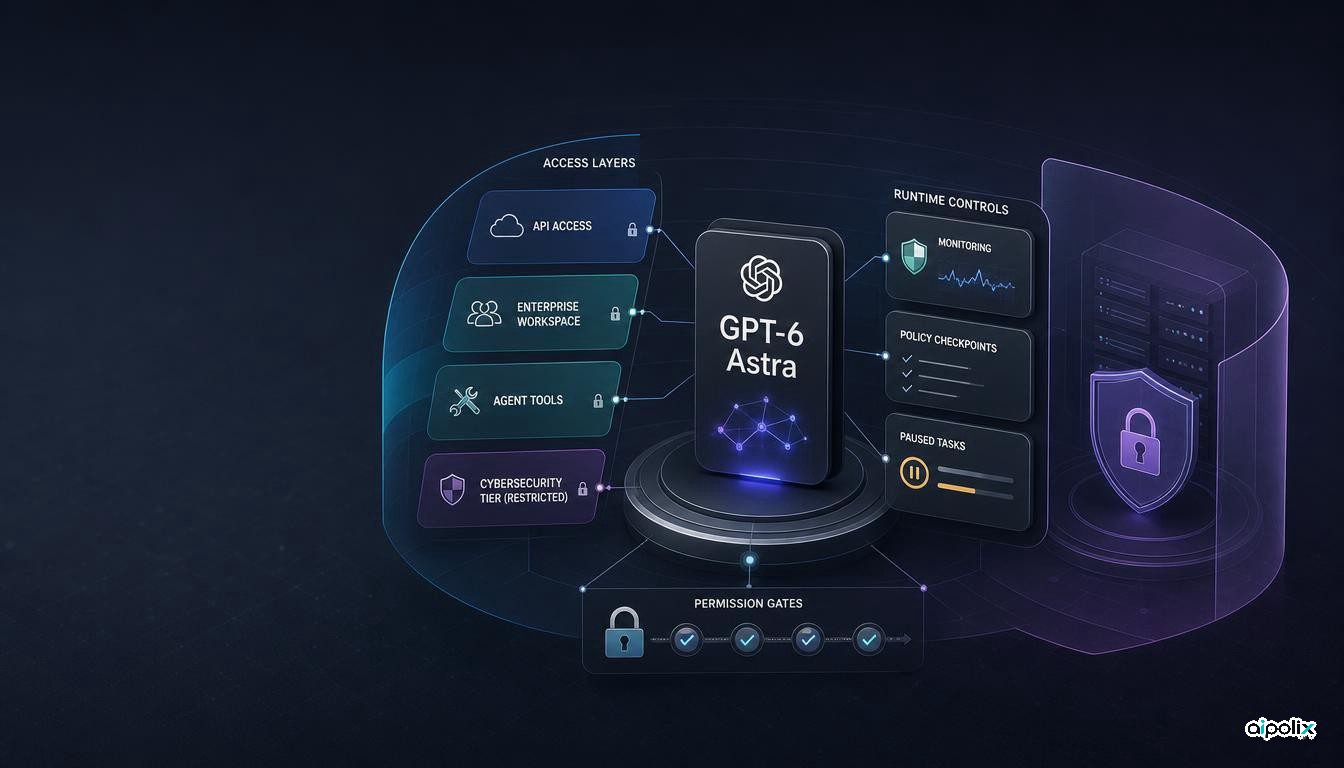
OpenAI launched GPT-6 Astra on September 3, moving the model from pre-release evaluation into staged production access. OpenAI says Astra is rolling out first to enterprises in its Daybreak Access Program and through the API, with Plus, Pro, Business and Enterprise availability following over the coming days. The release matters because Astra is not only a capability upgrade. It is the first OpenAI model the company has classified at the Critical cybersecurity capability threshold under its Preparedness Framework.
That combination changes what a model launch means operationally. For earlier frontier releases, organizations mainly had to decide whether a model was useful, reliable and economical enough to adopt. Astra adds another question: which users and workloads should be allowed to access its strongest capabilities, and under which monitoring and interruption rules?
Astra reaches production with staged access
OpenAI's enterprise documentation says GPT-6 Astra is rolling out today to enterprises in the Daybreak Access Program and is available through the API, while broader ChatGPT access is scheduled to expand over the coming days. In eligible Enterprise and Edu workspaces, Astra is off by default at launch and must be enabled through model-access controls.
Existing Early Model Access settings do not automatically carry over to Astra. Organizations that previously allowed early models therefore still need to make a fresh access decision. Workspace owners can enable Astra for the workspace or for selected roles as rollout reaches them.
Reuters reported that OpenAI presented Astra as its fastest and most versatile model so far, with demonstrations spanning software and game development, legal work, tax preparation, architectural rendering and consumer research. OpenAI customer examples published on launch day also show Astra being used inside agentic workflows rather than only as a chat model. Performance figures in those examples remain vendor or customer benchmark claims, not independent proof of general superiority.
Critical cyber capability changes the release boundary
Two days before launch, OpenAI said Astra meets its Critical cybersecurity threshold. Under the company's framework, that level covers systems capable, with suitable tools and access, of finding previously unknown vulnerabilities and developing working exploits across hardened systems without continuous human direction.
OpenAI reported a perfect result on its public ExploitBench evaluation and said Astra also found two previously unknown vulnerabilities while working on a newer internal benchmark. Those results are OpenAI's own evaluations, not independent validation, and the company notes that the strongest cyber results reflect Daybreak Blue access rather than the default production configuration.
The distinction is important. GPT-6 Astra is not one uniform operational capability exposed identically to every user. The model name sits above multiple access and safeguard layers. Advanced cybersecurity capability is initially restricted, while ordinary production access is expanding more broadly.
For security teams, model inventory therefore needs more than a model identifier. It should record the access tier, enabled tools, network reach, role permissions and safeguard configuration that define what an Astra deployment can actually do.
Monitoring becomes part of runtime availability
OpenAI says Astra is deployed with additional monitoring intended to detect potentially unauthorized behavior. The company warns that these controls can slow, pause or stop legitimate work. In ChatGPT or Codex, a paused task may require user review before it continues. In other surfaces such as the API, the task can stop.
That makes monitoring a production dependency, not just an offline safety evaluation. An enterprise workflow that assumes every long-running Astra task will finish without interruption could fail even when the model itself is functioning correctly.
Teams using Astra for agents should distinguish model errors from policy interruptions, preserve resumable state, make high-impact actions idempotent, and define what happens when a run is stopped by a safeguard. Reliability targets should include safety-triggered interruption as a separate operational state rather than hiding it inside a generic failure rate.
Access control becomes part of model governance
Astra's rollout exposes a governance pattern likely to matter beyond this model: frontier capability is increasingly controlled through identity, role and workload boundaries rather than a simple organization-wide model toggle.
OpenAI's enterprise documentation says Astra can be controlled through workspace model-access settings and role-based access controls. Because the model is off by default for eligible Enterprise and Edu workspaces at launch, administrators have an explicit decision point before users receive access.
The useful enterprise question is not simply whether Astra is approved, but which Astra configuration is approved for which work. A software team using Astra for repository analysis, a legal team reviewing documents and a security team testing hardened systems do not present the same risk even if the model name is identical.
A practical approval record should bind the model to the user group, tool set, data class, network permissions, allowed action scope and escalation path. If any of those change, the deployment should be reviewed as a materially different capability.
Launch claims still need local evaluation
OpenAI customer stories indicate that Astra is being positioned for long-horizon, multi-step work. Legora says an Astra-powered agent reviewed 41 financial documents in minutes and improved nearly 40% over the previous model on one financial-statement workflow, while its average improvement across all tasks in Legora's benchmark was about 3%. Playco says Astra required 50% fewer manual fixes than the previous model in its game-prototyping tests.
These are useful workload-specific signals, but they come from OpenAI customer stories and partner evaluations. They do not establish how Astra will perform on another organization's repositories, documents, policies or tool environment.
The correct adoption path is controlled evaluation rather than benchmark inheritance. Teams should test Astra against their own failure taxonomy, tool permissions, sensitive-data rules, interruption behavior and human-review requirements before replacing an existing production model.
The bigger change is operational, not just numerical
Astra is a major model launch, but the most consequential change is not a single benchmark score. OpenAI is shipping a frontier model while simultaneously restricting some capabilities, adding runtime monitoring, exposing role-based access decisions and warning that safeguards can interrupt legitimate tasks.
That turns model selection into a systems-governance decision. The effective capability of Astra depends on the model, access tier, tools, permissions and monitoring around it. For organizations adopting GPT-6 Astra, the release gate should capture that complete configuration. A model name alone is no longer enough to describe the risk or production behavior of an advanced agent.