Portugal has amended its Public Contracts Code to place digital systems, including artificial intelligence, directly inside the legal framework for public procurement. Decreto-Lei n.º 177/2026 was published on September 4 and enters into force on October 1, 2026. The reform applies to public-procurement procedures started after that date and to contracts resulting from those procedures.
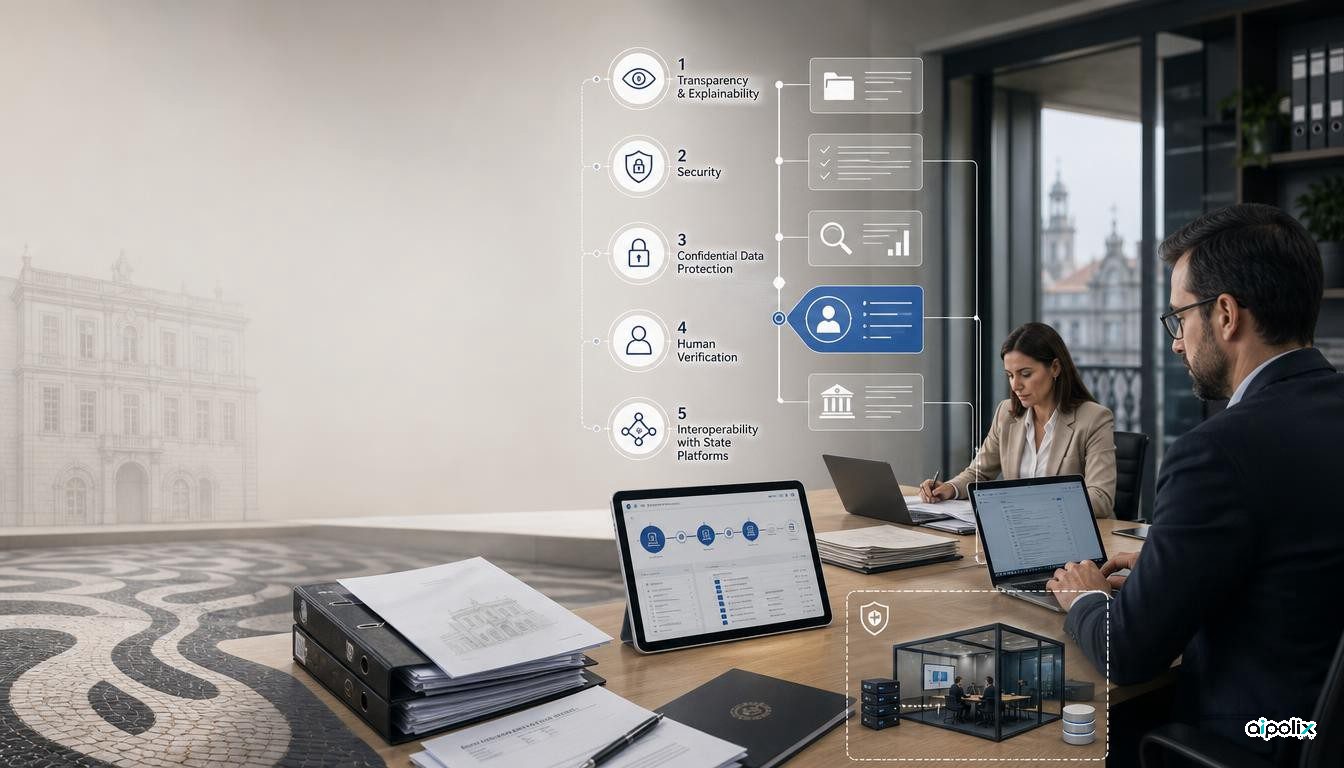
The AI language is operational rather than symbolic. A new Article 1-C says contracting authorities should use digital systems, including AI, in planning, preparing and conducting procurement procedures and in contract execution, with the aim of maximizing efficiency. It then sets five principles for those systems: transparency and explainability, security, protection of personal data and confidential information, human supervision and contribution, and interoperability with state aggregation platforms.
AI moves into procurement law, not just guidance
Many public-sector AI policies sit in strategies, recommendations or internal governance documents. Portugal's change is different because it is inserted into the Public Contracts Code itself. That matters for organizations selling to government as well as for public bodies deploying AI internally.
The law does not merely recognize that digital tools may be used. It gives contracting authorities a legal framework for how those systems should be used during both procurement formation and contract execution. The same provision explicitly keeps competent public officials responsible for checking results produced by digital systems. Automation therefore does not replace accountable decision-making.
The wording deserves care. Article 1-C says authorities should use digital systems, “including artificial intelligence,” to improve efficiency. That should not be read as an unconditional requirement to deploy AI in every procurement process. The safer operational reading is that digitalization is being embedded into procurement and that when AI is part of that digital layer, the listed safeguards apply.
Five controls become part of the procurement baseline
The first control is transparency and explainability. The code requires a right to know that digital systems are being used and how they function. For an AI-assisted procurement workflow, that pushes organizations toward documenting where automated analysis enters the process and what role it plays in recommendations or outputs.
The second is security. Authorities must choose solutions that minimize the risks of errors and discriminatory effects. This is broader than cybersecurity alone. It links technical reliability and fairness risks to the procurement decision.
The third is protection of personal data, trade secrets, industrial secrets and other confidential information. That is especially relevant when AI systems process bids, technical documentation, pricing, supplier data or commercially sensitive material.
The fourth is human supervision and contribution. The law says digital systems do not remove the intervention of competent public officials responsible for verifying results. An AI system may assist, rank, summarize or detect patterns, but accountable officials remain in the loop.
The fifth is interoperability. Systems used in procurement must work with state aggregation platforms. That turns interoperability from a technical preference into part of the legal design of public procurement systems.
Vendors now have a procurement-governance problem to solve
The reform changes what AI vendors need to demonstrate when selling into Portuguese public procurement. A feature list or model benchmark is unlikely to be enough for a serious deployment. Buyers will need evidence that the system can be explained, governed, integrated and operated under human oversight.
A practical evidence package can include data-flow documentation, role and permission models, audit logs, explanation of automated outputs, human-review points, security controls, handling of confidential information and interoperability capabilities. The law does not prescribe one technical architecture, but it gives buyers a stronger legal reason to ask for these controls during evaluation.
The reform also creates a specific mechanism for testing information systems before procurement. A new Article 35-C allows contracting authorities to promote or accept free, temporary trials of IT systems for technical, functional, interoperability, security and suitability assessment. The normal test period may not exceed 30 days, with one justified extension up to 90 days. For AI suppliers, that can create a more structured proof-of-capability path before a formal purchase.
The biggest consequence is traceable responsibility
Aipolix's main conclusion is that Portugal is making the governance layer part of the procurement object itself. If an authority buys an AI-enabled system, the practical question is no longer only whether the model performs well. The authority must also be able to show where automation is used, how results are checked, how confidential data is protected and how the system connects to public infrastructure.
That changes procurement architecture. A compliant design needs more than model selection. It needs a traceable chain from input and automated processing to human verification and final accountable action.
For public bodies, a useful implementation step is to map every AI-assisted procurement workflow against the five Article 1-C controls before October 1. For suppliers, the same map can become part of bid readiness: explainability, security, data protection, human oversight and interoperability should be demonstrated as product capabilities, not left as policy promises.
Entry into force and scope
Decreto-Lei n.º 177/2026 enters into force on October 1, 2026. Its amendments apply to public-procurement procedures initiated after that date and to execution of contracts formed through those procedures. The Order of Technical Engineers also highlighted the integration of digital and AI systems as one of the material changes in the reform.
Because the statute contains broader procurement changes beyond AI, organizations should not treat Article 1-C in isolation. Thresholds, procedures, testing mechanisms and other parts of the code also change. But for AI governance, the direction is clear: in Portuguese public procurement, digital systems are becoming a legally governed operational layer rather than an informal productivity tool.