NVIDIA has now formally confirmed its agreement to acquire Hugging Face for exactly $12,930,300,000, turning a deal that Aipolix previously covered as reported into a first-party-confirmed transaction with explicit promises about how the platform will operate after closing.
The new information is not merely confirmation of the price. NVIDIA says Hugging Face will remain open to models, frameworks, clouds, inference providers and computing platforms across the ecosystem, and that NVIDIA hardware will not be required. Those commitments create a concrete standard against which developers and enterprises can judge the platform after the ownership change.
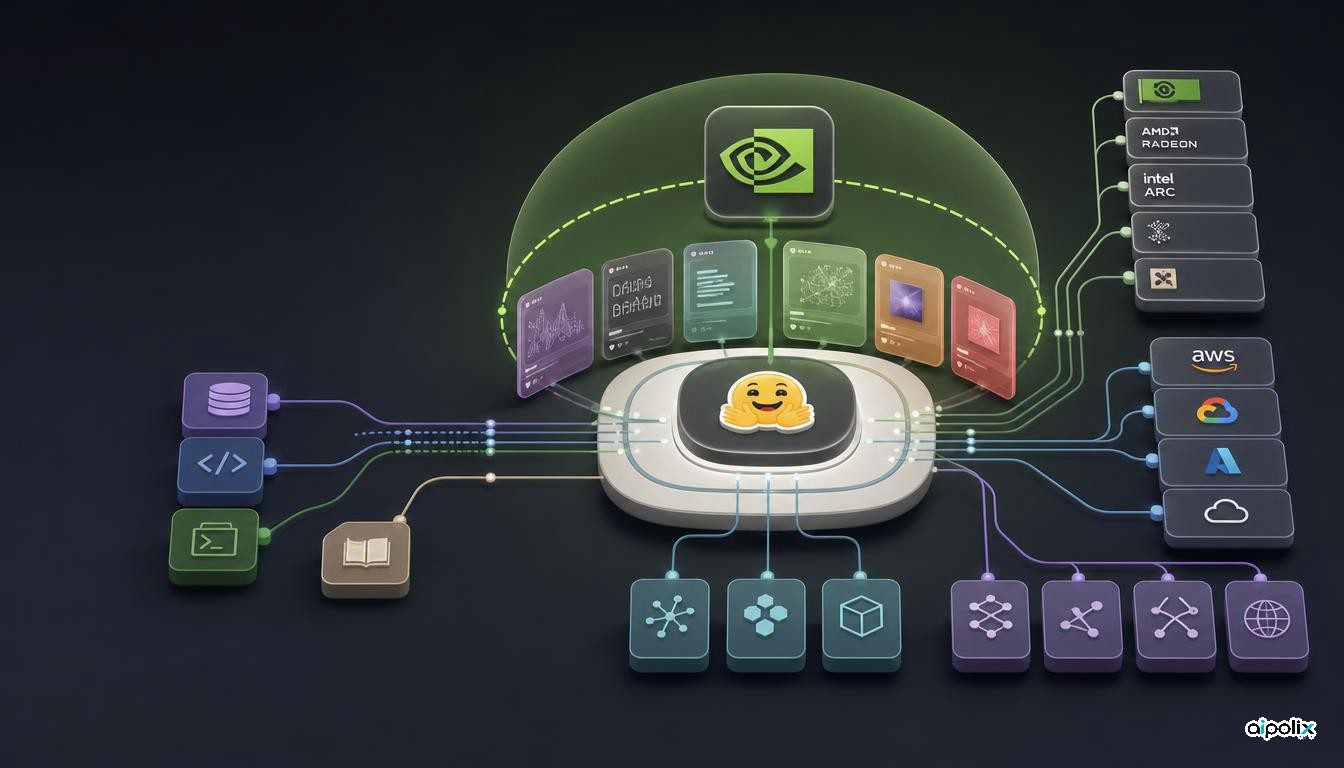
The transaction matters for more than its price. Hugging Face is not simply another model company. Its Hub, libraries and deployment tooling sit between model builders, application teams, cloud providers and hardware platforms. NVIDIA says that position will remain open: developers will still be able to choose their models, frameworks, clouds, inference providers and computing platforms, and NVIDIA hardware will not be required.
That commitment is important. It is also different from governance neutrality. After the deal closes, the platform may remain technically multi-vendor while ownership, capital allocation and strategic priorities sit inside NVIDIA.
What NVIDIA is actually buying
NVIDIA's announcement says it has agreed to acquire Hugging Face for exactly $12,930,300,000. Jensen Huang says more than 18 million developers, researchers and creators use Hugging Face, which hosts more than 3 million models, 500,000 datasets and 1 million applications. More than 200,000 companies use the platform to discover, evaluate, customize and deploy AI.
Those numbers help explain why this deal is not primarily about acquiring a single model family. Hugging Face has become infrastructure for the model ecosystem itself. A team can discover a model on the Hub, inspect its card and artifacts, pull weights through common libraries, compare alternatives and deploy through a range of providers.
Reuters reports that the transaction includes about $11.9 billion in payments to Hugging Face investors and about $1 billion in equity incentives for employees. The report also places the acquisition in NVIDIA's broader effort to deepen its role in open-model AI while large technology companies invest in their own accelerators.
NVIDIA promises openness across models, clouds and accelerators
The strongest first-party commitment is explicit. NVIDIA says Hugging Face will remain an open platform for the entire AI ecosystem.
Developers will continue to choose the models, frameworks, cloud platforms, inference providers and computing hardware that fit their work. NVIDIA compute will not be mandatory. Hugging Face is also expected to keep supporting open-source and open-weight models from across the ecosystem, together with multi-cloud and multi-accelerator development and deployment.
That matters because Hugging Face's value depends heavily on being useful before a developer has chosen a vendor. A repository that became meaningfully tied to one accelerator stack, one inference service or one model family would lose some of the neutrality that made it a default meeting point for the industry.
For now, the announced policy is the opposite: NVIDIA is promising to preserve broad compatibility.
Technical openness and governance neutrality are different
A platform can continue to support AMD accelerators, AWS infrastructure, Chinese open models and inference services that compete with NVIDIA while still becoming strategically controlled by NVIDIA. Technical interoperability describes what the software allows. Governance neutrality describes who ultimately controls roadmap, investment, defaults, partnerships, prioritization and commercial incentives.
There is no evidence that NVIDIA will close Hugging Face or deliberately disadvantage rivals, and NVIDIA has publicly promised the opposite.
But ownership changes the risk model for users that rely on Hugging Face as neutral ecosystem infrastructure. Enterprises, research groups and model developers should now separate two questions: can we technically use the platform with competing hardware and services, and are the platform's long-term strategic decisions independent of a major supplier in that market?
The first question has a clear answer in NVIDIA's announcement: yes, according to the company. The second cannot be answered by an API compatibility promise alone.
More capital could strengthen the open-model stack
There is also a credible upside.
Operating a global model hub, large artifact store, inference services, evaluation infrastructure and developer platform requires substantial engineering and capital. NVIDIA says its infrastructure, engineering and global reach can improve platform reliability, safety, model evaluation, inference and deployment.
The open-model ecosystem increasingly needs better ways to verify artifacts, compare models, manage large weights, optimize inference and deploy across heterogeneous hardware. If NVIDIA preserves genuine multi-vendor access while investing aggressively in those shared layers, the acquisition could make open models easier to use.
The real test will be defaults and incentives
The harder questions are unlikely to appear as an explicit ban on a competitor's model.
They will show up in defaults, integrations, featured workflows, evaluation tooling, hosted-inference economics, hardware optimization priorities and the order in which new capabilities reach different platforms. These choices can influence developer behavior without requiring formal lock-in.
That is why NVIDIA's openness promise should be measured over time. Developers should watch whether competing accelerators receive equivalent support, whether model discovery remains independent of NVIDIA's own model portfolio, whether third-party inference providers retain first-class integration and whether open projects can still use Hugging Face without adopting NVIDIA-specific infrastructure.
This is not a prediction that those outcomes will deteriorate. It is a way to make a broad promise measurable.
What engineering teams should do now
The acquisition still needs to move from agreement to completed ownership. The sources available at publication time do not provide a complete public timetable for regulatory approvals and closing conditions, so it would be premature to describe Hugging Face as already absorbed into NVIDIA.
For engineering organizations, the immediate action is not migration. It is dependency mapping.
Teams that treat Hugging Face as critical infrastructure should identify which parts of their workflow depend on the Hub, hosted inference, libraries, model metadata, authentication or artifact distribution. They should also record which of those dependencies are portable to alternate registries, object stores or inference platforms.
That work is useful regardless of the acquisition outcome. The deal simply makes platform governance a more explicit architectural dependency.
The signal to watch is not how often NVIDIA repeats the word "open." It is whether Hugging Face remains operationally multi-model, multi-cloud, multi-provider and multi-accelerator as product decisions accumulate after the transaction.